 |
| ASTAMIDS
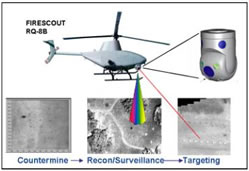
uses multispectral imaging and is multimission capable. |
Freedom to maneuver, maneuver with speed, seeing first, understanding
first and acting first are all Future
Combat Systems (FCS) Brigade Combat Team (BCT) tenets
applicable to the Airborne Surveillance, Target Acquisition
and Minefield Detection System (ASTAMIDS). Known until just
recently as the Airborne Standoff Minefield Detection System,
ASTAMIDS was initiated as an Unmanned
Aerial Vehicle (UAV) payload to detect surface laid and
buried minefields and obstacle impediments to maneuver forces.
The ASTAMIDS combat developer is the Maneuver Support Center
at Fort
Leonard Wood, MO. As ASTAMIDS approached a Milestone B
decision in early FY03, the FCS Army Transformation Program
was beginning to move quickly. Harmonization of ASTAMIDS with
FCS
was strongly emphasized by BG Paul S. Izzo, Program
Executive Officer (PEO) for Ammunition at the program
Milestone B.
Immediately after Milestone B and the solicitation release,
the team worked closely with the FCS Government and Lead Systems
Integrator (LSI) One Team. Mr. James Freeman, LSI Lead for
the Command, Control, Communication, Computers, Intelligence,
Surveillance and Reconnaissance Integrated Product Team (IPT),
stressed coordination with other UAV payload missions. The
team began to coordinate closely with Project Manager for
Robotic and Unmanned Systems (PM RUS), which was working on
an FCS UAV payload for reconnaissance, surveillance, target
acquisition and laser designation (RSTA/LD).
A system development and demonstration (SDD) phase ASTAMIDS
contract was awarded March 26, 2003, to Northrop
Grumman Integrated Systems (NGIS) of Melbourne, FL, less
than five months after releasing the solicitation. Shortly
thereafter, PM RUS funded a trade study under this contract
to examine combining the countermine/assured mobility mission
with the RSTA/LD mission. At the same time, the FCS program
selected the Fire Scout RQ-8B as the FCS UAV to perform the
combined Class III and IV missions.
By this time, ASTAMIDS harmonization with the FCS was well
underway. The Subordinate Memorandum of Agreement, synchronization
of schedules and requirements, Associate Contractor Agreement,
LSI IPT linkages and other FCS synchronization efforts were
all in various stages of progress.
|
ASTAMIDS was initiated as an Unmanned Aerial Vehicle
(UAV) payload to detect surface laid and buried minefields
and obstacle impediments to maneuver forces.
|
Throughout this period, multiple LSI IPT teams were assessing
state-of-the-art sensor technologies, UAV technology and tactical
data/information processing and networking, as well as user
requirements for assorted assured mobility and numerous RSTA
and LD functions. Extensive coordination between the PM
for Close Combat Systems (CCS) and FCS on horizontal technology
integration and organizations was breaking through mindset
barriers and implementing development strategies at a relentless
pace.
It should be remembered that, concurrently with these efforts,
the U.S. Army was also at war in Southwest
Asia, which placed additional demands for PEO
Ammunition managed items. For instance, there were numerous
operational requests for low-density, nonstandard countermine
equipment to support ongoing efforts of Operations
Enduring Freedom and Iraqi
Freedom. Improvised
explosive devices were showing up increasingly in Iraq,
and area and route mine clearance was a big mission in Afghanistan.
Up-armored vehicles and countermine equipment were needed
everywhere to protect troops.
Meanwhile, tradeoff studies, systems engineering, and cost
and operational benefit analyses were underway for FCS UAV
sensors. In April 2004, then-PM for FCS BG Donald F. Schenk
approved plans to perform both the countermine/assured mobility
and the RSTA/LD missions in one common ASTAMIDS payload within
the FCS
program. The ASTAMIDS combined-mission payload provides
optimization for all users and missions.
The FCS One Team helped make this happen. The enabling technologies
being used in the ASTAMIDS UAV payload are only just beginning
to be fully exploited. The linkage of high quality digital
information and imagery coming from FCS UAV sensors is exciting.
This information will be shared with joint forces, ranging
from Special Operations Forces to Heavy Armor Modular Brigades,
and with weapons systems from Selectable Lightweight Attack
Munition and Intelligent Munitions System, to Joint forces
Joint Direct Attack Munitions and assorted team members —
the tips of the spears. This information sharing help provide
more freedom to safely maneuver on the fluid battlefield.
Immediately following the FCS combined mission payload decision,
prime contractors were directed to move toward a slightly
larger gimbal
(the mount used to hold the ASTAMIDS payload) to allow additional
space for the addition of a laser designator into the design.
Through the summer and fall of 2004, detailed FCS RSTA/LD
requirements were extensively coordinated with all stakeholders
and inserted into the ASTAMIDS contract performance specification
and statement of work. A proposal for a modified design approach
to meet all requirements was received in December from NGIS
and carefully evaluated. The ASTAMIDS prime contract modification
to add the RSTA/LD functionality to the original ASTAMIDS
was officially awarded on April 1, 2005.
To reflect the combined countermine/assured mobility and
RSTA/LD mission and program requirements within the FCS (BCT),
a Memorandum of Agreement (MOA) was developed between PM CCS,
PM RUS and PM Unit of Action Intelligence, Surveillance and
Reconnaissance. The ASTAMIDS system description from this
MOA provides a summary of what this FCS UAV payload will do.
|
ASTAMIDS detects, locates and identifies ground targets, minefields and obstacles, designates and determines ranges to ground targets for attack by a variety of laser guided munitions.
|
“ASTAMIDS detects, locates and identifies ground targets,
minefields and obstacles, designates and determines ranges
to ground targets for attack by a variety of laser guided
munitions,” according to the MOA. “When integrated
with the FCS Class IVa Fire Scout RQ-8B UAV, the capability
to conduct RSTA, target designation and minefield detection
will be a key future capability of the BCT-equipped force
on a single UAV payload. This full-range capability is provided
by a multispectral payload using daylight TV, mid-wave infrared
and multispectral imaging sensors operating in the visible
and infrared spectrums. These sensors are augmented by an
eye-safe laser
range finder (LRF), laser illuminator and laser
designator. The hardware is integrated into a gimbal
that uses advanced “step and stare” technology
to scan the ground. Advanced automatic detection software
processing of ASTAMIDS imagery that exploits fused multi-spectral
images and other advanced concepts allows for near real-time
operations in multiple and varied worldwide environments.”
ASTAMIDS could help Soldiers and Marines in various ways.
Operationally, ASTAMIDS could be deployed on UAVs ahead of
a U.S. Army
or U.S. Marine
Corps maneuver element as it races over the battlefield
toward its objective — with supporting thrusts happening
to their left and right. ASTAMIDS could survey the land around
places like Bagram Air Base and the local road network, so
that the Soldiers clearing dangerous ordnance will have advance
information on potential mined or hazard areas and thus be
better prepared and take appropriate safety precautions. A
swarm of ASTAMIDS equipped UAVs could prevent a maneuver force
from being funneled into an enemy planned kill-sack by providing
needed information on possible bypasses or safe lanes. ASTAMIDS-equipped
UAVs could provide sensor overwatch of Fallujah,
enabling Soldiers and Marines to keep tabs on threat movements
and activities. Or, an ASTAMIDS-equipped UAV could chase enemies
back to their base, catch them with all their IED-manufacturing
materials and relay this information to nearby friendly units.
It will take the FCS Army and industry team 5 years to reach
fielding of the ASTAMIDS currently projected for FY 2010,
but development is proceeding as fast as is practical. Time
spent bringing this capability to the field will be well worth
it. FCS can spin off technology as it is ready but the ultimate
payoff for the Soldier will come with a fully-synchronized,
interlinked UAV sensor-equipped force. The FCS program has
put an excellent and focused Army and industry One Team in
place and this team is executing the vision of a fully-networked
FCS force. Information provided by ASTAMIDS will save lives
and help our Soldiers win the fight.
| RICHARD ESS
is a Project Management Engineer in the Countermine Division
of PM CCS, Fort Belvoir, VA. He has a B.S in engineering
from Virginia Tech and has been a registered Professional
Engineer in Virginia since 1985. He is an Army Acquisition
Corps member and is certified Level III in project management. |
|