|
| Secretary of the Army Dr. Francis J. Harvey (center), a former ASB member, awards the Decoration for Distinguished Civilian Service to departing ASB Chair Dr. James Tegnelia (left) as ASB Executive Secretary LTC Scott Haraburda (right) reads the citation, Feb. 24, 2005. (Photo courtesy of ASB Photo Archives.)
|
For more than 50 years, the Army Science Board (ASB) has
served as the Army’s senior scientific advisory board.
When it was chartered as a Federal Advisory Committee
under the Federal Advisory Committee Act in 1977, the ASB
replaced the Army Scientific Advisory Panel (ASAP). Both the
ASAP and the ASB grew out of the need for Army-specific guidance
on scientific research and development (R&D) and the Army’s
desire to maintain its strong technical advantage over other
nations.
From the founding of the Army through the early 1900s, the
Army did not have an effective R&D program — production
and procurement were emphasized and the R&D during this
era was limited to product improvement. Prior to World War
II, the Army’s R&D was controlled through the G-4
as a function of the supply arms and services. In October
1943, Secretary of War Henry Stimson indicated that he wanted
scientific help in the war effort, resulting in the R&D
branch’s reorganization and its elevation to division
level in May 1944. This elevation eliminated obstacles related
to recruiting and retaining enough qualified scientific people,
and provided them the clout to effectively perform their duties.
Following World War II, despite GEN Dwight D. Eisenhower’s
warnings that using scientific and technological resources
solely for procurement purposes limited the usefulness of
those resources and indications that separating R&D from
procurement and production would benefit the military, concerns
remained that the senior Army leadership lacked the vision
to effectively guide the direction of R&D programs. However,
funding and personnel limitations continued to direct R&D
toward the necessary areas of procurement and production.
A few years later, Dr. Donald Loughridge, the Army’s
Senior Scientific Advisor, was concerned that the Army lacked
an effective basic research program, resulting in its inability
to attract desirable entry-level scientists to its laboratories.
By April 1950, Secretary of the Army Gordon Gray was also
concerned with the Army’s R&D program and its ability
to support warfighters in future wars. He did not believe
that the United States could fight a war based solely upon
soldiers, especially with the fall of China to communism.
Shortly thereafter, Gray’s replacement, Secretary of
the Army Frank Pace, evaluated the existing Army R&D program,
which was then engaged in supporting the conflict in Korea.
In January 1951, the evaluators recommended that a research
advisory board be established to assist the Secretary of the
Army in R&D matters. Based on this report, GEN Joseph
Collins, Army Chief of Staff, recommended establishing an
Army Scientific Advisory Committee as this research advisory
board. By March, Pace approved establishing this board in
principle and in November he took the first steps to obtain
this scientific advice. Without formally establishing a committee,
the Secretary appointed 10 outstanding scientists and industrialists
as his scientific advisers. These pioneer advisers were:
- Dr. Detlev Bronk, National Academy of
Sciences President, 1950 to 1962, and Johns Hopkins University
President, 1949 to 1953. He was credited with formulating
the modern theory of biophysics.
- Mr. Crawford Greenewalt, DuPont President,
1948 to 1962. He was instrumental in transforming the theoretical
work into a production system capable of manufacturing sufficient
plutonium for the Manhattan Project.
- Mr. Robert Haslam, consultant and as
Chief of Division 3, Rocket Ordnance Research, National
Defense Research Committee.
- Mr. Kaufman Keller, Chrysle board of
directors member of W.R. Grace & Co.; retired Standard
Oil Co. Vice President. Previously, he was a professor of
chemical engineering at the Massachusetts Institute of Technology
(MIT).
- Dr. Frederick Hovde, Purdue University
President, 1946 to 1971. During World War II, he w
r Chairman of the Board, 1950 to 1956; Chrysler President,
1935 to 1950.
- Dr. James R. Killian Jr., MIT President,
1948 to 1959; MIT Corp. Chairman, 1959 to 1971. Following
his service on this board, he became the presidential science
advisor to President Dwight D. Eisenhower from 1957 to 1959.
- Dr. Charles Lauritsen, Danish-born physicist
and professor of electrical and radio engineering at the
California Institute of Technology, 1911 to 1962. During
World War II, his nuclear physics research was instrumental
in the Manhattan Project.
- Dr. Murrough O'Brien, University of California’s
College of Engineering Dean, 1943 to 1959. Previously, he
was the university’s Mechanical Engineering Department
Chair, 1937 to 1943.
- Dr. William Shockley, Bell Telephone
Laboratories Research Physicist, 1945 to 1954. During World
War II, he was the Anti-Submarine Warfare Operations Research
Group Research Director. He received the Nobel Prize in
physics in 1956 for his role in developing the transistor.
- Mr. William Webster, New England Electric
System Executive Vice President and Director. Following
World War II, he was Deputy to the Secretary of Defense
on Atomic Energy and the Chairman of the Military Liaison
Committee to the Atomic Energy Commission. In 1950, he was
the DOD R&D Board Chairman.
Following the Korean War, the Advisory Committee on Army Organization
analyzed the Army’s organization with respect to its ability
to support the nation in times of war and peace. This committee
praised the scientific advisory group’s creation, indicating
it was a significant step in bringing the best scientific ability
and experience to the Army. In 1954, the House Committee on
Government Operations issued a report stating that the Army’s
scientific advisory group was not being used effectively. Army
Secretary Robert TenBroek Stevens, Pace’s successor, concurred
with these recommendations and established plans to formalize
the ASAP with a permanent charter, enlarge its membership and
give it more latitude in its efforts.
The ASAP — then with 25 members — held its first
meeting Nov. 16-17, 1954. During the meeting, the panel heard
briefings on various areas involving the Army’s R&D
efforts. By 1958, the panel grew to 70 members and divided
itself into eight different subpanels:
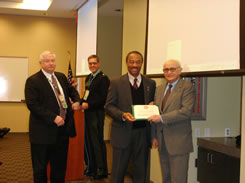 |
| Army
Acquisition Executive and Assistant Secretary of the
Army for Acquisition, Logistics and Technology Claude
M. Bolton Jr. presents a Certificate of Appreciation
for Patriotic Civilian Service to departing ASB member
Dr. John Blair (right) as ASB Chair Dr. Frank Akers
Jr. (left) and LTC Scott Haraburda (at podium) look
on, Feb. 24, 2005. (Photo courtesy of ASB Photo Archives.)
|
- Air Mobility
- Chemical, Biological and Radiological Warfare
- Communications and Electronics
- Firepower
- Environmental Research
- Human Factors
- Surface Mobility
- Research Organization and Planning
|
Over the past 50 years, 590 people — including 50 women
— have served as ASB members, resulting in more than
3,700 years of uncompensated, voluntary service to the Army.
The ASB’s distinguished members also include two astronauts,
three Olympians (one with a silver medal in the long jump),
one U.S. Ambassador to France and a member of the first expedition
team to ascend Mount Minya Konka in Eastern Tibet, China.
ASB and ASAP personnel have accepted many of the significant
challenges the Army has had during the past half century.
Even though these are some of the country’s busiest
people, these 590 board members have willingly rearranged
their complex schedules on short notice to use their own time
to solve these significant challenges. They have placed the
needs of their country first; and the Army has been fortunate
to have, and grateful for, their generous service. With good
fortune, the ASB will continue supporting our Nation long
into the future.
For more information about the ASB, go to https://webportal.saalt.army.mil/main/asb.htm.
Click
here for additional photos 
Army
Science Board Chairs
Army
Science Board Vice-Chairs
Army
Science Board Executive Secretaries
| DR. SCOTT S. HARABURDA
is the Deputy Site Project Manager for the Newport Chemical
Agent Disposal Facility in Indiana. He has a B.S. in chemistry
from Central Michigan University and both an M.S. and
a Ph.D. in chemical engineering from Michigan State University.
He is a registered Professional Engineer from the State
of Indiana. As an Army Reserve lieutenant colonel, he
was selected to command the 464th Chemical Brigade. As
an Army Acquisition Corps member, he holds certifications
in program management; contracting; systems planning,
research, development and engineering; test and evaluation;
and information technology. |
|