

An overwhelming turnout at the AUSA Contemporary Military Forum: Accelerating Transformation with Next Generation Command and Control (NGC2), where Army leaders and defense experts discussed how the U.S. Army is advancing its C2 capabilities for the future fight on October 14, 2025, in Washington. (Photo by Ken Cedeno, AUSA)
ACCELERATING TRANSFORMATION: AUSA FORUM FOCUSES ON THE ARMY’S PATH TO NEXT GENERATION COMMAND AND CONTROL
by Cheryl Marino
Army leaders and defense experts met in Washington at the Association of the United States Army (AUSA) Contemporary Military Forum: Accelerating Transformation with Next Generation Command and Control (NGC2), on October 14, 2025, to discuss how the U.S. Army is advancing its command-and-control (C2) capabilities for the future fight. The session highlighted the urgency of modernizing C2 systems to enable faster, more informed decision-making across increasingly contested and complex multidomain environments.
Panelists explored how digital integration, data-driven operations and adaptive network architectures are reshaping the way forces communicate, coordinate and respond on the battlefield. These advancements aim to empower commanders with real-time situational awareness and the agility to act decisively in high-tempo operations.
During the panel, emphasis was on the transition from segmented systems and shift from legacy C2 systems to rapidly deliver integrated information across all warfighting functions. As well as the application of technologies like artificial intelligence (AI) and machine learning; the importance of data and software characterized by a software-defined, data-centric approach involving “full stack architecture;” data consolidation; rapid prototyping and fielding; modularity and commercial engagement; vendor involvement; and enhancing interoperability.
“From a larger acquisition perspective, this really helps us think about how we deliver capabilities faster, get smarter at how we go and contract for these things, share risks and really allow us to pivot when the technology tells us we either need to change or there is a better capability out there that we can ensure our warfighters have,” said Hon. Brent G. Ingraham, assistant secretary of the Army for acquisition, logistics and technology, who described NGC2 as a pathfinder for portfolio management. “This is about how we drive outcomes over process in general from an acquisition perspective.”
This also means ensuring that program executive offices or, potentially, portfolio acquisition executives as defined in the Streamlining Procurement for Effective Execution and Delivery (SPEED) and Fostering Reform and Government Efficiency in Defense (FoRGED) Acts are held accountable for managing their own portfolios effectively, he explained. They have the authority to make “trades” or strategic adjustments, by reallocating resources across programs to align capabilities with current priorities and needs—whether that involves testing, contracting or other critical functions.
“Ultimately NGC2 will demonstrate what this sort of pathfinder approach is to lay out new acquisition reforms across all of the Army to ensure that we are actually delivering on scale and on time,” Ingraham said.
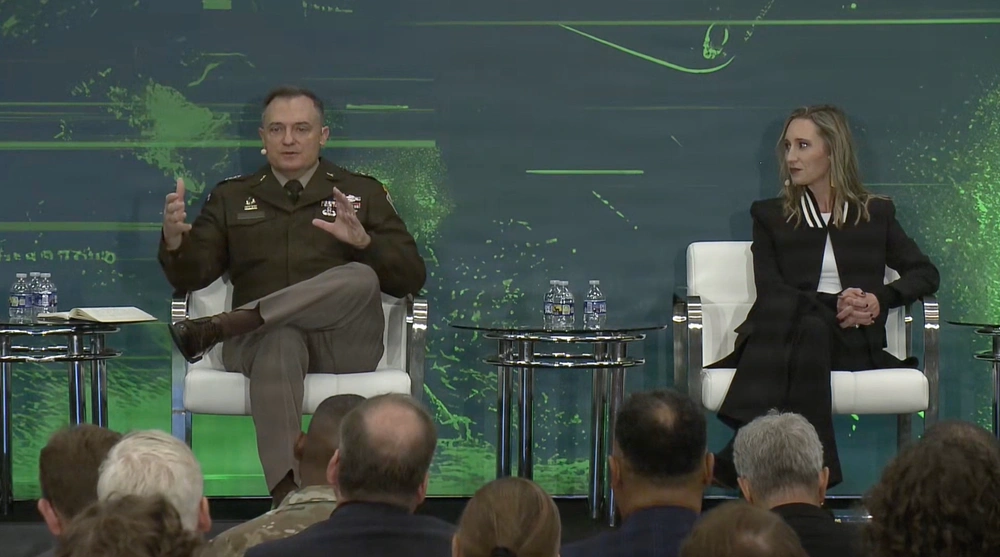
Maj. Gen. Patrick Ellis, left, commanding general, 4th Infantry Division and Fort Carson have been running a series of exercises called “Ivy Stings” to evaluate and develop its NGC2 prototype. (Photo by Army Multimedia and Visual Information Division and USAASC)
GAME CHANGER FOR THE ARMY
NGC2 marks a fundamental shift from traditional, hierarchical command structures to a data-centric, networked approach that enables faster, more agile decision-making.
In the past, command and control relied heavily on linear processes and static communication pathways, often slowing the flow of information across echelons and domains. NCG2 replaces these legacy systems with a seamless, integrated digital ecosystem that connects sensors, shooters and decision-makers in real time across land, air, sea, cyber and space.
By leveraging AI-driven analytics, cloud-based networks and resilient data sharing, NGC2 allows commanders to see, decide and act at the speed of relevance. This means decisions no longer depend on fragmented reports or delayed transmissions, but on live synchronized data that empowers leaders to adapt instantly to changing battlefield conditions. It’s a system designed not just to connect units, but to converge effects—linking intelligence, fires, logistics and maneuver in a single, cohesive framework.
For the Army, NGC2 is more than a modernization effort. It’s a strategic enabler for multidomain operations. It ensures interoperability with joint and coalition partners, strengthens resilience against electronic and cyber threats and provides a scalable foundation for future technologies. In an era defined by speed, complexity and competition, NGC2 represents the Army’s blueprint for maintaining decision dominance, today and in the future.
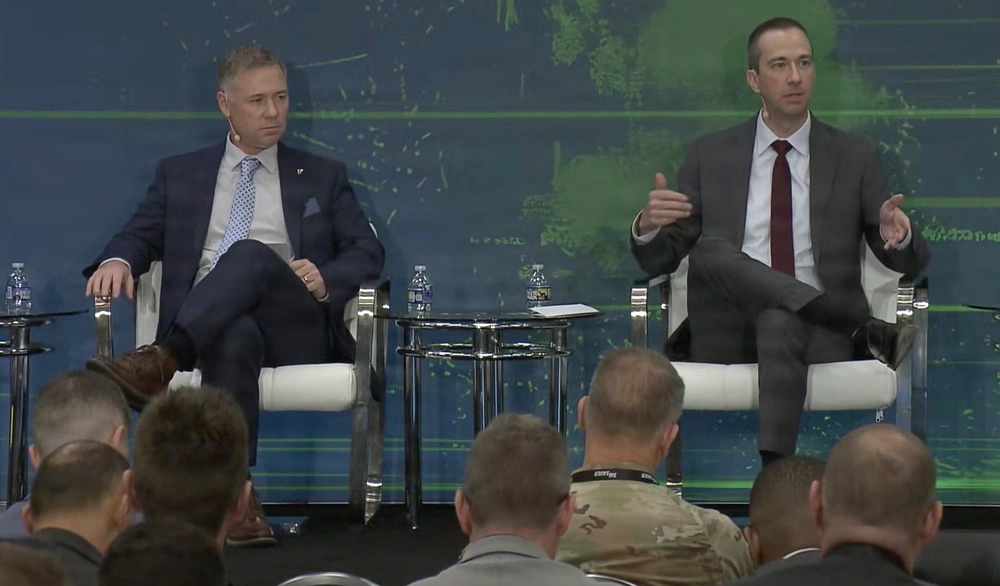
Hon. Brent G. Ingraham, left, assistant secretary of the Army for acquisition, logistics and technology and Joseph D. Welch, right, deputy to the commanding general, Army Futures Command, emphasizes that NGC2 should remain under checks and balances to avoid future challenges or points of concern, during a panel at AUSA in Washington, October 14, 2025. (Photo by Army Multimedia and Visual Information Division and USAASC)
THE INDUSTRY PERSPECTIVE
NGC2 represents both a challenge and an opportunity from an industry perspective—a chance to strengthen collaboration with the Army, while shaping how future command-and-control capabilities are developed and integrated.
For contractors, non-traditional tech firms and legacy defense companies, NGC2 is a chance to break out of old habits, and adopt modular open systems, faster prototyping, more frequent iterations and closer collaboration with Soldiers. For example, Other Transaction Authorities awarded to build parts of the NGC2 “full-stack” technology framework (from transport and infrastructure to data layers and applications) reflects the belief that the Army’s shift toward integrated architecture offers better flexibility and a cleaner path for innovation.
Panelist Tara Murphy Dougherty, chief executive officer of Govini, a defense acquisition software company, stressed the importance of addressing the systems that deal with personnel, materiel, sustainment logistics and the resources and requisitions that go into making all of this happen on the battlefield.
“All of those things are what drive effectiveness for the warfighter on the battlefield. And we’re going to take it all on because we know what can be done if we pair up American ingenuity and industry with the best, united with the best Army in the entire world,” she said.
While NGC2 integration is a major step forward for the Army’s modernization efforts, it doesn’t come without challenges. Efforts are underway to address concerns ranging from the security of software, data access control and resilience against adversarial cyber or electronic warfare threats to the challenges of quickly training Soldiers for NGC2 and accelerating contracting through new operational models and rapid feedback loops. Panelists highlighted the need for a continuous feedback cycle between Soldiers and developers to ensure equipment remains relevant and responsive to battlefield conditions.
Panelist John Baylouny, executive vice president and chief operating officer of Leonardo DRS Inc., a defense contracting company, expressed concerns about the Army reverting to traditional silos at some point down the road.
“From the industry’s perspective, we always looked at the way that the Army is buying and saying how is it that you’re going to have an integrated solution when you’re buying this over here, this over here and this over here. It’s not going to fit together an optimum way because those ‘boxes’ are going to be separate boxes. So you can’t have an integrated solution when you’re buying from three different places,” he said. “This is transformational in this respect, that you’re buying a capability solution and you’re listening to different ideas.”
He said that it’s important to ensure that architecture and the solution evolve with technology. “Whether it’s commercial technology or military technology or militarized technology, that transformation has to continue and you have to continue to think about this as an integrated solution that you’re buying as a capability … that’s the challenge because at some point someone’s going to be tempted to push it back into the regular ‘box’ and you’ve got to keep it away from there.”
Joseph D. Welch, deputy to the commanding general of Army Futures Command, emphasized that NGC2 should remain under checks and balances so the Army does not regress into the traditional silos it seeks to transcend. Drawing on the spirit of the SPEED and FoRGED Acts and Department of War, he asserted that institutional reforms—across requirements, resourcing, acquisition and contracting—are designed to enforce transparency, modular competition and accountability. The objective is to embed guardrails in the transformation process so decisions stay aligned with mission needs, not stovepiped bureaucracies.
To maintain persistent competition and inspire companies to align their products to NGC2, he said the Army is looking to remain competitive, continuously, without stagnating.
“We are holding ourselves and our team lead partners accountable to make sure that this all works, because that’s all that matters to our Soldiers at the end of the day,” he said. “They’re not interested in the finger-pointing between program offices or vendors about why things aren’t working well together.”
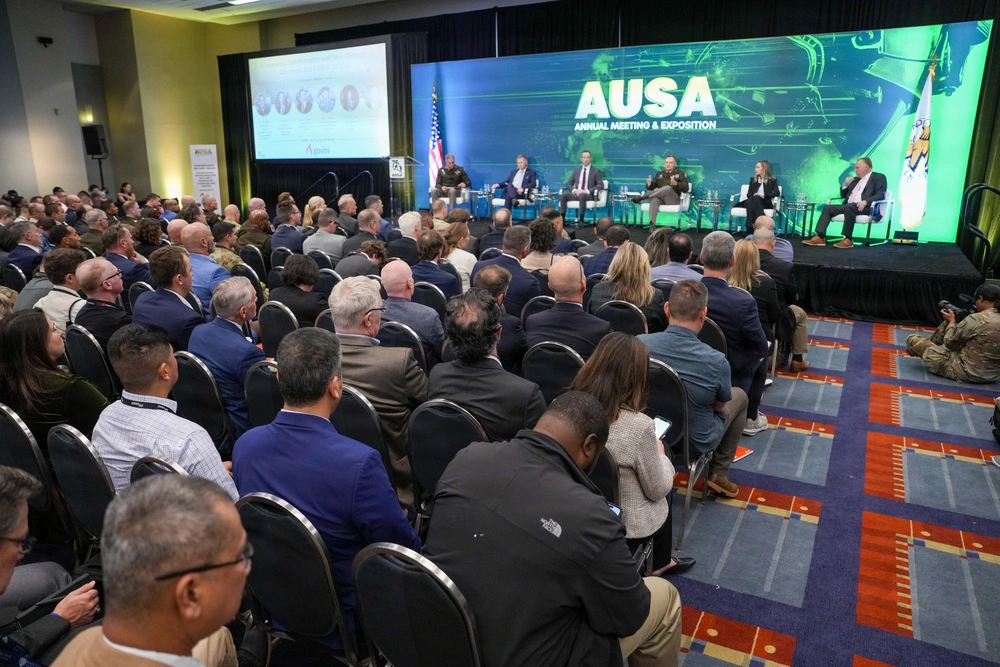
An overwhelming turnout at the AUSA Contemporary Military Forum: Accelerating Transformation with Next Generation Command and Control (NGC2), where Army leaders and defense experts discussed how the U.S. Army is advancing its C2 capabilities for the future fight on October 14, 2025, in Washington. (Photo by Ken Cedeno, AUSA)
NGC2 FORWARD
Twenty-five years ago, the 4th Infantry Division became the Army’s first fully digitized division. Now, the Army is returning to the IV Division to prototype NGC2 at scale.
A video shown during the forum, highlighted that “NGC2 is a fundamentally different approach to command and control giving commanders the data they need to outpace, outthink and out maneuver any other server.” The full-stack ecosystem of four layers incorporates applications, data, infrastructure and transport and is designed to be scalable, secure and customizable for the fight “allowing commanders to make more, better, faster decisions.”
Maj. Gen. Patrick Ellis, commanding general of the 4th Infantry Division and Fort Carson, views NGC2 as a system that enhances command-and-control capabilities by leveraging and integrating existing Army platforms and equipment, along with continuous, realistic testing that involves Soldiers early in the development process for rapid, iterative improvements over lengthy traditional development cycles.
“We put a pretty high bar out there for ourselves and for the industry partners and for our acquisition teammates,” he said. “We learned a ton and I think [this] really reinforces the fact that we’re willing to iterate and if it doesn’t all work, we’ll help get it right so that it gets in the hands of our Soldiers faster.”
Ellis told the panel he’s been running a series of Army test exercises conducted by the 4th Infantry Division (also known as the IV or Ivy Division) called “Ivy Stings” to evaluate and develop its NGC2 prototype. These exercises are designed as “sprints” or solution summits where captains, majors, warrant officers, senior noncommissioned officers and industry partners meet to incrementally add and test new capabilities to scale the NGC2 system to the division level.
“It’s an opportunity to whiteboard,” he said. “To discuss what the problems are and determine strategy and let the user define clearly what their requirements are.”
Across the globe, Ivy Soldiers are already employing NGC2 in the Republic of Korea, where the Raider Brigade is employing Mounted Mission Command platforms and sensor networks. At the southern border, Mountain Warrior Soldiers are synchronizing with U.S. Border Patrol to enhance detection and security.
The Iron Brigade at Fort Carson, Colorado, is equipping NGC2 communications to maintain connectivity even in denied or degraded conditions, and the Ivy gunners are accelerating fires with AI-enabled targeting software.
At U.S. Central Command, the Ivy Eagles are pioneering mission planning software to control and dominate division airspace, and the Wranglers are fielding predictive logistics systems to sustain the fight, better equipping Soldiers with more advanced and reliable support.
Next summer, the 4th Infantry Division will fight using NGC2 as its only command-and-control system during Project Convergence Capstone 6. The video concluded with, “Our prototyping will set the standard for every Army Division. This is not just the future of command and control. It’s the future of victory, steadfast and loyal.”
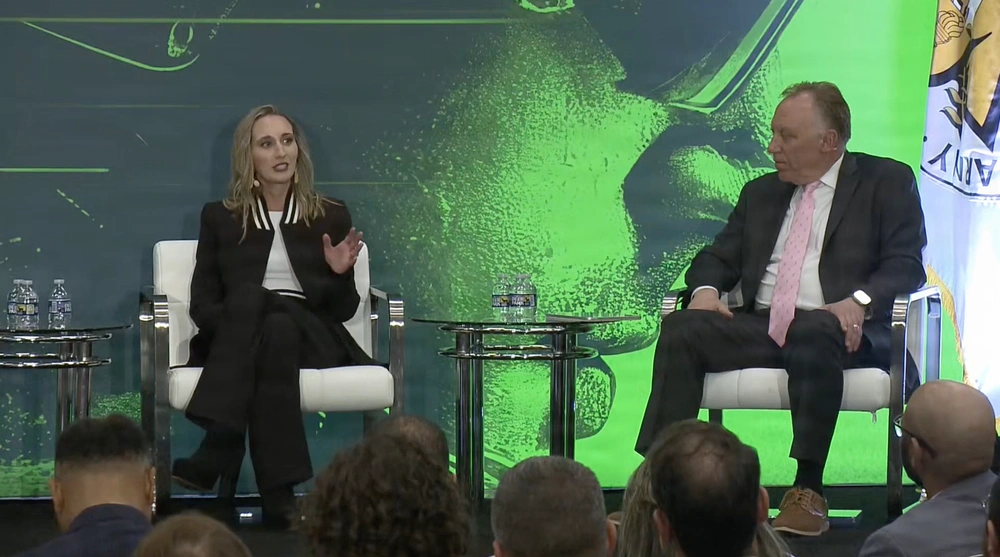
Tara Murphy Dougherty, left, chief executive officer of Govini, and John Baylouny, right, executive vice president and chief operating officer, Leonardo DRS Inc., weigh benefits and potential challenges of NGC2 going forward during a panel at AUSA in Washington, October 14, 2025. (Photo by Army Multimedia and Visual Information Division and USAASC)
CONCLUSION
The NGC2 panel discussion reflected a broader global shift toward military transformation, as nations invest in next-generation technologies to maintain strategic advantage in an evolving geopolitical landscape. For the U.S. Army, NGC2 represents more than just modernization—it’s the foundation for future dominance in an era defined by speed, precision and interconnected operations.
“From an NGC2 perspective, it’s not a ‘one and done’ contract … it’s a continuous effort,” said Ingraham, noting the contract was awarded under a Competitive Commercial Solutions Opening with the key word being ‘commercial.’ “We’re trying to leverage as much commercial as we can, adopt it, modify it if we have to and really at the very end get to developing something new.”
For more information, go to https://peoc3n.army.mil.
CHERYL MARINO provides contract support to the U.S. Army Acquisition Support Center at Fort Belvoir, Virginia, as a writer and editor for Behind the Frontlines and TMGL, LLC. Prior to USAASC, she served as a technical report editor at the Combat Capabilities Development Command Center at Picatinny Arsenal. She holds a B.A. in communications from Seton Hall University and has more than 25 years of writing and editing experience in both the government and private sectors.