
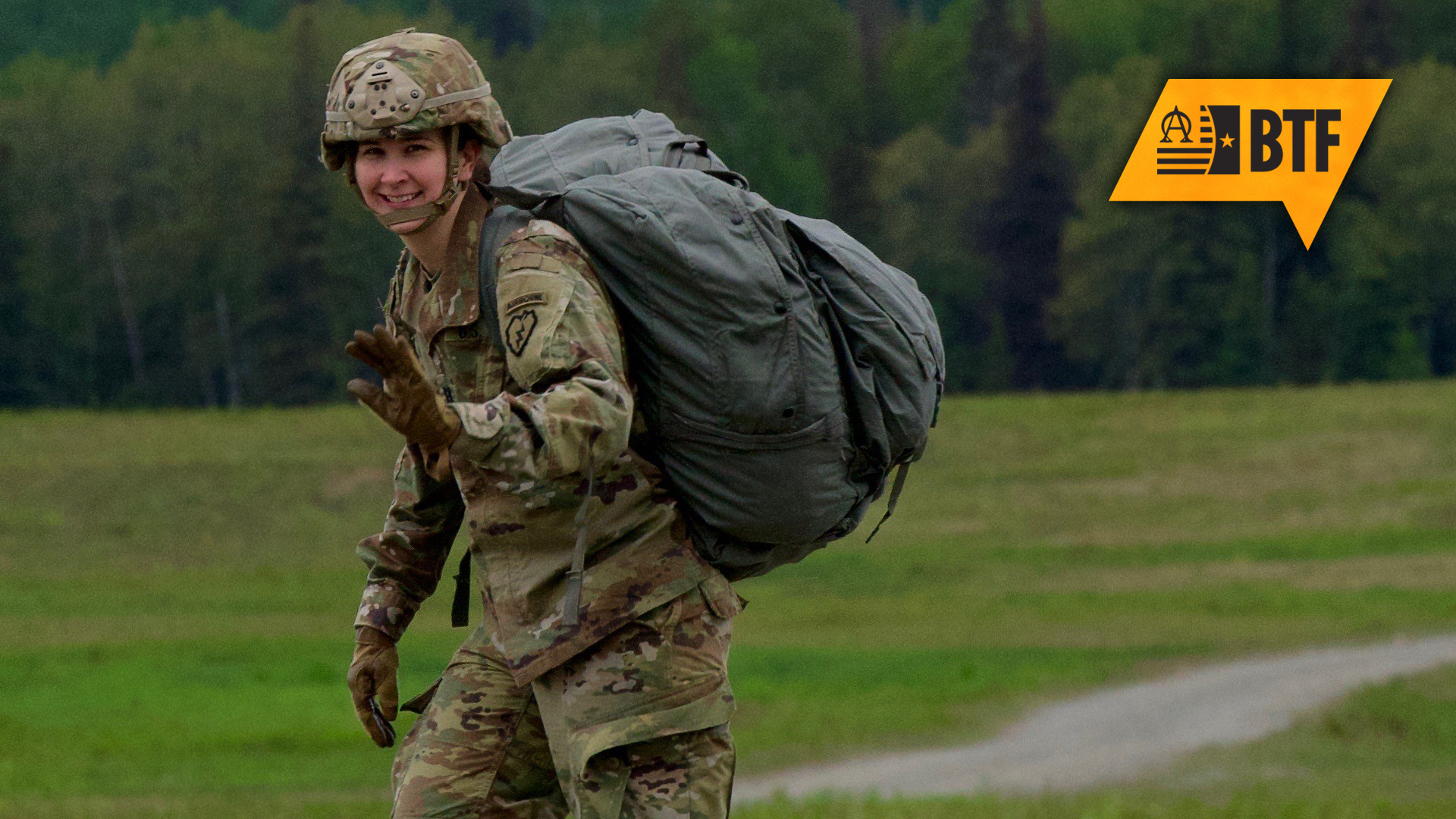
Maj. Mary Lord leaving the drop zone after a successful UH-60 jump in June 2016 at Joint Base Elmendorf-Richardson. (Photo provided by Maj. Mary Lord)
FROM PREP TO PASS: COMPARING PM PRACTITIONER PREP COURSES
by Maj. Mary Lord
There I was, sitting in a mini cubicle in SecureNinja, the proctor facility where I chose to take my Program Management (PM) Practitioner Exam, because it had the word “ninja” in it. Well, that’s only partially true; it was one of two facilities closest to my house that had decent reviews and I also like ninjas. There were simple instructions on the screen prompting me to “select next” to begin the exam. I closed my eyes and took a deep breath in, nervous about what the first question would be, whether my prep was enough. My heart was racing, my hands shaking. I do not enjoy exams. I slowly released my breath and pressed “next.”
Spoiler alert: I passed.
This was not an easy test; it took significant preparation. I am the type of person that needs to do everything I can in preparation for any event—exams, presentations, etc. No matter how much I prepare, I feel like it’s not enough, so I do more. Because of this, I took both PM Practitioner prep courses, PMT 4810 and PMT 4800V.
PREP COURSE OPTIONS
PMT 4810 is an online version of the Warfighting Acquisition University’s prep course for the PM Practitioner Exam, accessible through the Warfighting Acquisition University Virtual Campus. This self-paced course is worth 21 continuous learning points (CLPs), does not involve an instructor and can be taken as time permits. The course includes two practice tests. You must complete the content to access the first exam, but the second “optional” exam can be found in the “Tools and Resources” tab as soon as you register for the course. I did not know this until I completed the content of the course and the first practice exam—this “extra” practice exam can be a great tool in your self-study whether you choose to take either of the full prep courses or not to get a feel for the type of questions and content on the exam. PMT 4810 also includes four knowledge checks spread throughout the curriculum.
PMT 4800V is the quota-based, Virtual Instructor-Led Training (VILT) version of the Warfighting Acquisition University prep course, totaling nine days and worth 30 CLPs. You must register for PMT 4800V through the ATRRS Internet Training Application System (AITAS). The course is conducted virtually through the Warfighting Acquisition University’s Teams platform and is led by one or two instructors. Each iteration of the course is limited to 48 students. While the course is designed so that you can “go at your own pace,” the course requirements must be completed within the nine-day timeframe of the class. Additionally, there are group sessions for students and instructors to discuss the content of the review material.
COMPARING THE COURSES
Now let’s compare the two courses. The content between the two courses is nearly identical and presented in the same way. Both include four knowledge checks and two practice exams. Rather than your standard PowerPoint-type slide format, the courses are more interactive, including test-taking tips, information about the structure of the exam, links to source documents and embedded videos. The content is not split up by each prerequisite course but, rather, covers specific topic areas that may or may not include content from multiple courses. For example, the section on DOW’s Acquisition Management System includes content from ACQ 1010, ACQ 2020 and ACQ 2030.
To verify that the content of each course was nearly identical, I went back through my PMT 4810 notes and saw the exact same language, in the same order, throughout the PMT 4800V curriculum. The only difference? PMT 4800V does not include a “Key Takeaways” section at the end of each module, while PMT 4810 does. The real difference and benefit of PMT 4800V is the access to instructors to answer questions, the nine days to dedicate yourself to studying for the exam and your fellow students. Many students choose to share their notes and study aids to help their peers.
MY EXPERIENCE
I started taking PMT 4810 (online version) a couple of weeks before the PMT 4800 (VILT version) began. I took it between my normal work duties, as time allotted. To prepare, I took detailed, copious notes from each section in a OneNote file. I’m not sure how much time I spent on the curriculum, because I took it sporadically across two weeks when I had time, but the CLPs associated signify about 21 hours’ worth of content. As I took the practice tests, I noted which questions I got wrong and what the correct answers were. Unlike some of the prerequisite courses, like ACQ 2020, the knowledge checks and exams include the correct answers for your reference. I was frustrated while taking ACQ 2020 because I couldn’t see what the correct answers were to the questions I got wrong. I then went back and reread those sections. It is important to note that the knowledge checks only cover the content in the section they cover—they are not comprehensive while the practice tests are. The practice tests also mimic the exam in the spread of content from each course. Warfighting Acquisition University’s FAQ sheet includes a table that displays the spread of exam questions by course for each PM Exam.
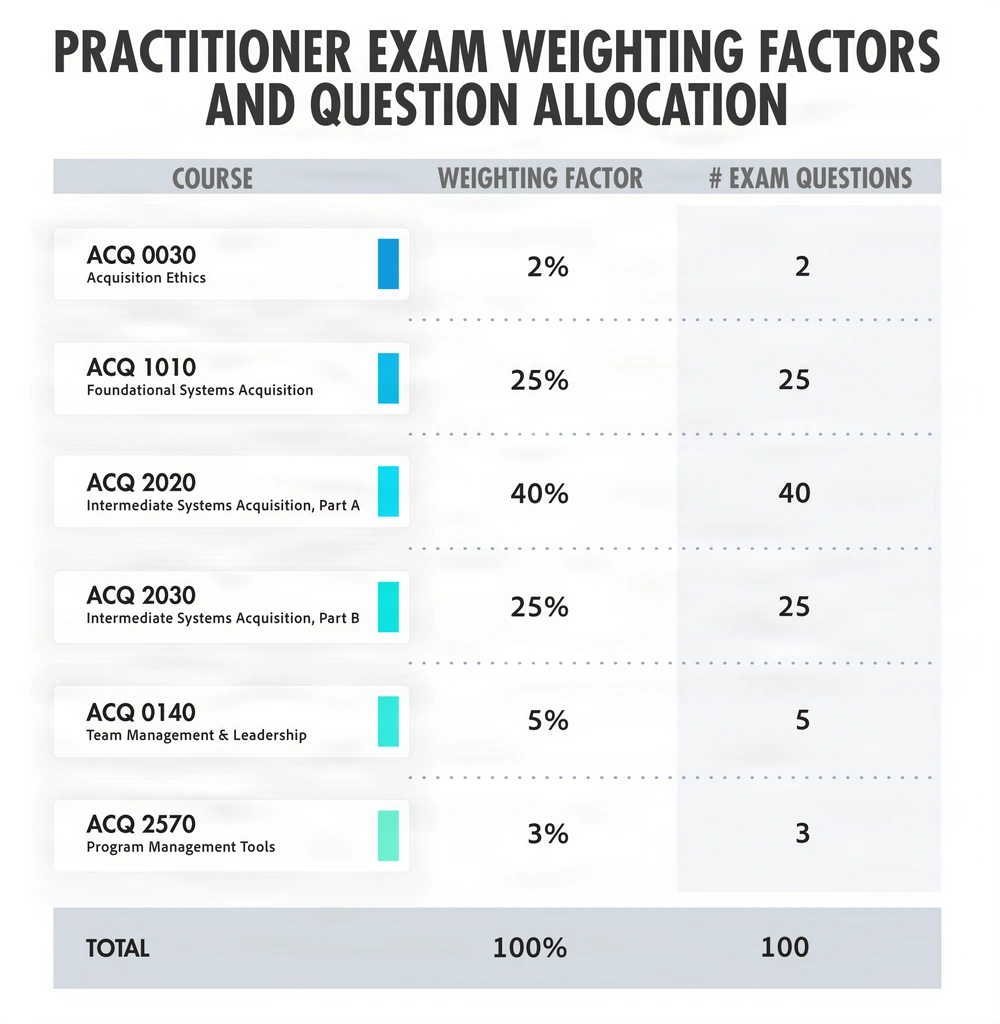
Note: This will be updated to incorporate the new classes before FY27.(Graphic by U.S. Acquisition Support Center)
This is a great tool to focus on self-study. In fact, on the day before the exam, I opted to retake ACQ 2020 after looking at this, since most questions are derived from that course. There is a lot of information on the prep course, and it does not cover everything you will see on the exam. It is meant to be a refresher after completing the prerequisite courses. I recommend going to the original course files to brush up on the specifics. The Warfighting Acquisition University has a SharePoint site where this information is housed. I did not go as in depth with the content on PMT 4810, since I knew I was about to take the VILT version.
To prepare for PMT 4800V, you must log into the Warfighting Acquisition University Teams platform two weeks ahead of time to ensure you are able to access the platform and troubleshoot any issues. The instructors send instructions via email leading up to the course and provide multiple 2-hour sessions to choose from to verify accessibility and communications. There is a quick checklist of items to complete to ensure you can access the required materials and communicate with instructors and peers. The whole checklist takes approximately 5 minutes to complete.
PMT 4800V begins with a mandatory group session, where the instructors take attendance, go through the pace and format of the course and answer student questions. This is the only mandatory group session of the course. There are additional optional group sessions spread throughout the nine-day course, aligned with the suggested pace of the material and knowledge checks. During these optional group sessions, instructors are present to answer student questions and they may go through frequently missed knowledge check questions. Some instructors may choose to go through every question, but at least for ours, we just went through those questions that a significant portion of the class missed, or that a student requested. The rest of the course is completed independently.
The most impactful group session was towards the end, when one of the students admitted that they had already taken the exam and failed. Her story really opened my eyes to something important: “Doing well on the practice exams is not enough to pass.” This news was both shocking and helpful for the rest of us.
Many of us have taken exams before where a significant portion of the practice exam is on the actual exam, and if you do well on one, you generally do well on the other. For this person, that was not the case. Now that I have taken the PM Practitioner Exam, I can attest to this. While I had some repeat questions from the practice exams, the majority were new. There is a very large bank of questions that the exams are drawn from, so the likelihood of seeing the exact questions is low. The exam questions, however, were structured similarly, so the practice tests did help in understanding the wording and structure of the exam questions. Additionally, by taking the practice exams, I was able to identify the areas I was not comfortable with, reread those sections and take additional notes on those areas as a whole—not just the specific questions I got wrong.
The questions on the knowledge checks and first practice exam in PMT 4800V were almost identical to those in PMT 4810. Since I had already taken PMT 4810, I got almost all the questions correct. The couple that I answered wrong helped me to identify weak areas to study more. There is a little more nuance on the second practice exam. For PMT 4800V, the second practice exam is not available until after the end of the PMT 4800V course. This exam was different than the second practice exam in PMT 4810 and was structured very similarly to the actual Practitioner Exam. I scheduled my Practitioner Exam for the day after the end of PMT 4800V, so I did not yet have access to the second exam. Because I was curious, I went ahead and took the second practice exam after I had already passed the Practitioner Exam. Most of the questions I had come across already through the other practice exams and knowledge checks, but there were a few that I hadn’t come across. Since it is not identical to the second exam in PMT 4810, it does give you a third bank of practice test questions to study from and identify weaker areas. For me, the benefit of taking the Practitioner Exam immediately after the course, before the weekend, with the information fresh in my mind was preferable to the extra rep with the additional practice exam.
In addition to taking the practice tests, I handwrote physical flash cards of key terms, concepts and roles to study. I used the “Key Takeaways” from PMT 4810 as a guide and also went back through my OneNote to capture any key elements that were missing. I wrote these notes as I went back through the curriculum of PMT 4800V. Handwriting flashcards was essential to me, because I learn best by physically writing. Others in my class used digital flash cards to study. Some of my peers used AI platforms to study and greatly benefited from it, so that is an option as well. I studied the flashcards in the three days leading up to the exam. I also decided to retake ACQ 2020 on the day before my exam. After completing ACQ 2020, I went through my notecards one last time and went to bed early enough to ensure eight hours of sleep. I did not study immediately before the exam. Either the information was lodged in my brain, or it wasn’t, but I wanted to go into the exam as calmly as possible.
THE EXAM
To sign up for the Practice Exam, you must register for PMT 4890V in AITAS. Once you register, you have 90 days to complete the exam. If you do not complete it within that timeframe, you will be considered a no-show and will need to submit a waiver, signed by your leadership, to reapply for the exam. After registering in AITAS, you will receive an “Authorization to Test” message from Pearson Vue within 72 hours to create an account and schedule either a virtual or in-person (proctored) exam. If proctored, you will be prompted to select the location.
I arrived at the exam site 45 minutes before test time. I made sure to eat some granola and hydrate before going inside. Once inside, I used the restroom, turned off my phone, locked my belongings in the locker provided and completed the required forms. The facility provided ear plugs, which helped to drown out any distractions. The proctor sat me in my cubicle, I put in my ear plugs, took a deep breath and began.
SO WHAT?
Preparation is key to pass this exam. Does everyone need to take both prep courses? No. You may not need to take either prep course to pass, but you do need to study the material in some way. The prep courses do a good job of summarizing the key concepts and terms, but they do not include everything you need to know. It does help to focus your study, refresh your memory and highlight weak areas that require further emphasis. As for PMT 4810 versus PMT 4800V, my recommendation is PMT 4800V, because of the nine days provided to study for the exam and the input of other students. PMT 4810 has the same content as PMT 4800V, with the addition of the “Key Takeaways” at the end of each module, but it does not provide the peer input and generally, is conducted as time provides during normal duties, so it is not as focused. For the most bang for your buck, take PMT 4800V, but register for PMT 4810 as well. This will provide you access to the second “optional” practice exam (the mandatory one is almost identical to the one you will get in PMT 4800V), and you can access the “Key Takeaways” by going to the “Print Files” for the course. Print Files provides a PDF with the entire content for each module in PMT 4810. You can also print the files if you prefer to study by paper rather than on screen. It all depends on how you learn best. For me, it was writing flashcards. The U.S. Army Acquisition Support Center PM Functional Area webpage also has information about the exam, frequently asked questions, test taking tips and other helpful information about the exam and prep courses. Whatever your method, just do the work. Study, breathe and ace that exam.
For more information, go to the Warfighting Acquisition University iCatalog PM Practitioner Certification webpage at https://icatalog.dau.edu/onlinecatalog/CareerCertGuides.aspx?lvl=2&cfld=9.
MAJ. MARY LORD is the 51A Proponency Officer in the Strategy and Communications Division of the U.S. Army Acquisition Support Center. She holds an M.S. in systems engineering management from the Naval Postgraduate School, a B.A.in communication from George Mason University and is certified Lean Six Sigma Black Belt. Prior to her role as a proponency officer, she served as the assistant product manager for the Next Generation Short Range Interceptor in PEO Missiles and Space. She spent her first 10 years serving as a signal officer in units in Schofield Barracks, Hawaii, Joint Base Elmendorf-Richardson, Alaska and Fort Irwin, California.