
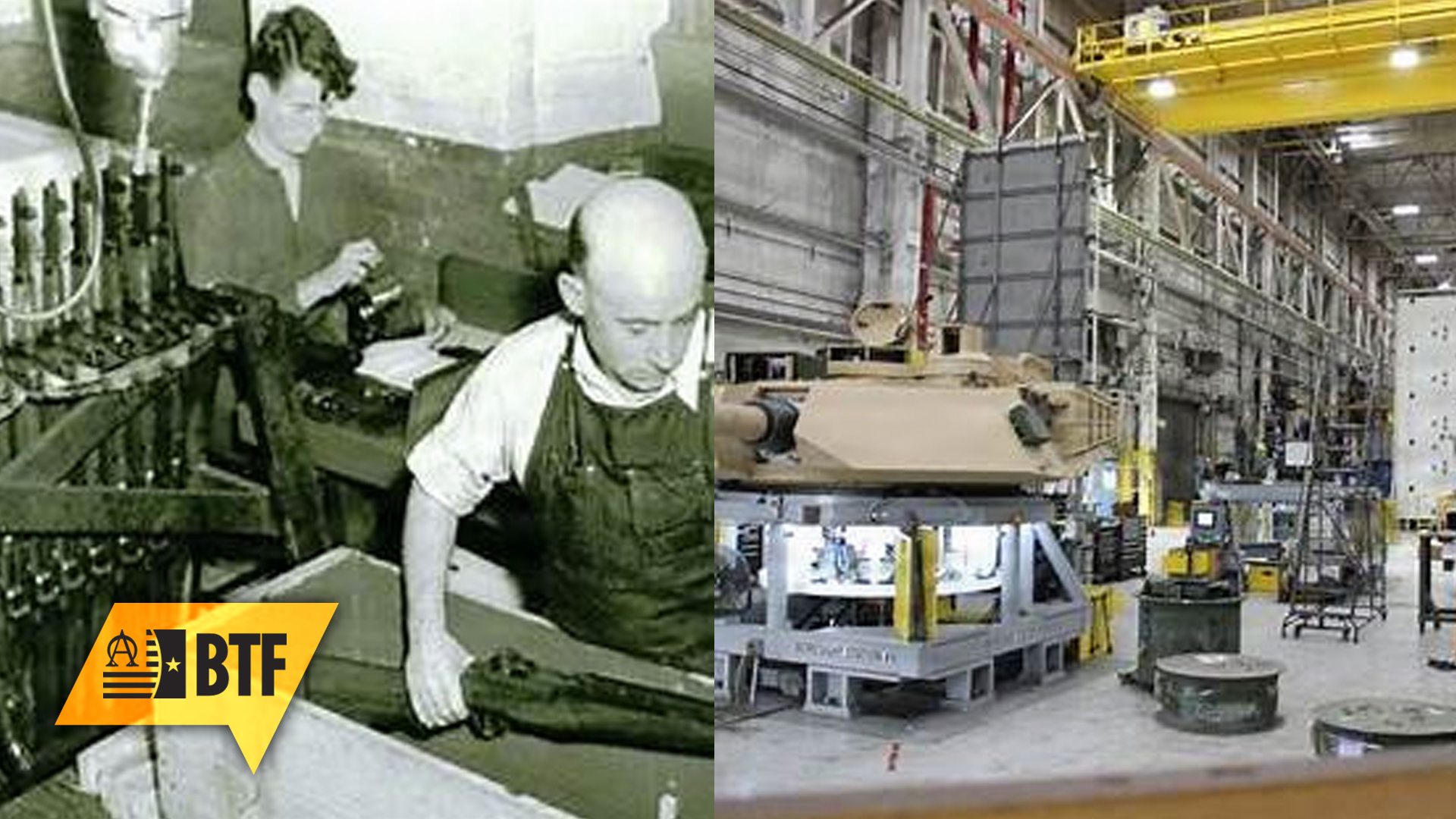
Workers pack completed M1 Garand rifles for shipment at the Springfield Armory (c. 1940s), emblematic of the Ordnance Department’s mass-production “arsenal of democracy” that armed U.S. forces at scale. (Left Photo courtesy of Darrel Ames, PAE Fires)
At the Army-owned Joint Systems Manufacturing Center in Lima, Ohio, an M1A2 Abrams turret is boresight-calibrated before being mated to its hull, showing the Army, industry model for heavy armor production. (Right Photo by Brian Hahn, U.S. Army Tank-automotive and Armaments Command)
HISTORY OF ARMY ACQUISITION AND ITS ONGOING TRANSFORMATION
by Darrell Ames
From the earliest days of the American Revolution to the modern digital battlefield, the U.S. Army Acquisition Workforce (AAW) has served as the engine behind the Army’s ability to equip, sustain and modernize the force. While Soldiers fight on the front lines, acquisition professionals fight behind the scenes, negotiating contracts, testing weapons systems, developing future capabilities and ensuring that America’s sons and daughters go into battle with the best equipment possible.
Over the years, each era of Army acquisition reform has sharpened that mission. From standardizing procurement practices in the early 20th century, to embracing rapid acquisition authorities during the post-9/11 fight, to implementing data-driven decision frameworks in the last decade, reform has been the Army’s mechanism for accelerating progress. Every reform wave has created new tools, streamlined processes and empowered the workforce to adapt faster than the threats they face. Today’s newly announced acquisition reform rollout is the next step in that lineage, a continuation of the Army’s long tradition of transforming how it equips the force to meet the demands of a changing world.
COLONIAL ROOTS AND EARLY LOGISTICS
The roots of Army acquisition date back to the Revolutionary War. George Washington, recognizing the desperate need for weapons, uniforms, food and ammunition, urged the Continental Congress to create a system for procuring military supplies. The result was the appointment of Quartermaster and Commissary Generals—precursors to today’s logisticians and program managers—who were tasked with securing everything from muskets to rations.
Even then, procurement was complex. The young American republic relied heavily on contracts with private merchants and foreign governments. Navigating war and scarcity, these early officers wore many hats, part logistician, part diplomat and always a steward of limited public funds.
CIVIL WAR TO WORLD WAR I: INDUSTRIAL EXPANSION
During the Civil War, the Union’s ability to produce and distribute supplies at scale became a decisive factor in the creation of the U.S. Army Ordnance Department. The creation of the U.S. Army Ordnance Department and the Army’s reliance on industrial manufacturing set the stage for a more formal acquisition system. Procurement officers coordinated with railroads, factories and arms dealers to keep the Union Army supplied.
By World War I, acquisition had evolved significantly. The Army created the War Industries Board to coordinate industry and allocate resources efficiently. Acquisition professionals managed contracts for millions of rifles, uniforms and artillery pieces, laying the foundation for modern contracting and program management.
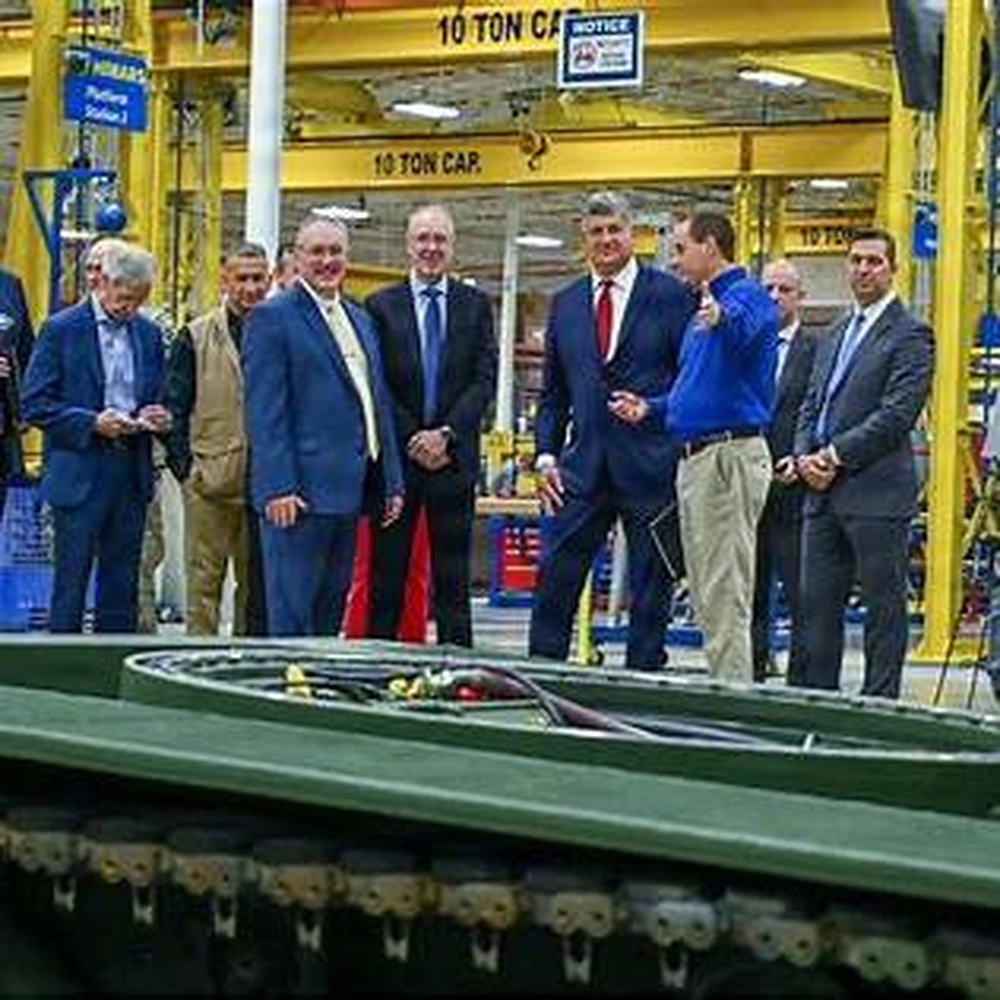
Department of War acquisition leaders tour the Camden, Arkansas facility that produces Army precision-fires launchers and munitions, highlighting contemporary government–industry coordination to surge capacity. (Photo courtesy of Darrell Ames, PAE Fires)
WORLD WAR II: THE ARSENAL OF DEMOCRACY
World War II marked a turning point in the history of Army acquisition. Facing the global Axis threat, the United States mobilized its industrial might, becoming what President Franklin D. Roosevelt called the “Arsenal of Democracy.” The Army’s acquisition professionals played a central role in this transformation.
Thousands of contracting officers, engineers, scientists and logisticians worked together with industry to deliver tanks, aircraft, small arms and radios at quantities and speeds never seen. Perhaps no better example exists than the Manhattan Project, an audacious Army-led fusion of science and logistics that forever altered global power dynamics.
THE COLD WAR ERA: INNOVATION AND BUREAUCRACY
The post-World War II period saw the emergence of a permanent defense acquisition structure. As the Cold War intensified, so did the need for rapid technological innovation. However, with growing scale came growing complexity. Congressional oversight increased, and the Department of War introduced a series of reforms aimed at improving efficiency, transparency and accountability. The warfighting acquisition workforce became more specialized, with formal training and certification systems introduced to professionalize the field.
Notably, the Army Materiel Command was established in 1962 to centralize logistics and acquisition functions. It became a key player in the development and sustainment of Army equipment worldwide. Meanwhile, the Vietnam War placed a heavy burden on acquisition personnel, who had to rapidly deliver helicopters, jungle gear and communications equipment while adapting to asymmetric warfare requirements.
THE 1980S–1990S: REFORM AND MODERNIZATION
The 1980s were marked by acquisition scandals and rising program costs, prompting sweeping reforms like the Goldwater-Nichols Act (1986) and the establishment of the Defense Acquisition Workforce Improvement Act (DAWIA) in 1990. DAWIA introduced structured education, training and certification standards for acquisition professionals, elevating acquisition into a distinct career path.
The Gulf War in 1991 demonstrated the benefits of a mature acquisition system. Precision-guided munitions, advanced communications and robust logistics networks enabled a swift and decisive victory in Operation Desert Storm.
21ST CENTURY: AGILE, INTEGRATED AND SOLDIER-FOCUSED
Since 9/11, the AAW has faced the twin demands of sustaining long-term operations in Iraq and Afghanistan while also preparing for future high-tech threats. Rapid fielding initiatives brought life-saving technologies like up-armored vehicles, counter-improvised explosive device systems and unmanned aerial systems to the battlefield in record time.
In the last two decades, Army acquisition has shifted toward agility, speed and innovation. The establishment of Army Futures Command (AFC) in 2018 was a watershed moment, bringing acquisition, requirements, science and technology and test and evaluation together under one strategic roof. AFC worked closely with portfolio acquisition executives (PAEs)—formerly program executive offices—industry and academia to accelerate delivery of capabilities in areas like long-range fires, integrated air and missile defense and next-generation combat vehicles.
This collaborative ecosystem ensures that modernization is not just conceptual, it is translated into real capability for Soldiers at speed and scale.
As the Army transitions from AFC to the new Transforming the Total Army Command (T2COM), that partnership framework is evolving. The shift reflects the Army’s intent to integrate modernization authorities, resources and decision-making under a single, more agile structure. Likewise, the migration of responsibilities from program executive offices to capability program executives (CPEs) represents a deliberate move toward enterprise-level oversight and unity of effort, ensuring that modernization efforts are synchronized across the entire Army, Active, Guard and Reserve. Together, these shifts mark a new chapter in how the Army organizes, prioritizes and delivers the capabilities needed for the future fight.
Today’s AAW, over 30,000 strong, is a multidisciplinary team of engineers, scientists, logisticians, testers, finance experts and contracting officers. They embody a culture of collaboration, stewardship and excellence.
CONCLUSION
The AAW may not make headlines, but its impact is profound and enduring. These quiet professionals ensure that America’s Army remains the most ready, lethal and technologically advanced land force in the world.
“We don’t just buy things, we empower Soldiers, we shape the battlefield and we deliver readiness,” said Maj. Gen. Frank Lozano, PAE Fires (formerly Program Executive Office Missiles and Space).
As the Army looks to 2030 and beyond, embracing artificial intelligence, hypersonics, robotics and space-based systems, its acquisition professionals will continue to forge the future. Their legacy is one of adaptation, innovation and unwavering service to the Soldier.
For more information, go to https://asc.army.mil/web/access-army-acquisition-a-brief-history.
DARRELL AMES, U.S. Navy (Ret.), is the public affairs officer for PAE Fires. Previously, he served as a historian at Pearl Harbor for the U.S. Navy from 1992-2012. He holds an M.A. in economics from the University of Oklahoma and a B.A. in journalism from Wayland Baptist University.