

Secretary of the Army Dan Driscoll and Chief of Staff of the Army Gen. Randy A. George join “Fox and Friends” to discuss the new Department of Defense memorandum on Army transformation and acquisition reform, at the Pentagon, Washington, D.C., May 1, 2025. (Photo by Petty Officer 1st Class Alexander Kubitza, Office of the Secretary of Defense Public Affairs)
The Naval Postgraduate School Provides Defense Acquisition-Relevant Graduate Education
by Col. Robert F. Mortlock, USA (Ret.), Ph.D., Lt. Col. Rene G. Rendon, USA (Ret.), D.B.A. and Col. Keith Hirschman, USA (Ret.)
On April 9, 2025, Executive Order titled “Modernizing Defense Acquisitions and Spurring Innovation in the Defense Industrial Base,” was signed by President Donald J. Trump. The executive order clearly outlines a mandate and commitment for the U.S. to maintain the most “lethal warfighting capabilities in the world.” The order also recognizes the defense acquisition workforce as a “national strategic asset” and a healthy Defense Industrial Base as a key enabler to “deliver state-of-the-art capabilities at speed and scale.” The executive order is spot on target. The order outlines policy, acquisition process reform, internal regulations review, acquisition workforce reform, major defense acquisition program reviews and requirement reviews. This most recent defense acquisition reform effort follows past acquisition reform initiatives that have delivered limited success and impact. One thing that stands out during past acquisition reform initiatives was lack of emphasis on graduation education. Education in the acquisition workforce has not been leveraged sufficiently as a tool to achieve the goals and the desired end states. This time can be different—and the Naval Postgraduate School (NPS) stands at the ready to provide defense acquisition-relevant graduate education.
WHAT’S THE BACKSTORY?
Acquisition reform picked up steam in 1986 with the Final Report of the President’s Blue Ribbon Commission on Defense Management, known as the Packard Commission Report, aimed to address systemic inefficiencies and management problems in U.S. defense operations. The report provided a comprehensive set of findings and recommendations. In the area of Acquisition Organization and Procedures, the commission found that defense acquisition was plagued by excessive cost, delays and overly bureaucratic oversight. The commission recommended empowering program executive officers, emphasizing prototyping and competitive procurement, and overhauling regulations to reduce red tape and gold-plating requirements. A notable result was the establishment of the Defense Acquisition University (DAU) in 1990 under the Defense Acquisition Workforce Improvement Act (DAWIA). DAU has created a plethora of robust training courses to keep pace with each change over the years that allows acquisition professionals to remain current with policy, regulations and statutes.
In the May-June 2021 issue of Defense Acquisition magazine, Brian Schultz’s article, “Brian’s Laws, Part I,” highlighted 62 major events from 1981 to 2016 that have shaped Defense Systems Acquisition over the years. Reform initiatives on top of previous reform initiatives have diluted the impact of any one effort and led to the current complex defense acquisition environment. Student capstone research projects at NPS have also studied the impact of acquisition reform. For example, in 2016, Dale Bond, Scott Davis and Aaron Pearsall published their capstone report titled “The Goldwater-Nichols Act of 1986: 30 Years of Acquisition Reform,” and found that the DOD and Congress should target reforming the requirements, resourcing and management processes equally to have real impact. Their research highlighted that most reform initiatives targeted changes in the Defense Acquisition System, also referred to as little “A” acquisition, and very few initiatives centered on changes to the resourcing system (also known as planning, programming, budgeting and execution) or on changes to the requirements processes (known as Joint Capabilities Integration and Development System). In February 2019, the Advisory Panel on Streamlining and Codifying Acquisition Regulations, commonly known as the Section 809 Panel, published reports on recommendations to reform Defense acquisition through the resourcing lens.
The DOD has updated the Defense 5000 series of acquisition regulations to keep pace with the changes over the years. The current DOD Directive 5000.01, “The Defense Acquisition System,” emphasizes delivery “at the speed of relevance.” DODD 5000.01 states “The objective of the Defense Acquisition System is to support the National Defense Strategy, through the development of a more lethal force based on U.S. technological innovation and a culture of performance that yields a decisive and sustained U.S. military advantage. The acquisition system will be designed to acquire products and services that satisfy user needs with measurable and timely improvements to mission capability, material readiness and operational support, at a fair and reasonable price.”
In a complementary way, the DOD Instruction 5000.02, “Operation of the Adaptive Acquisition Framework (AAF),” provides the framework for the use of six acquisition pathways: urgent capability acquisition (less than 2 years), middle tier of acquisition (rapid prototyping and fielding, less than 5 years), major capability acquisition, software acquisition, defense business systems and acquisition of services.
The common theme absent from past acquisition reform efforts, initiatives, studies and reports is an investment in the graduate education of the acquisition workforce professionals. Cornerstones of any profession are education programs that teach theory, principles and applications and teach an adherence to recognized standards of conduct for that profession. NPS supports this recent acquisition reform effort by the current administration and enables its success by offering defense acquisition-relevant graduate education.
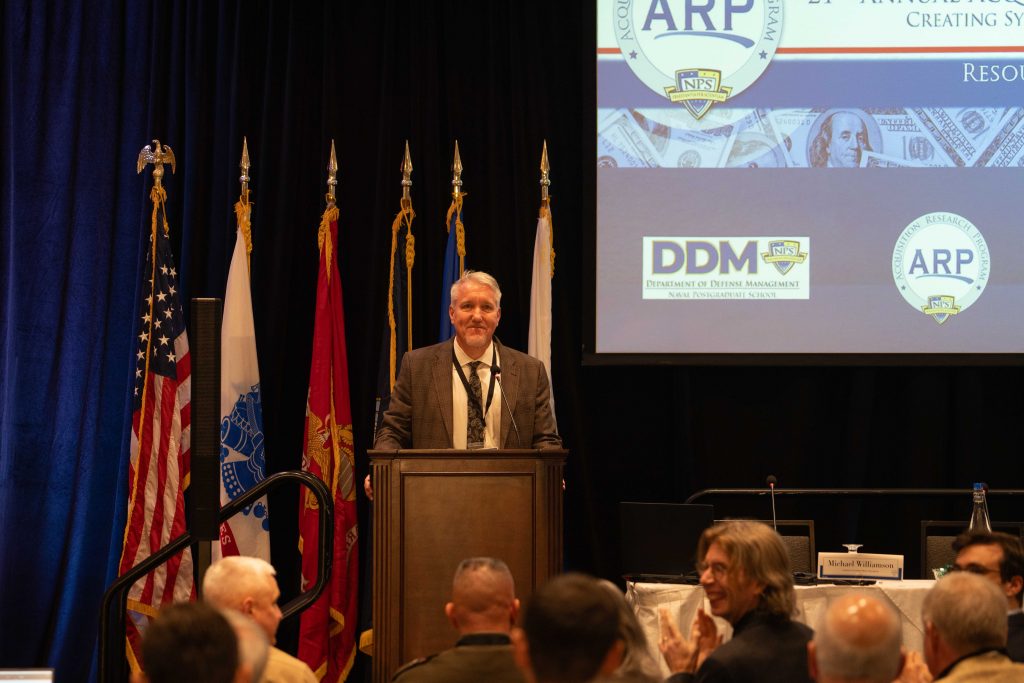
Robert Mortlock, Ph.D., associate chair of acquisition management at NPS, offers administrative remarks during the final day of the NPS Acquisition Research Symposium. The event, now in its 21st year, brings together acquisition professionals in a research-focused forum that connects scholars, practitioners and policymakers. (Photo by Petty Officer 2nd Class Andrew Langholf, Naval Postgraduate School)
GRADUATE EDUCATION IS THE KEY TO ACQUISITION REFORM
The Modernizing Defense Acquisitions and Spurring Innovation in the Defense Industrial Base executive order highlights a commitment “to ensuring that the United States military possesses the most lethal warfighting capabilities in the world.” The defense industrial base and defense acquisition workforce are specifically called out as keys to “deliver state-of-the-art capabilities at speed and scale through a comprehensive overhaul of this system … with an emphasis on speed, flexibility and execution.”
To this end, NPS offers graduate degrees in the acquisition sciences—specifically Master of Science (M.S.) degrees in program management and contract management. Each degree has education skills requirements to support the development of the defense acquisition workforce. The degrees are tailorable and flexible, ranging from full-time, one-year resident options as well as part-time, two-year online distance learning degrees. The degree program objectives include critical thinking, problem solving, decision making, resource management and stakeholder engagement. The degrees are designed and delivered for members of the defense acquisition workforce—both active-duty members and government civilians. Courses within the degrees include case studies “of successful approaches for implementing innovative acquisition authorities” within the defense industrial base, providing students with opportunities to gain experience with how the defense industrial base contributes to the objectives of delivering capabilities at speed and scale.
The Modernizing Defense Acquisitions and Spurring Innovation in the Defense Industrial Base executive order continues with an emphasis on specific acquisition process reform to include “first preference for commercial solutions and a general preference for Other Transactions Authority, application of Rapid Capabilities Office policies or any other authorities or pathways to promote streamlined acquisitions under the Adaptative Acquisition Framework.” Reform requires better decision-making and risk management by “program managers, contracting officers, engineering authorities, financial managers, cost estimators and logisticians.”
Courses in the NPS degree programs integrate experiential lab exercises that facilitate learning how to develop and integrate emerging technologies through strategies that use rapid prototyping and experimentation, leverage non-Federal Acquisition Regulations-based contracts and develop innovative and risk appropriate acquisition strategies using the AAF pathways. NPS courses align with DAWIA functional areas of program management, contracting, engineering and technical management, test and evaluation, life cycle logistics and financial management and cost estimating.
The executive order specifically highlights acquisition workforce reform mandating a plan to reform and train the acquisition professionals to better leverage “commercial solutions, adaptive acquisition pathways through the Adaptive Acquisition Framework, and iterative requirements.” The executive order mandates the establishment of field training teams to provide “hands-on guidance, deliver templates and case studies of successful approaches for implementing innovative acquisition authorities.”
NPS courses in the acquisition sciences of program and contract management are aligned with executive order principles of improving and accelerating defense acquisition through innovative use of the AAF, contracting authorities and integration of commercial technologies to maintain warfighting capability dominance on the battlefield. NPS courses also support incremental development and delivery strategies balancing technical and sustainment risks through case studies and lab exercises. It is often said “If you work in defense acquisition long enough, you will revisit the same issues on multiple programs,” and NPS courses in program and contract management emphasize analysis of current acquisition strategies for novel approaches in exploiting multiple pathways in the AAF to accelerate deployment of capability to the warfighter.
Graduate-level program management courses focus on the theories that underpin sound project, program and portfolio management principles as outlined in the global standard and American National Standards Institute (ANSI) accredited Project Management Institute (PMI) Project Management Body of Knowledge, the Standard for Project Management, the Standard for Program Management and the Standard for Portfolio Management. Recent accreditation of NPS’ Project Management degrees through the PMI and courses designed to facilitate student certification as Project Management Professionals, further illustrate the NPS commitment to bridging the gap between defense acquisition and best practices in project, program and portfolio management found in aerospace and other commercial industries. Finally, NPS graduate level courses in program management are aligned with DAWIA required DAU courses for the PM Practitioner level of certification.
Graduate-level contract management courses focus on the theories that inform contract management, as well as the principles of contract management as reflected in the National Contract Management Association (NCMA) Contract Management Body of Knowledge, and the ANSI-accredited Contract Management Standard, which has been adopted by the DOD as its contracting competency model. NPS offers graduate electives that help students prepare and successfully pass the NCMA professional certification exams for the Certified Professional Contract Manager and the Certified Federal Contract Manager to supplement the Back-to-Basics credential.
Here is a list of NPS offerings for M.S. degrees and academic certificate programs:
- Master of Science in Defense Program Management: Curriculum 816 – Department of Defense Management – Naval Postgraduate School.
- Master of Science in Defense Contract Management: Curriculum 815 – Department of Defense Management – Naval Postgraduate School.
- Master of Science in Acquisition – Program Management (Distance Learning): Curriculum 836 – Department of Defense Management – Naval Postgraduate School.
- Master of Science in Acquisition – Contract Management (Distance Learning): Curriculum 835 – Department of Defense Management – Naval Postgraduate School.
- Advanced Acquisition Studies Certificate (217 resident and 218 distance learning): Curriculum 217 – Department of Defense Management – Naval Postgraduate School and Curriculum 218 – Department of Defense Management – Naval Postgraduate School.
- Basic Contract Management Certificate (237 resident and 238 distance learning): Curriculum 237 – Department of Defense Management – Naval Postgraduate School.
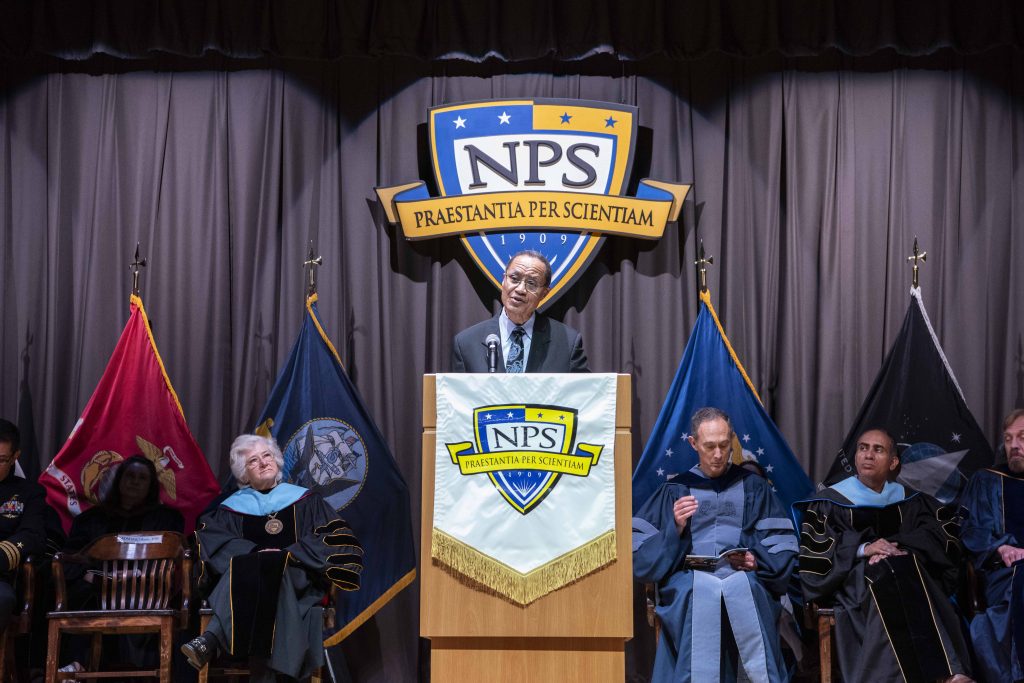
NPS Hall of Fame alumnus retired U.S. Navy Adm. Cecil D. Haney delivers the keynote address at NPS’ 2025 Winter Quarter commencement ceremony. Haney, a former commander of U.S. Strategic Command and U.S. Pacific Fleet, is the 26th inductee into the NPS Hall of Fame and earned two master’s degrees from the institution in engineering acoustics and systems technology. (Photo by Javier Chagoya, Naval Postgraduate School)
CONCLUSION
The recent executive order on acquisition reform highlights a critical challenge facing national security: how to reform defense acquisition reform to maintain capability overmatch on the modern battlefield. Defense acquisition is a warfighting enabler to integrate emerging technologies and commercial solutions into warfighter systems to maintain battlefield capability dominance against evolving and adaptive enemy threats. Various acquisition reform initiatives over the last 45 years have attempted to fix the system, but many have resulted in an even more bureaucratic system. This time can result in a different outcome if DOD realizes the best return of investment is an investment in the graduate education of active-duty military and DOD civilians in the acquisition workforce. The dedicated members of the acquisition workforce are members of the acquisition profession—offer them the opportunity to earn a graduate degree in the acquisition sciences from NPS—and over the long term—this latest acquisition reform effort may deliver on the objective of delivering capabilities at speed and scale of relevance.
For more information, email the authors at rfmortlock@nps.edu, rgrendon@nps.edu and keith.hirschman@nps.edu.
COL. ROBERT F. MORTLOCK, USA (Ret.), Ph.D., has managed defense systems development and acquisition efforts for the last 15 of his 27 years in the U.S. Army. He is a professor of practice, associate chair in acquisition sciences and principal investigator of the Acquisition Research Program at the Naval Postgraduate School in Monterey, CA. He holds a Ph.D. in chemical engineering from the University of California, Berkeley, an M.S. in national resource strategy from the Industrial College of the Armed Forces and an MBA from Webster University.
COL. RENE G. RENDON, USA (Ret.), DBA, has managed defense acquisition contracts for 22 years in the U.S. Air Force. He is a professor of acquisition and manages the contract management graduate degree programs at the Naval Postgraduate School in Monterey, CA. He holds a D.BA. from Argosy University, an MBA from the University of North Dakota and a BBA from Angelo State University.
COL. KEITH HIRSCHMAN, USA (Ret.), has managed defense systems development and acquisition programs for 19 of his 30 years in the U.S. Army, in addition to 4.5 years within the international aerospace and defense industry. He is a professor of practice at the Naval Postgraduate School in Monterey, CA. He holds an M.S. in management at the Naval Postgraduate School and an M.S. in strategic studies from the U.S. Army War College.