

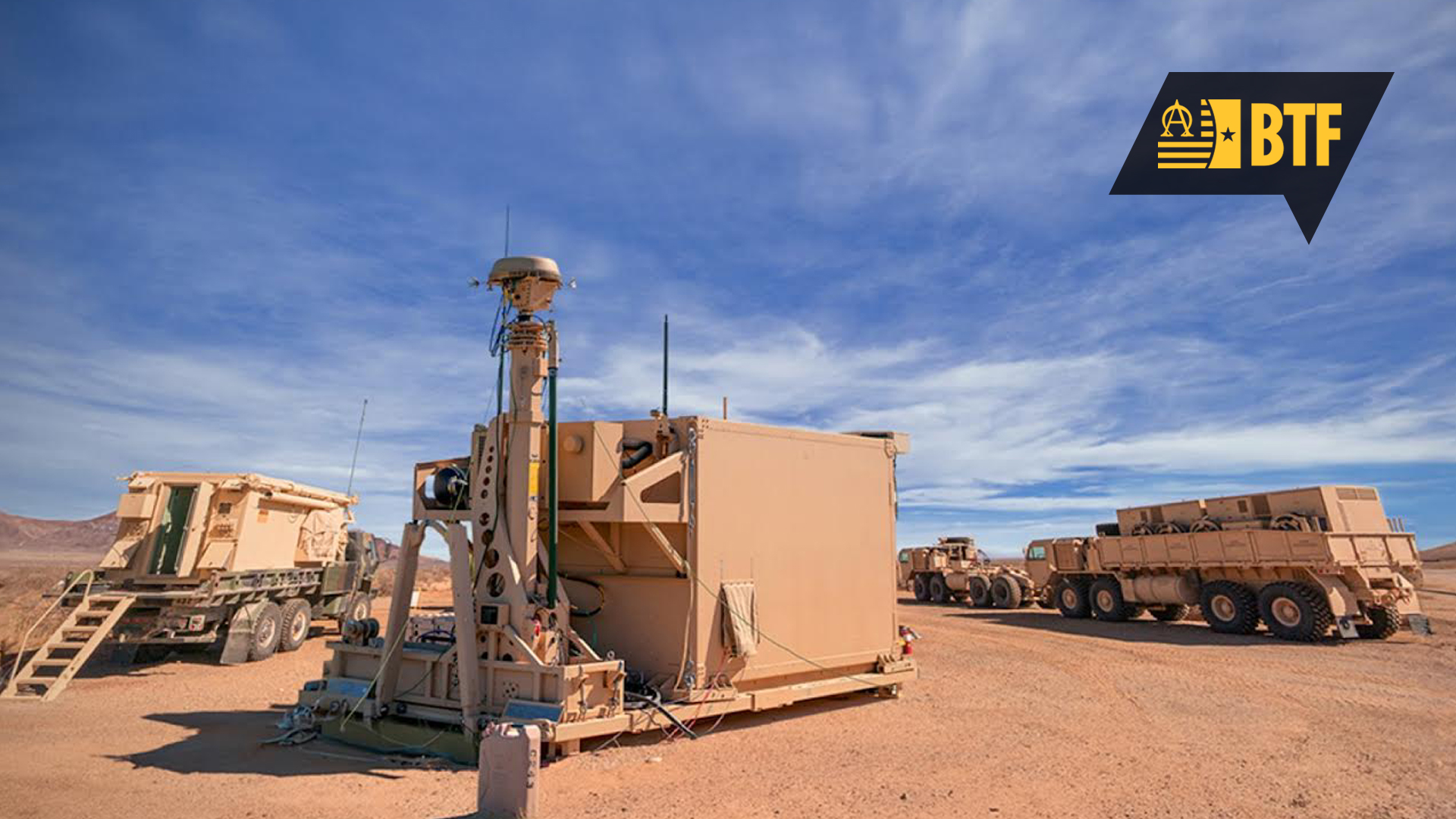
IBCS enables joint and coalition interoperability by linking sensors and shooters across domains. IBCS provides commanders with a resilient, open-architecture command-and-control capability designed to defeat evolving aerial threats. (Photo by Nathaniel Pierce, Portfolio Acquisition Executive Fires)
IBCS AND THE FUTURE OF OFFENSIVE AND DEFENSIVE INTEGRATED FIRES
by Brandon M. Williams
Near-peer adversaries now field a sophisticated arsenal of aerial threats capable of executing complex, multidomain attacks designed to overwhelm traditional defenses. This reality has rendered stove-piped air and missile defense systems dangerously obsolete. In response, the U.S. Army launched one of its most ambitious and technologically demanding modernization efforts: the Army Integrated Air and Missile Defense (AIAMD) to address the limitations of traditional air defense programs.
AIAMD is the Army’s overarching architecture for a system-of-systems approach to air and missile defense and is the cornerstone of the Army’s air and missile defense modernization. Its core principle of “any sensor, best weapon” breaks down traditional silos, enabling greater flexibility, interceptor efficiency and responsiveness. AIAMD integrates the Army’s air and missile defense capabilities into a unified network, providing a resilient and adaptable defense against evolving threats.
Managed by the Portfolio Acquisition Executive Fires (previously Program Executive Office Missiles and Space) Integrated Fires Mission Command Project Office in Huntsville, Alabama, the Integrated Battle Command System (IBCS) is the material solution to the AIAMD program. IBCS integrates sensors and effectors across the Integrated Fire Control Network (IFCN) to dramatically enhance operational capabilities. Far from a simple upgrade, IBCS is a foundational architectural shift redefining battle command and fire control. It moves the Army from a reactive, platform-centric model to a unified, network-centric kill web that transforms a fragmented collection of standalone systems into a single resilient defensive network.
REDEFINING PROTECTION
The concept for IBCS began in the early 2010s with the desire to replace and modernize siloed air and missile defense systems with a unified Single Integrated Air Picture. The Army, with the aid of industry partners, developed that vision and will continue to bring to bear a modernized capability. As the first Acquisition Category I-D program in the Department of the Army to use the Agile DevSecOps software development methodology, IBCS successfully streamlined development and testing to deliver faster and more efficient capability to the warfighter. Early Soldier involvement and support from the Army’s Integrated Fires Directorate contributed to the accelerated development and delivery.
IBCS delivers enhanced situational awareness, faster decision-making and a more robust defense against a broad spectrum of aerial threats. By compositing data from a wide range of sensors, it provides warfighters at all echelons with a single, integrated air picture for optimal asset allocation through the Common Warfighter Machine Interface, as part of the Integrated Collaboration Environment connected across the battlefield via the IFCN relays.
IBCS uses an “any-sensor, best-weapon” approach for determining the most effective kinetic or non-kinetic weapon to engage each threat, improving effectiveness while conserving advanced interceptors for high-end targets. Additionally, IBCS’s inherent resilience automatically re-routes data via a self-healing mesh network to maintain the critical mission defensive capabilities through component attrition.
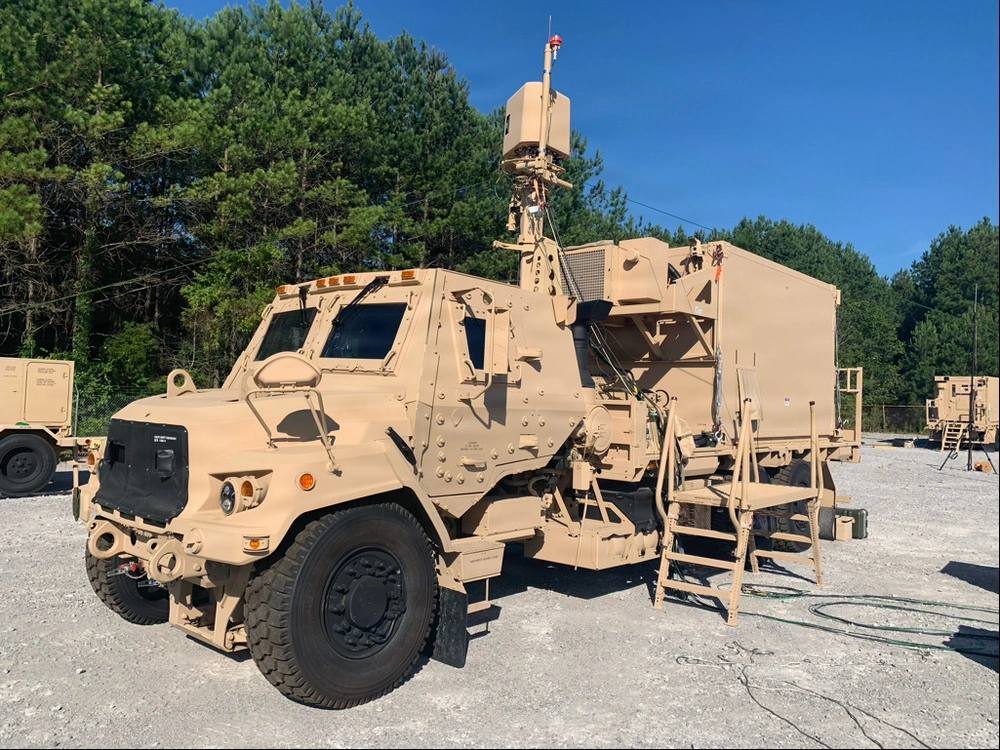
The IBCS Engagement Operation Center is the primary data process and communication component of IBCS. (Photo by Nathaniel Pierce, Portfolio Acquisition Executive Fires)
IBCS PROVIDES THE OFFENSIVE EDGE OF INTEGRATED FIRES
IBCS has prototyped the capability to enable a rapid defensive-to-offensive kill chain through previous test events. By linking air and missile defense with long-range precision fires through the AIAMD architecture, IBCS provides cross-domain targeting. When a networked sensor detects an enemy launch, it identifies the incoming threat’s trajectory and point of origin. That targeting data flows to offensive and defensive systems for automated engagement or rapid-human decision, ensuring immediate, coordinated responses across all domains.
Integration with airborne platforms amplifies these effects. For example, a friendly aircraft detects an enemy surface-to-air missile site and pushes that data into the IBCS network, enabling other friendly forces to neutralize the threat before it fires. This capability creates an agile, lethal and survivable force that can seamlessly shift between defensive and offensive operations.
JOINT FIRES, IBCS DELIVERS UNIFIED EFFECTS FROM PARTNERS
As a critical enabler of joint and coalition warfare, IBCS’s open architecture and government owned interface control documents support integration with systems from other U.S. military branches and allied nations, forming an interoperable fire control network and achieving the core principles of the AIAMD approach. This multidomain battle command and fire-control capability synchronizes and deconflicts fires across the joint force.
Since fielding IBCS, strategic effects are already being realized in key theaters. It shifts the military balance, complicates adversary planning and strengthens integrated deterrence. When networked among a coalition of allies, IBCS creates a credible, multinational defensive capability far exceeding a set of disconnected national systems. This networked capability delivers a more effective defense than any single nation can provide on its own.
CONCLUSION
Through the AIAMD architecture, modern Agile software development practices, and efforts to involve Soldier feedback earlier in the acquisition life cycle, IBCS is transforming how the U.S. Army and its partners counter emerging and complex air and missile threats. Built on an “any-sensor, best-weapon” principle, IBCS composites real-time data from diverse sensors to deliver a unified battlespace picture, optimizes weapon employment and ensures resilience under attack. It extends beyond defense to rapidly link detection to offensive strikes across domains and integrates seamlessly with joint and allied systems across AIAMD. Perhaps most significantly, IBCS is a technological leap forward for the Army and a strategic deterrent giving U.S. and coalition forces the capability to dominate in future multidomain operations.
For more information, go to https://www.army.mil/peoms or contact public affairs at usarmy.redstone.peo-ms.list.msls-hq-public-affairs@army.mil.
BRANDON M. WILLIAMS is the technical director at Portfolio Acquisition Executive Fires’ Integrated Fires Mission Command Project Office. He holds an M.S. in program management from the Naval Postgraduate School, a B.S. in mechanical engineering from the University of Alabama and is a DAWIA Certified Practitioner in program management, engineering and test and evaluation. He has received the Secretary of the Army Award for Excellence in Contracting Product Team of the Year Award as well as the 2024 David Packard Excellence in Acquisition Award.