Acquisition Leadership Challenge Program

ELIGIBILITY

(GS-07-15 or Equivalent and SES/GO/Eligible Military)

APPLICATION WINDOW

2nd Quarter FY27 Announcement
Opening: October 1, 2026
Closing: October 30, 2026

ANNOUNCEMENT DATES

3rd Quarter FY27 Announcement
Opening: January 4, 2027
Closing: January 29, 2027

Program Overview

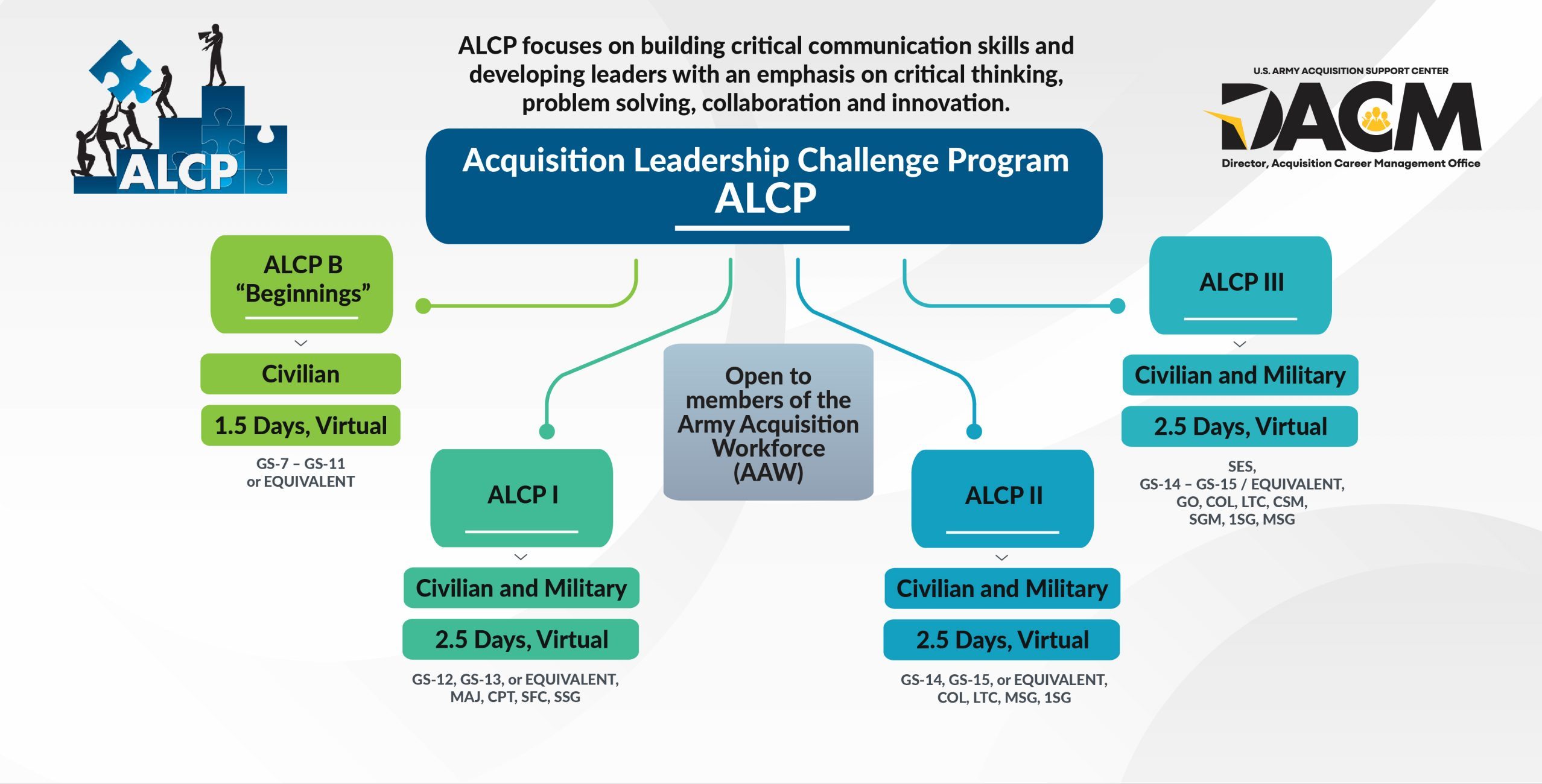
The Acquisition Leadership Challenge Program (ALCP) is a tiered leadership development seminar offered at four levels designed to strengthen self-awareness and leadership capability across the Army Acquisition Workforce (AAW). Each level builds on previous experience and supports leadership development at different stages of a participant’s career. The four program levels are:

Select a tier below for more information about the specific program offering:

Target Grades: Civilian AAW members GS 7-11 or broadband equivalent

Course Length: 1.5 days (Virtual)

ALCP B focuses on building a solid foundation for new hires to assimilate effectively and efficiently into the federal civil service and acquisition workforce. By introducing participants to their behavioral preferences and leadership tendencies, participants are given the “big picture” of three consistent challenges faced by professionals serving in the DoW; mission requirements versus available resources (Future Years Defense Program (FYDP) / Program Objective Memorandum (POM) /Authorization & Appropriation); responsibility, accountability and authority, where they fit into the system by becoming effective followers and finally providing some basic “rules of engagement” on social, cultural and legal expectations in the workplace (understanding generational perceptions including dress, communication and basic behavior through a series of mentoring “do’s and don’ts”). The goal is to mitigate frustration and misunderstanding.

Participants complete three credentialed assessments prior to and during class that will be introduced during key segments of the course to provide personal insight on how each individual is unique and how we apply our uniqueness to multiple leadership development applications.

ALCP B provides a solid foundation, common language and common expectations for both ALCP I and eventually ALCP II.

Objectives:
  • Develop an awareness of individual leadership strengths, weaknesses, preferences, styles, and behaviors.
  • Introduce the concept of “multiple ideas”.
  • Learn a model for followership.
  • Assess and understand preferred styles for approaching leadership in individual and team settings.
  • Experience leadership styles in a work group activity.
  • Identify acceptable behavioral “norm” for the workplace.
Modules of Instruction:
  • Introduction
  • Mission Challenges – “The Big Picture”
  • Leadership and followership – MBTI
  • The Challenge of Change – CSI
  • Handling Interpersonal Relations – FIRO-B
  • Surviving the Workplace

Target Grades: Civilian AAW members GS-12/13 or broadband equivalent; Military AAW Captains and Majors; Staff Sergeants and Sergeants First Class

Course Length: 2.5 days (Virtual)

ALCP I focuses on the individual with emphasis on who they are, their behavioral preferences and leadership tendencies and how those preferences work for them now and in the long term. Participants are presented with a model of leadership dynamics to facilitate their understanding of how a variety of psychological instruments results indicate how an individual approaches leadership challenges in different scenarios addressed such as change, decision making and conflict resolution.

The instructional methodology uses a combination of:

  • Assessment and Feedback
  • Group Discussion
  • Experiential Activities and Goal Setting
  • Application to the group’s current challenges

Participants complete five credentialed assessments prior to and during class that will be introduced during key segments of the course to provide personal insight on how each individual is unique and how we apply our uniqueness to multiple leadership development applications.

ALCP I is targeted for those individuals in the organization who are now being asked to lead smaller groups and “worry about things other than themselves.”

Objectives:
  • Develop an awareness of individual leadership strengths, weaknesses, preferences, styles, and behaviors.
  • Understand and apply “multiple ideas”.
  • Learn a model for understanding and appreciating leadership challenges.
  • Assess and understand preferred styles for approaching leadership in individual and team settings.
  • Experience leadership styles in a work group activity with a shared and executable vision.
  • Identify and understand key organizational cultural traits that impact the organization’s performance.
  • Develop an awareness and appreciation for multigenerational and cross-cultural environments.
  • Create a list of attainable goals and practical strategies to reach them and appreciate the concept of life-long learning.
Instruments:
  • Myers-Briggs Type Indicator (MBTI)
  • Change Style Indicator (CSI)
  • Fundamental Interpersonal Relations Orientation – Behavior (FIRO-B)
  • Thomas-Kilmann Conflict Model (TKI)
  • Decision Style Profile (DSP)
Modules of Instruction:
  • Introduction
  • Leadership Styles – MBTI
  • Influence and Power – Decision Style Profile
  • Leading Across Generations
  • Building Resilience in the Changing AQ World – CSI
  • Managing Conflict in the workplace – TKI
  • Managing Interpersonal Relations – FIRO-B
  • Understanding Multiple Ideas
  • Understanding the Acquisition Enterprise
  • Understanding the Acquisition Culture

Target Grades: Civilian AAW members GS-14/15 or broadband equivalent; Military AAW Lieutenant Colonels and Colonels; Master Sergeants and First Sergeants

Course Length: 2.5 days (Virtual)

ALCP II focuses on the major challenge for new organizational leaders: how to incorporate individual talents into a cohesive workforce. To be prepared to do so, they need to understand the motivations, needs and interests of other people. The goal is to bring each participant to a heightened level of self-awareness for better understanding and appreciation of different cultures and to promote a willingness to build intrinsic and extrinsic value in their organization.

Rather than trying to provide prescriptive answers to the management problem of the moment, this seminar prepares participants who already have significant challenges in an organization facing change. Participants will learn the tools to build a shared and executable vision, enhance self-awareness and engage in continuous self-assessment and development, fostering their commitment towards life-long learning.

The seminar will help prepare individuals for developing and implementing coherent strategies to lead organizational transformation in joint, interagency, multinational and cross-cultural environments.

This program is designed for individuals entering environments where a strategic grasp of the moral, social, and ethical implications of the 21st-century information age is essential for effective leadership.

The instructional methodology uses a combination of:

  • Assessment and Feedback
  • Group Discussion
  • Experiential Activities and Goal Setting
  • Application to the group’s current challenges

Participants complete six credentialed assessments prior to and during class that will be introduced during key segments of the course to provide personal insight on how each individual is unique and how we apply our uniqueness to multiple leadership development applications. Included in the ALCP II is the Campbell Leadership Index (CLI) – a comprehensive 360° assessment.

ALCP II is targeted for those individuals in the organization who are in a group level of leadership. They are now being asked to manage an organization.

Objectives:
  • Reinforce and heighten an awareness of leadership strengths, weaknesses, preferences, styles, and behaviors.
  • Embrace “multiple ideas”.
  • Gain deeper insight into how personal style and preference impact individual, team, and organizational performance.
  • Gain an understanding of the dynamics of conflict by learning to identify its nature, sources, and techniques to influence the outcome, especially in cross cultural environments.
  • Improve group communication and develop strategies to lead organizational transformation across multigenerational and cross-cultural environments (joint, interagency and multinational).
  • Explore how collaboration and effective peer relationship strengthens coherent strategies and organizational success with a shared and executable vision.
  • Create a list of attainable goals and practical strategies to reach them and continue to appreciate life-long learning.
Instruments:
  • Myers-Briggs Type Indicator (MBTI)
  • Change Style Indicator (CSI)
  • Fundamental Interpersonal Relations Orientation – Behavior (FIRO-B)
  • Thomas-Kilmann Conflict Model (TKI)
  • CLI 360° Assessment
  • Influence Style Indicator (ISI)
Modules of Instruction:
  • Introduction
  • Managing Leadership Styles – MBTI
  • Executing Change in the AQ World – CSI
  • The Dynamics of Conflict in the workplace – TKI
  • Creating Interpersonal Relations – FIRO-B
  • Applying your Influence Style – Influence Style Indicator
  • How others view you – CLI
  • Embracing Multiple Ideas
  • Leading Across the Acquisition Enterprise
  • Leading in the Acquisition Culture

Target Grades: Civilian AAW members GS-14/15 or broadband equivalent and Senior Executive Service Acquisition Professionals; Military AAW Lieutenant Colonels, Colonels and General Officers; Master Sergeants, First Sergeants, Sergeants Major and Command Sergeants Major

Course Length: 2.5 days (Virtual)

ALCP III is an opportunity for further sequential development of leadership skills in areas not heretofore included in ALCP I or II. The focus is on mentoring, coaching and feedback skill development as well as the ability to measure and assess influence style and work engagement profiles. Greater participant engagement is employed, involving specific goal setting and comparison of improvements made in their leadership style and effectiveness through use of the Campbell Leadership Index (CLI) 360° Assessment.

Since people thrive on feedback and information and the first duty of a leader is to grow more leaders, the best leaders know how to provide feedback in a non-threatening manner. Participants will learn to understand the characteristics of what it takes to successfully deliver and receive feedback and further develop coaching and mentoring skills by a practical application of “how to” elements.

Fine-tuning leadership’s ability to reach up, down and across the aisle for the sake of the overall good is critical to eliciting optimum individual performance. The program is designed to address previously unmet leadership development needs from critical thinking, strong influencing skills and boundary spanning practices.

Objectives:
  • Reinvigorate past participants with analysis of results from the CLI 360° Assessment.
  • Measure individual level of work engagement and intrinsic motivators.
  • Understand an individual’s preferred style as they influence others.
  • Improve the ability to connect with others using a variety of influencing styles.
  • Successfully practice delivering effective performance feedback.
  • Apply the constructs of an effective coaching session.
  • Assess coaching strengths and developmental needs.
  • Set specific and measurable leadership goals.
Instruments:
  • Work Engagement Profile (WEP)
  • CLI 360° Assessment
  • Influence Style Indicator (ISI)
Modules of Instruction:
  • Program Opening, Introductions, Expected Outcomes
  • Understanding and Defining Your New Role
  • Power and Influence/Value Alignment
  • Influence Style Indicator – Use of Influence
  • Work Engagement – How Engaged Are You?
  • Multi-Rater Feedback – Connecting the Dots
  • Mentoring/Coaching/Feedback – Understanding the Continuum
  • Leader as Coach
  • Coaching Practicum
  • Organizational Culture – How Cultures Effect Individual Performance
  • Strategic Visioning – Thinking Across Boundaries
  • Next Steps – Application to Current Work Environment
  • Setting specific and measurable leadership goals

Eligibility

ALCP applicants will submit their reservation requests in the Events Management section of AITAS (ATRRS [Army Training Requirements & Resources System] Internet Training Application System).

  • Acquisition Leadership Challenge Program B (Beginnings): GS‐07 – GS‐11 or equivalent.
  • Acquisition Leadership Challenge Program I: GS‐12/13 or equivalent, Captains, Majors, Staff Sergeants and Sergeants First Class.
  • Acquisition Leadership Challenge Program II: GS‐14/15 or equivalent, Colonels, Lieutenant Colonels, First Sergeants and Master Sergeants.
  • Acquisition Leadership Challenge Program III: GS-14/15 or equivalent and SES, General Officers, Colonels, Lieutenant Colonels, Command Sergeants Major, Sergeants Major, First Sergeants and Master Sergeants that have taken ALCP I or II.

How to Apply

Applications for ALCP are submitted via the Training Events module of AITAS. Applicants may also check the status of their applications within the Training Events module.

Once an application is submitted, the application is routed to the employee’s supervisor for review/approval. If the supervisor approves the application, the application is routed to the ALCP PM for consideration. Once eligibility is confirmed by the ALCP PM, applications are processed in alignment with command quota allocations. When the ALCP PM processes the application, the applicant will receive a system-generated email from AITAS notifying them of their reservation, waitlist, or disapproval. After enrollment is confirmed, pre-course assessments will be provided by the course vendor to approved applicants. Students who apply are expected to lock in their plans to attend and perform their pre-course work on time.

Quick Start Guide

Resources

Program in Action

Contact

Kelly Quigley
ALCP Program Manager
USAASC, Army DACM Office
520-671-0145
kelly.n.quigley.civ@army.mil