
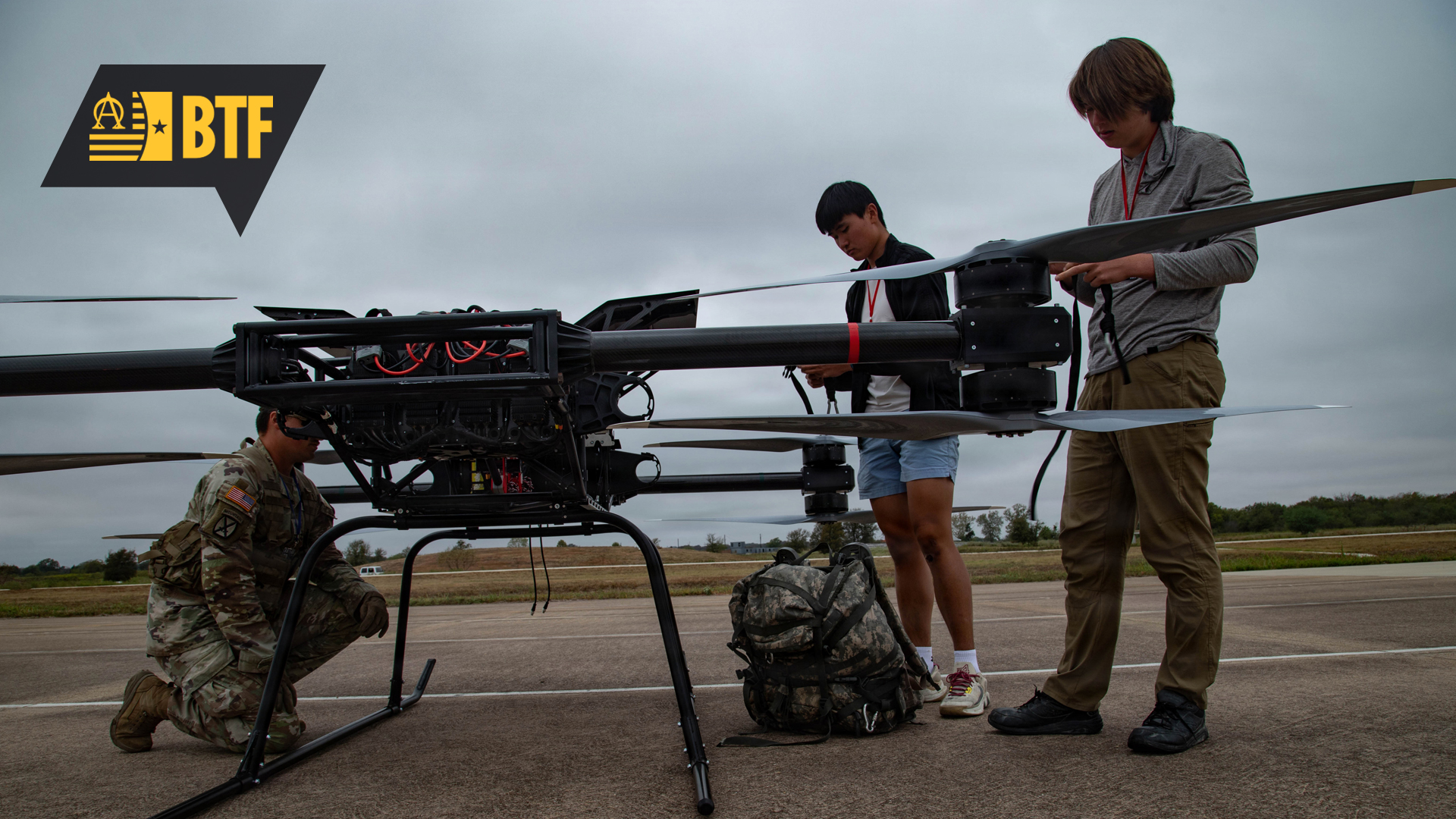
U.S. Army Transformation and Training Command hosted xTech Overwatch for Unmanned Systems Oct. 27-29, 2025, at the Bush Combat Development Center – Innovation Proving Ground in Bryan, Texas, which provided industry partners and academia the ability to continue development integrated within the Army. (Photo by Master Sgt. JaJuan S. Broadnax, U.S. Army Transformation and Training Command)
FUZE: THE ARMY’S NEW VC MODEL
by Maj. Joseph Aumendo
Traditional approaches to Army prototyping efforts have been known to move at a lackluster speed, letting ideas gather dust, while near-peer adversaries field “good enough” solutions to operational units. FUZE is the U.S. Army’s flagship innovation program, which adopts a venture capitalist (VC) model to expedite military technology development. Launched in September 2025 with a projected $750 million annual investment, it unifies existing initiatives like xTech, Small Business Innovation Research (SBIR) and Small Business Technology Transfer (STTR), Technology Maturation Initiative (TMI) and Manufacturing Technology (ManTech) to fund emerging commercial and “dual-use” firms. The program aims to get technology from concept to operational prototype within 70 days or less. This model represents a significant shift from the traditional, slow-moving acquisition cycle, embracing a high tolerance for failure in pursuit of rapid technological superiority in the hands of operational Army forces.
KEY COMPONENTS AND HOW THEY FIT
The FUZE model integrates several pre-existing innovation pathways into a single streamlined portfolio. This centralized management serves to harmonize these components, not just discover innovation but to enable it to flourish. The FUZE portfolio encompasses four programs: xTech, SBIR and STTR, TMI and ManTech. Together these programs identify, fund and facilitate the path from concept to production.
xTech Program
The xTech program is the Army’s entry point for announcing and spurring competition within industry through allocating prizes to companies that can solve known operational and technological gaps. It serves as a key “on-ramp” for innovative companies to enter the Global Tactical Edge Acquisition Directorate (G-TEAD) Marketplace—a platform designed to accelerate delivery of equipment and software to the U.S. Army. Successful participants in xTech competitions can receive cash prizes and, once within the G-TEAD Marketplace, can be rapidly awarded follow-on contracts without further competitive limitations. The xTech Counter Strike Competition is a great example of this concept in action. It streamlined user-based assessments to select four companies for follow-on nomination into G-TEAD, awarding $2.5 million to the selected winners.
SBIR/STTR
SBIR and STTR programs provide government funding to small businesses and research partners. Funding through private investors would often result in demand for a large portion of ownership or control, as many of these small businesses are seen as high-risk. In contrast, SBIR and STTR utilizes a “zero-equity” approach, preserving a small business owner’s control of their company. Paired with the VC framework of FUZE, these zero-equity capital investments allow the Army to propel innovative companies aimed at solving validated Army gaps.
TMI and ManTech
TMI and Manufacturing Technology serve to provide funding for de-risking and operationalizing the successful prototypes from the above-mentioned programs. TMI focuses on the rigorous testing and hardening that prototypes must undergo for suitability within the operational environment and Army networks. ManTech provides funding and expertise that ensures readiness of the complex manufacturing processes and capacity to produce the proven technology at scale.
MEASURES OF SUCCESS
FUZE acts as the overarching strategy and model to enable strategic investment and capital into leading innovative companies. It provides the framework for capital loans and banking guarantees. This integrated approach aims to accelerate the discovery, development and deployment of emerging technologies, creating a synchronized innovation ecosystem. Paired with other initiatives, FUZE looks to aid in bridging the well-known “Valley of Death,” where innovative ideas languish in long bureaucratic prototyping phases. FUZE provides a continuous funding and development pathway from bold idea to field-ready, mass-produced capability.
The return on investment for FUZE is not measured by financial gain, but by strategic and operational value. This includes metrics like speed-to-capability, an index to stratify emerging technologies and improved operational readiness based on Soldier feedback. The operational value is weighed against the cost of inaction, which includes the risk of technological obsolescence and the loss of operational advantage to adversaries.
TRADE-OFFS AND DECISION-MAKING
The trade space for cost, schedule and performance is a conscious decision to prioritize speed and minimum viable product performance over perfect solutions. The goal is to get a functional solution to the warfighter in months rather than a perfect one in a decade. Decisions are decentralized, made by subject matter experts, technology scouts and Soldier feedback, rather than through a traditional, centralized program office model.
The FUZE model has significant longer-term implications for both small businesses and the traditional defense industry. For small businesses, it lowers the barrier to entry into the defense sector but also introduces potential vulnerability to shifting strategic priorities from the government. For large defense primes, it creates increased competition from smaller, more agile companies, forcing them to re-evaluate their own innovation strategies.
CONCLUSION
These points only highlight the shifting business dynamic that is both at play in the defense and technology sectors but also engrained in the psyche of acquisition professionals. FUZE, and other acquisition reforms, change the risk environment for all to accept high operational risk as a trade-off for reducing operational risk. This “fail fast” mentality can lead to an 80% solution that lacks the ability to integrate across the entire Army infrastructure, creating a high-tech but fragmented ecosystem with high maintenance costs. Through a cultural shift toward agile processes, as well as closer collaboration with innovators and users, the Army can ensure that these speed-of-relevance pathways deliver not just fast technology, but a sustainable warfighting ecosystem.
For more information, go to fuze.army.mil.
MAJ. JOSEPH AUMENDO is an acquisition officer in the Intelligence-Future Capability Directorate located at Fort Huachuca, Arizona. He holds an M.S. in systems engineering management from The Naval Postgraduate School, an M.B.A from Canisius University and a B.S. in business administration from University of North Carolina at Charlotte. He has served in the U.S. Army for 13 years and has held positions of leadership in Field Artillery, Military Intelligence and now the Army Acquisition Corps.