
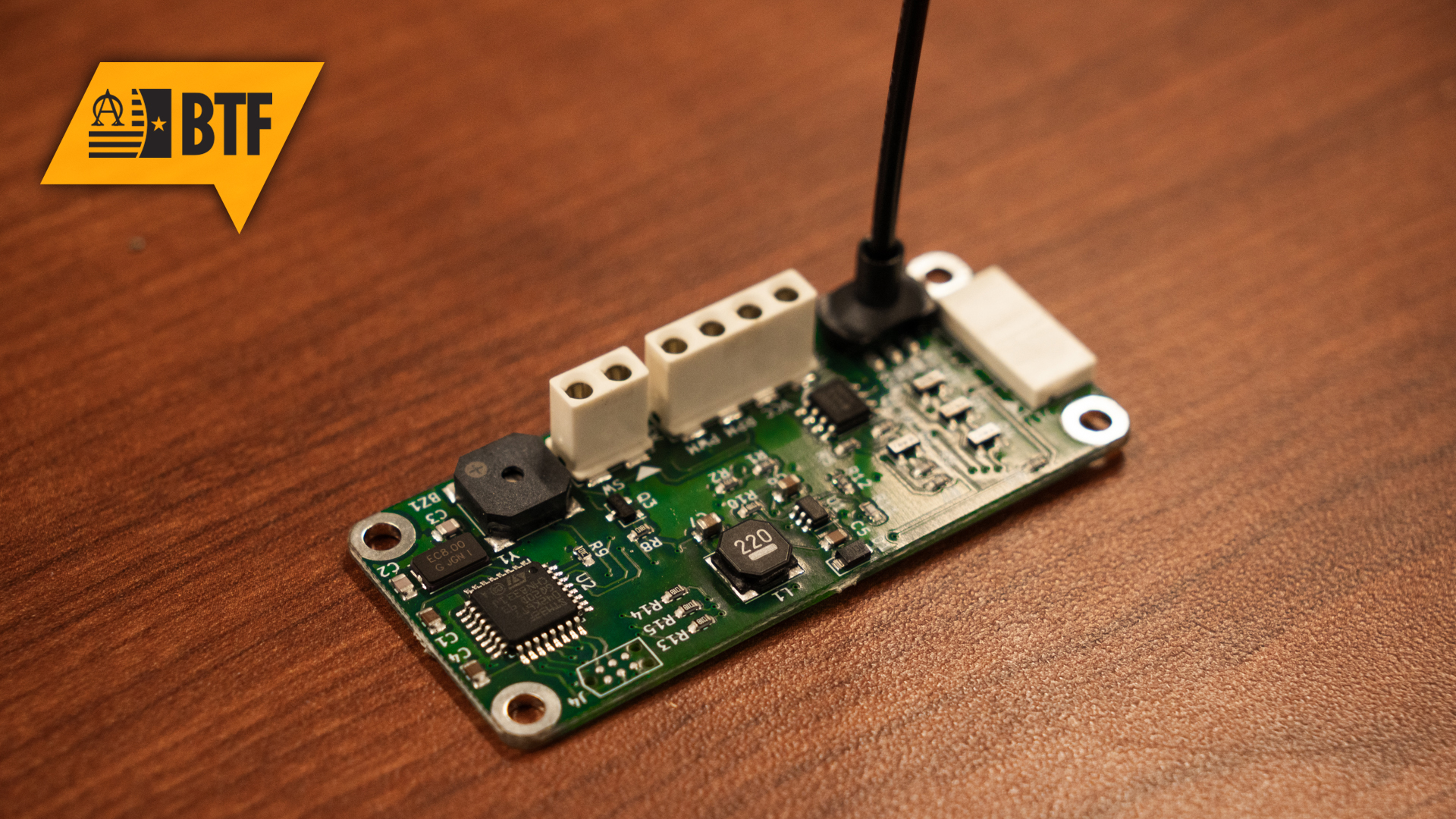
Positive pressure respirator electronics developed by JAKTOOL engineers in Cranbury, New Jersey exemplify scalable control architectures supporting autonomous operation and sensor integration for defense-relevant applications. (Photo by Nicholas Depasquale, JAKTOOL)
by Victoria Kaiser
Soldier systems operating at the tactical edge are failing not because they lack advanced sensors or autonomy, but because they are not engineered with sufficient consideration for the complexities of the battlefield. Power agnostic design, fragile transitions, interface complexity and interoperability, especially in coalition environments, are where reliability measures break down. Systems that succeed are designed from the outset to tolerate non-ideal conditions, treat power and interfaces as first-order constraints, and are exercised early under realistic field conditions. At the tactical edge, complexity does not win, disciplined system design does.
Reliability Is the Engineering Challenge
Modern Soldier systems are not gadgets attached to a human. They are tightly coupled, power-conscious, sensor-rich systems that recognize the Soldier is the system. The engineering challenge is no longer capability. Soldiers in the field need reliability. Cost-benefit tradeoffs are measured in watts, weight and Soldier effectiveness. Successful developers must architect for these costs, iterate robust systems quickly and close the loop between the lab and the battlefield tasks, conditions and standards.
Designing for Non-Ideal Conditions at the Tactical Edge
Environmental sensing wearables on the body introduce persistent non-ideal conditions. Sensors experience constant motion, intermittent shock, temperature variation, moisture and mechanical interference from clothing and equipment. Devices in these conditions that assume stable mounting and fixed transfer functions tend to require frequent recalibration or manual intervention. Unlike consumer wearables, Soldier systems cannot tolerate intermittent failure or periodic troubleshooting during adverse conditions. Treating drift or degradation as an operating mode, rather than an exception, means continued useful operation even as absolute accuracy degrades. Considerations in the design might include:
- Periodic self-characterization and adjustment.
- Signal quality metrics tracked alongside sensor outputs.
- Thresholds defined with margin to allow for or manage intense wartime conditions.
- Logic to handle data absence.
- Logic to handle data unreliability or poor quality.
Power-Intent Architecture and Controlled Transitions
The cost of these design decisions is power consumption. Sampling frequency determines energy consumption, compute placement determines thermal behavior and data storage decisions can have system-wide impact on power draw, interoperability,coexistence and overall firmware architecture. Every milliwatt correlates to battery weight or charge time, and thus, additional burden on the Soldier.
Power-intent firmware architecture is ideal for mission-critical wearables. Design starts with power states as first-class design elements. These states have constraints, such as:
- Entry conditions.
- Exit conditions.
- Allowed behaviors.
- Known costs (watts, latency, data loss risk).
Transitions are explicitly controlled by logic, and are driven by events, thresholds or mission context. Transitions like:
- Moving from low-power monitoring to high-rate sensing at an event boundary.
- Dropping radios before a brownout.
- Throttling compute when thermal margins are exceeded.
- Returning to a degraded-but-functional state after a fault.
Deciding when higher-power sensing or processing is justified, or when to execute a transition can rely on discrete comparisons or control inputs.
A lightweight edge machine learning model (Edge ML), applied narrowly and within the logic, can support event detection, classification and data reduction. The system might run a low-duty-cycle classifier to detect a meaningful change in state—movement onset, exposure threshold or environmental transition—and inform the state transition. It must be architected with the same discipline and be bounded, confidence-aware, power-conscious and operate within the explicit firmware state logic for the system to gain power efficiency.
Using Edge ML as a control input increases the number of system behaviors that depend on context rather than static thresholds. Validating those behaviors requires rapid integration and exposure to real operating conditions.
Learning Early Through Integration and Field Exposure
Exposure to field conditions trains and validates models, and failure modes such as extended wear, thermal soak, radio frequency congestion and interaction with adjacent systems which may not be present in laboratory conditions. Incorporating instrumentation into the prototype for field testing gains diagnostic data to guide design iterations and distinguish design flaws from usage effects. Systems that generate this data early close the loop faster and require fewer redesign cycles.
As systems are exercised under real operating conditions, they are measured against an individual operational mission profile/mission summary (OMP/MS) requirement. Wearables, radios, weapons, optics and power distribution increasingly share physical, electrical and logical interfaces. Many of the failure modes exposed through rapid integration are not internal to a single device but emerge at those interfaces and seams where individual OMP/MS requirements fail. Design decisions around connector pinouts, voltage domains, timing budgets, data schemas and firmware update paths are often optimized locally and validated in isolation, then discovered later to be incompatible with adjacent systems under real operating conditions.
Interoperability, Delay and the Cost of Waiting
What consistently emerges from fielded programs is that delay, not imperfection, is the dominant risk. Systems optimized for laboratory validation but withheld from operational exposure, exposure to other intellectual property-controlled systems, accumulate hidden technical debt—power assumptions, interface fragility and human interaction failures—that surface only when correction is most expensive or no longer possible.
Jeff Kinsberg, founder and chief operating officer of JAKTOOL, frames this challenge bluntly: “Every program says they’ll get to field testing eventually. The ones that fail are the ones that believe waiting makes them safer. It doesn’t. The opportunity cost of improvement quickly outweighs any immediate benefit, and it just guarantees that the first time the system meets reality is when you can no longer afford to change it.”
According to Kinsberg, the choice is not between speed and rigor, but between learning early under control or learning late under consequence. Systems that are integrated and exercised early (while power margins, firmware logic and interfaces are still malleable) expose failure modes when they can still be engineered out. Systems that wait for maturity discover those same failures in deployment, where they persist for the life of the platform.
Nowhere are the challenges of operating at the tactical edge more acute than in coalition environments, where systems must function seamlessly across services and nations. Barton H. Halpern, Ph.D., a recognized authority on the technologies that enable modern warfighters, knows this best. As a retired former director of the Army Research Office, he shaped large-scale research and development investments in sensing, networked systems and operational autonomy, making his perspective especially relevant to the challenges at the tactical edge.
Drawing on his experience shaping multinational defense capabilities, Halpern underscores why interoperability and standards must be treated as foundational technical constraints from the outset. “Rapidly formed coalition forces often face critical, real-time interoperability gaps due to compressed timelines that prevent traditional, in-depth integration exercises. Because these coalitions must often ‘fight tonight,’ they lack the time to bridge gaps in doctrine, communications and critical interface systems. Interoperability and standards must be treated as early technical design constraints,” Halpern said.
Interoperability is frequently framed as a policy concern. In practice, it is an engineering constraint and often a result of national intellectual property concerns. Systems that scale treat interfaces as contracts. Practically, this means a few things:
- Conservative voltage domains and tolerance margins.
- Explicit timing assumptions that are documented and enforced.
- Data interfaces designed to degrade predictably.
- Update mechanisms that do not assume exclusive control of the platform.
Integrating and field testing early can incorporate incompatibilities in early iterations before deployment where they are difficult to correct and often persist for the life of the system. The central lesson that emerges across these systems is not one of increasing sophistication, but of increasing discipline. At the tactical edge, complexity does not equate to capability, reliability does. A frozen interface, a “signal not found,” or a system that requires troubleshooting under stress is not a minor defect; it is a mission failure in a life-threatening environment.
Systems must be architected so that structure, clear subsystem boundaries and disciplined interfaces absorb uncertainty rather than amplify it. Only through deliberate system design, where power, transitions, failure modes and interoperability are treated as first-order constraints, can technology remain dependable amid harsh, unpredictable conditions.
The future Soldier system is not predicted. It is characterized through measured behavior under stress and shaped by rapid exposure to reality. As Kinsberg puts it, “Perfection in the lab is comforting. Survivability in the field is decisive … and you only get there by showing up early.”
For more information, contact JAKTOOL to learn more about current programs and fielded solutions.
VICTORIA KAISER is an electrical engineering design supervisor specializing in power-constrained sensing systems and Soldier-centric system design. She holds an M.S. in electrical engineering from Rutgers University and a B.S. in electrical engineering from the University at Buffalo.
CONTRIBUTORS
BARTON H. HALPERN, Ph.D., SES (Ret.), is the co-founder and principal of Halpern Strategic Services LLC, a consulting firm specializing in science and technology, policy development, advocacy and research and development management.
JEFFREY KINSBERG is founder, chairman and chief operating officer of JAKTOOL.
CHRISTOPHER GANDY is the director of business development at JAKTOOL.
Recent Posts
Read more of our recent Behind The Frontlines Posts.