
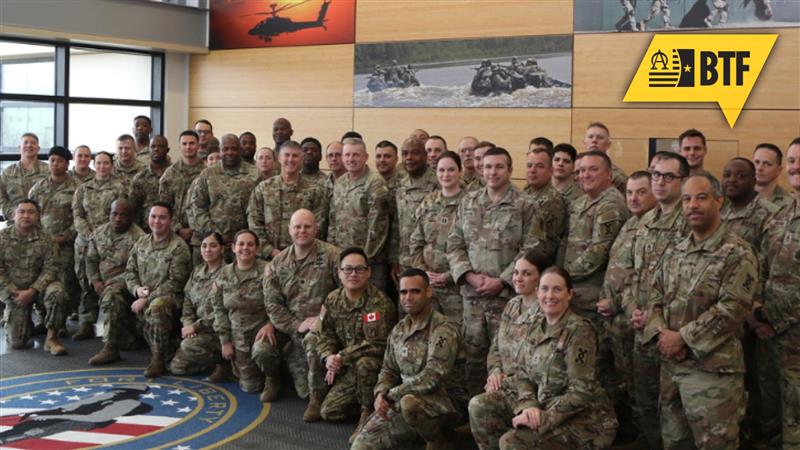
Contracting personnel assigned to the 419th Contracting Support Brigade and members of the 143rd Expeditionary Sustainment Command posed for a photo during their Warfighter Exercise at Fort Bragg, North Carolina, February 2025. Soldier conducted 51C contingency contracting operations using AI simulations and the Maven Smart System. (Photo courtesy of Tish Williamson, U.S. Army Mission and Installation Contracting Command)
THE ALGORITHMIC BATTLEFIELD: FORGING THE U.S. ARMY’S FUTURE DOMINANCE WITH A NEW BREED OF ACQUISITION LEADER
by Lt. Col. Aditya S. Khurana
Imagine a world where artificial super intelligence conducts combined arms warfare across all domains of war, using quantum computing, robotics, predictive logistics and nanotechnology. This vision, once the realm of science fiction, is rapidly becoming a strategic reality, as outlined in the U.S. Army’s concept for multidomain operations. As artificial intelligence (AI) technologies become integral to modern warfare, it is critical to identify and address gaps in current acquisition strategies related to AI threats, ethical considerations, necessary infrastructure and cost-effectiveness. By 2030, AI supremacy will likely equal military supremacy as the militarization of AI has severe implications for global security, according to a United Nations University article, “Militarization of AI Has Severe Implications for Global Security and Warfare.”
The transformation of the 51C workforce (officers and noncommissioned officers, or NCOs) from traditional transactional roles to strategic acquisition leaders is essential for empowering personnel to navigate the complexities of modern algorithmic procurement effectively. Upskilling in AI, cybersecurity, ethics and energy markets will enhance capabilities, build public trust through transparency and ensure alignment with military objectives. The Army has already begun exploring these concepts by launching pilots to use generative AI for acquisition activities. Ultimately, forging AI dominance through strategic adaptation and workforce development is critical to securing the U.S. Army’s supremacy on the multidomain algorithmic battlefields of tomorrow.
THE NEW STRATEGIC IMPERATIVE: AI IN MODERN WARFARE
The global military landscape is undergoing a profound transformation driven by technology, with AI at its epicenter. The character of warfare is shifting, demanding immediate and decisive adaptations in the Army’s acquisition strategies to ensure operational aptitude and effectiveness. AI is no longer a peripheral advantage but a cornerstone of military operations, influencing everything from strategic-level decision-making to tactical execution. It enhances operational efficiency, provides unparalleled analytical capability, and is fundamentally reshaping future geopolitical scenarios.
Nations are in a race to integrate these technologies, understanding that the military that can best harness AI will hold a significant advantage.
This isn’t merely a race to build autonomous weapons, it’s a strategic imperative to establish cognitive overmatch, dominating the intellectual and decision-making process battlespace, effectively turning modern warfare into a high-stakes game of speed chess. The advantage does not go to the player with the most pieces, but to the one who can process the state of the board, identify patterns and constantly execute decisive moves while their opponents are still thinking. AI provides unmatched cognitive velocity, data processing and analysis of information at a speed and scale impossible for humans, turning vast datasets from the battlefield into actionable intelligence and productive decisions. As the conflict in Eastern Europe has demonstrated, the effective use of AI for target recognition, data analysis and drone operations can be a decisive factor, allowing a smaller, technologically adept force to challenge a larger adversary. The U.S. Army must not only keep pace, but lead and dominate in harnessing these technologies to maintain national security, as outlined in its Army Futures Command Concept for Maneuver in Multi-Domain Operations 2028.
IDENTIFYING THE GAPS: A SYSTEM UNDER STRAIN
The primary challenge is that the Army’s current acquisition strategies were designed for an industrial age of hardware, not a digital age of software. The rapid, iterative development cycles of AI are often too fast for these slow and rigid processes to accommodate. Consider the Federal Risk and Authorization Management Program (FedRAMP), a mandatory security vetting process for cloud technologies. The authorization timeline, typically lasting between 6 and 18 months, serves as a significant bottleneck, preventing the timely deployment of cutting-edge AI tools and creating a substantial lag between commercial innovation and government implementation. This creates critical gaps:
- Threat integration: Current frameworks are at risk when they lack the agility to address specific AI-related threats, such as adversarial AI designed to deceive or disrupt U.S. systems, or the rapid proliferation of low-cost, AI-enabled drones. Active concerns prohibit the use of AI from adversarial nations within federal agencies.
- Ethical and legal frameworks: Lethal autonomous weapons have often dominated the debate around military AI, but the ethical implications are far broader, covering decision-support systems, intelligence analysis and predictive logistics. We must build acquisition strategies with ethical considerations and legal compliance from the ground up to ensure responsible deployment and public trust.
- Infrastructure and talent: AI requires a robust digital infrastructure, including secure cloud computing and massive datasets for training models. Equally important is a 51C workforce that understands this technology not just technically, but strategically.
- Cost-effectiveness: To ensure long-term cost-effectiveness, the acquisition model must shift from high-risk, monolithic procurements to a sustainable and iterative investment buildout. This approach treats the initial investment not as a final, static solution, but as a foundational capability, a “digital backbone” upon which we build future advancements. Each subsequent funding cycle then acts as a force multiplier, leveraging the established infrastructure, accumulated data and operational feedback to deliver progressively more advanced capabilities for a fraction of the initial cost. This creates a powerful compounded growth effect; the more we use and invest in the system, the more effective and efficient it becomes. This ensures that each dollar contributes to a perpetually improving and strategically dominant asset, rather than a depreciating one.
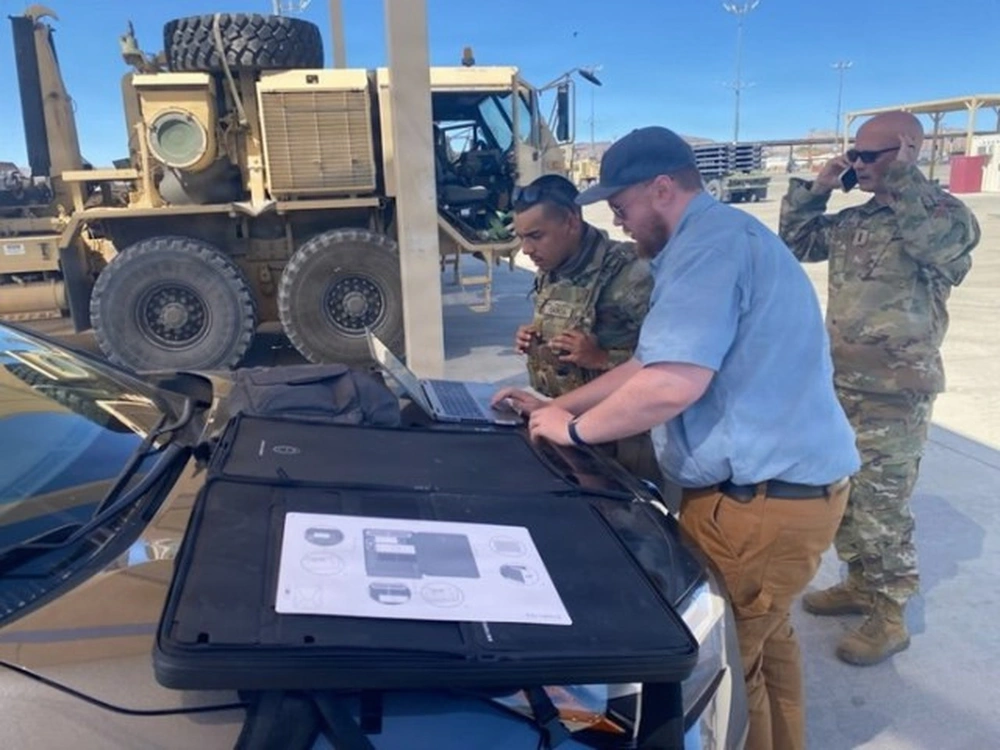
AI tools are becoming critical to modern warfare. In this photo, Sean Murphy works alongside Soldiers on the artificial intelligence assisted maintenance (AIAM) tool during a test at the National Training Center on Fort Irwin, California. (Photo by Kevin Lagowski, U.S. Army Communications-Electronics Command)
THE HUMAN-CENTRIC SOLUTION: RE-FORGING THE 51C WORKFORCE
The most critical component of this transformation is human talent. There is a pressing need to evolve the role of the 51C workforce, from transactional managers to strategic acquisition leaders. In the current paradigm, many are relegated to executing manual tasks and navigating bureaucracy. They must become architects of acquisition policy, capable of shaping and executing strategies as dynamic as the technologies they procure. This transformation requires a deliberate expansion of their skill sets to navigate the complexities of modern algorithmic procurement effectively. An AI-ready 51C professional must be a multi-disciplinary leader, ensuring that the Army is not just buying AI, but buying it smartly, securely and ethically. This new role is pivotal for maintaining public trust and ensuring the transparent, compliant and ethical use of AI in all military operations. This approach focuses on developing teams with cross-functional skills.
A BLUEPRINT FOR TRANSFORMATION: ACTIONABLE RECOMMENDATIONS
To cultivate a new generation of acquisition leaders capable of navigating rapidly evolving technologies, the U.S. Army should implement comprehensive training and development programs for its 51C contracting workforce because modern procurement, especially for AI and other advanced technologies, demands far more than traditional contracting skills. It requires a workforce that understands emerging technology, can evaluate complex vendor claims, and can operate confidently in fast‑moving, high‑risk environments, focusing on the following core competencies:
- AI and data analytics acumen: Foundational training in machine learning, data science and algorithmic processes. This enables 51Cs to understand what they are buying, ask the right questions of vendors and identify potential risks like data bias.
- Cybersecurity and digital contracting: Deep knowledge of the unique cyber vulnerabilities of AI systems and the complexities of software-as-a-service and other digital contracting models.
- Compute and energy contracting: Understanding the significant computational and energy resources required by advanced AI models, and how to procure these resources efficiently and securely.
- Ethics and responsible AI: Training in ethical frameworks for military AI to ensure that all acquisitions comply with the Law of War, Department of War directives and a commitment to minimizing civilian harm. This includes building frameworks that address potential biases and ensure human accountability.
- Agile acquisition methodologies: Mastery of modern procurement methods like the Scaled Agile Framework (SAFe) that favor speed, iteration, adaptation and collaboration with industry, moving away from slow, linear acquisition cycles and processes.
- Industrial innovation and market intelligence: Developing the skills to constantly scan the horizon for emerging technologies and build partnerships with non-traditional defense companies, startups and academic institutions, leveraging programs like Army SBIR and xTech.
- Test & evaluation of AI fundamentals CTST 005: Explore AI‑enabled capabilities that impact test and evaluation, including machine learning techniques, relevant AI policies and ensuring reliability. Gain the skills to evaluate supervised machine learning models and develop effective test plans for AI‑enabled systems.
CONCLUSION
The convergence of AI advancements in the constantly evolving global geopolitical and military landscape presents both profound challenges and significant opportunities for the U.S. Army. By transforming acquisition strategies and empowering 51C professionals as strategic, forward-thinking leaders, the U.S. Army can effectively navigate the complexities of procuring next-generation technology. This doctrinal shift, detailed in the Army Futures Command Concept for Maneuver in Multi-Domain Operations, coupled with a deep investment in upskilling and ethical frameworks, will ensure the U.S. Army remains prepared for future multidomain operations and maintains a decisive competitive advantage over its adversaries. Mastering constant AI dominance is more than an operational imperative; it is the fundamental necessity for prevailing in a new age of global competition defined by constantly evolving algorithmic conflict.
For more information, contact the author at Aditya.khurana2.mil@army.mil.
LT. COL. ADITYA S. KHURANA serves as the military deputy director for the Mission and Installation Contracting Command at Fort McCoy, Wisconsin. He holds an MBA in strategic management from the Universidad Del Este and is a certified DAWIA Contracting Professional. He is a 51C contracting officer and his credentials also include specialized certifications in services acquisition and information technology acquisition from the Warfighting Acquisition University. He is fluent in English, Hindi, Spanish and Punjabi.