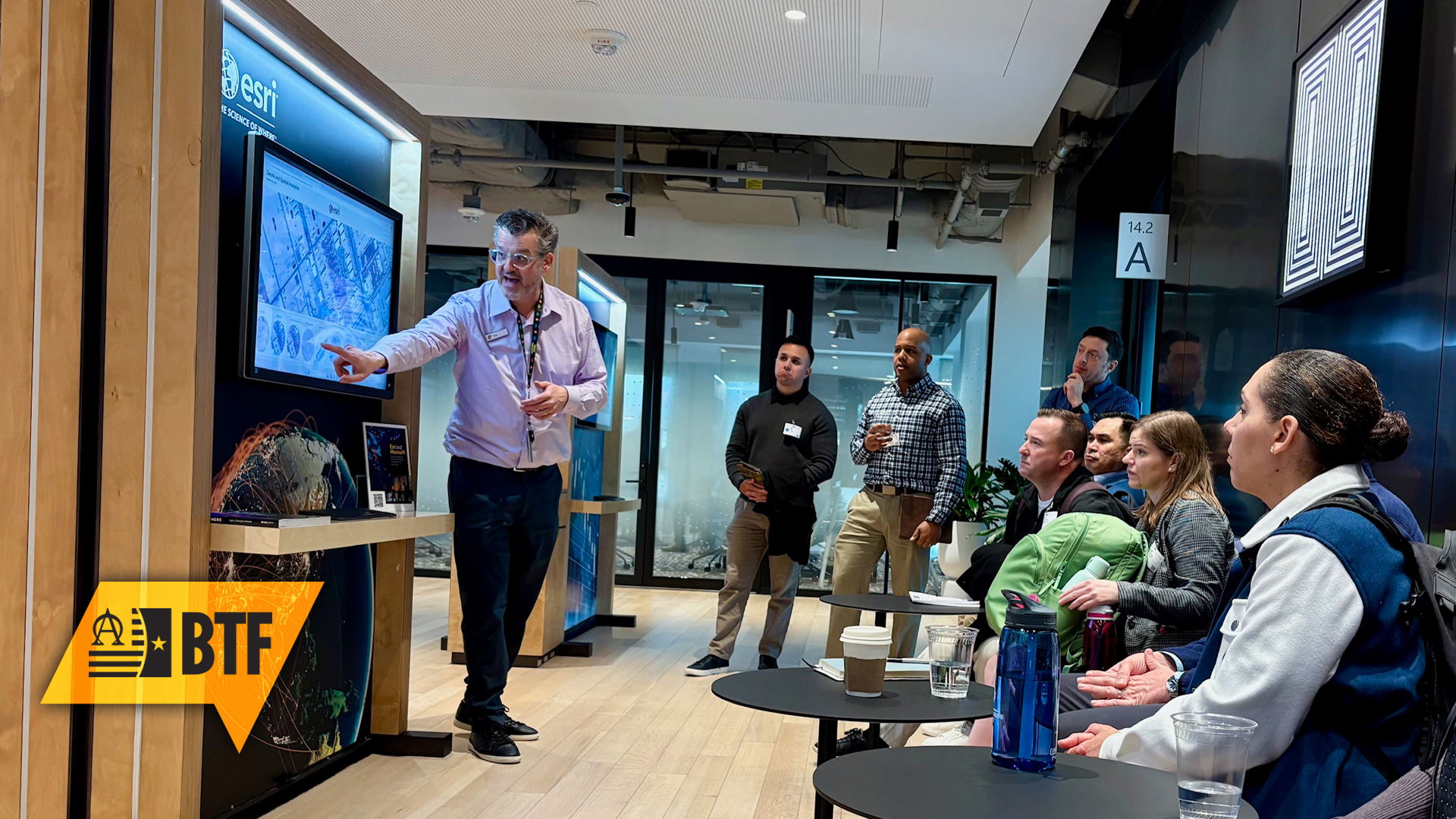
U.S. Army Transformation and Training Command hosted xTech Overwatch for Unmanned Systems Oct. 27-29, 2025, at the Bush Combat Development Center – Innovation Proving Ground in Bryan, Texas, which provided industry partners and academia the ability to continue development integrated within the Army. (Photo by Master Sgt. JaJuan S. Broadnax, U.S. Army Transformation and Training Command)
TWI FELLOWS MEET FOR 2026 MIDPOINT REVIEW
by Jacqueline M. Hames
Training With Industry (TWI) fellows convened for their annual midpoint review Jan. 12-16, 2026, in Arlington, Virginia at Microsoft’s Innovation Hub. The event had an industry day on Tuesday, where fellows received demonstrations on the latest artificial intelligence-enabled technology from Microsoft and heard from defense industry leaders.
The TWI program is a work-experience program designed to provide extensive exposure to managerial techniques and industrial procedures within corporate America to competitively selected officers.
Program participants were welcomed by friendly Microsoft employees in the lobby and then escorted to the Innovation Hub on the upper floors of the building. After a breakfast networking event, fellows gathered in a small theater-style presentation room to hear opening comments from Maj. Douglas Richardson, a fellow currently working at Microsoft. The theme of the day was transformation, and the opening briefings centered on the new acquisition reforms and incorporating artificial intelligence (AI) into operational technologies.
Carmen Krueger, corporate vice president of U.S. Federal, Microsoft, said TWI gives fellows a front row seat to technology incorporation and development with industry. The fellows will have an “outside in perspective” on industry partners after completing the TWI program. It is important to bring that perspective back to the Army to accelerate transformation and “change the game.”
“What our obligation is to do, is to harness that piece of technology [AI] against the mission,” Krueger said, emphasizing that the point of using AI is not to have a shiny new technology, but rather to effectively apply the use of AI to the operational mission in support of the Soldier.
She also advised the fellows that it’s ok to fail while developing technology and transforming the force. “Fail fast,” she said. “That has to be part of any transformational effort, we have to fail, we have to do it fast, and we have to learn and adapt quickly. That’s critical.”
“Military leaders are taking acquisition reform seriously,” said Leigh Madden, vice president of National Security Group, U.S. Federal, Microsoft. He explained that the TWI fellows during this pivotal time in the Army are in a unique position to facilitate change. “Carmen talked about transformation going on everywhere, from corporate to government entities, taking place right now. Our challenge in the United States is that we must transform faster and more effectively,” he said.
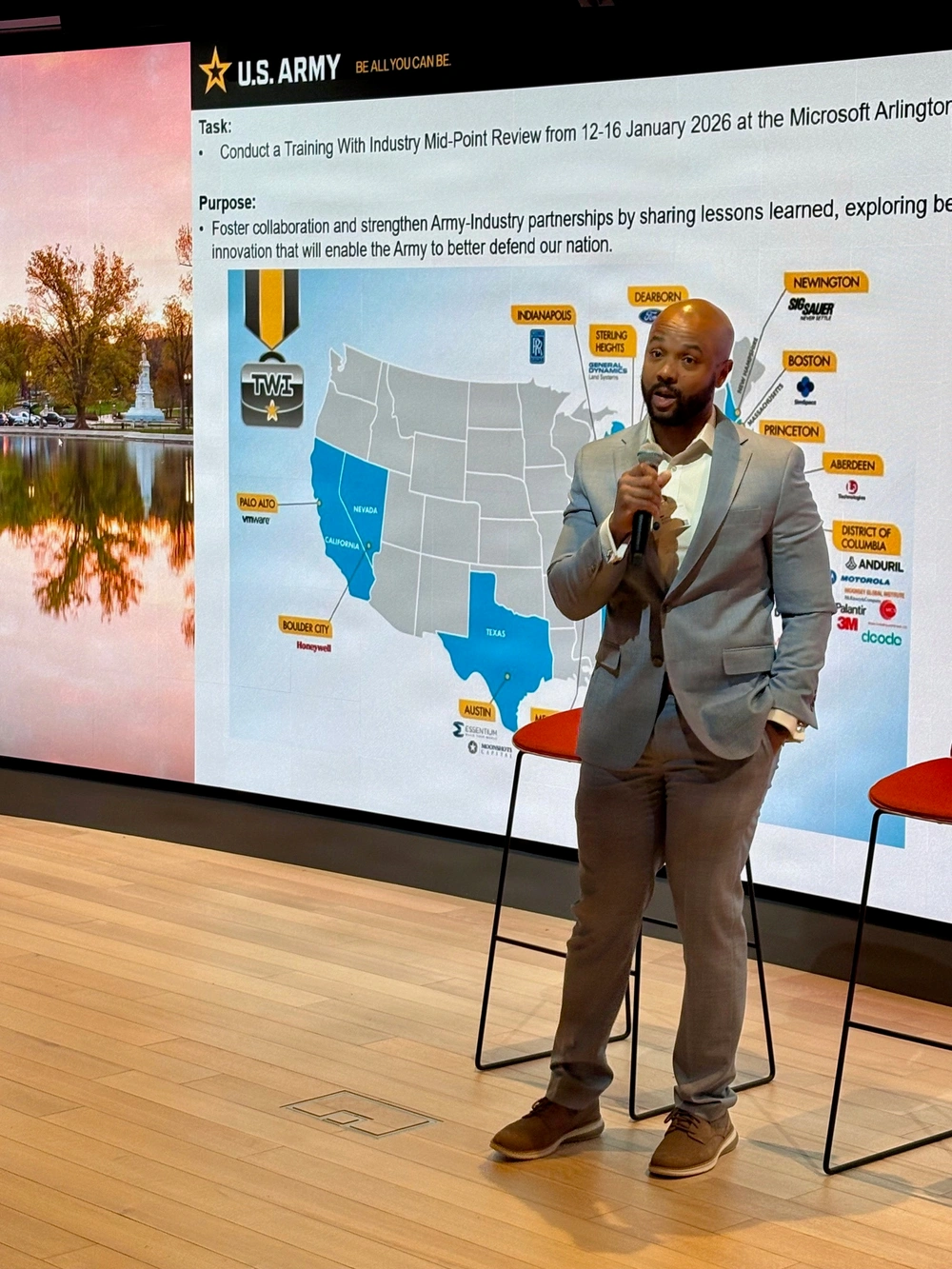
Adam Polite, chief of the DACM Office AAW Proponency Branch, addresses TWI fellows during the January 2026 Midpoint Review. (Photo by Jacqueline Hames, USAASC Behind the Frontlines)
The TWI program helps build trust with industry, Madden continued, and the fellow will be able to build on those relationships when they return to their various commands.
After the opening remarks, fellows were given a tour with several AI-enabled technology demonstrations throughout the Innovation Hub. Microsoft personnel provided a demonstration of Furhat and ESRI during a tour of the Innovation Hub. Furhat is a robotic bust with a human face projected onto it, that can answer questions within a limited dataset. Querents simply make eye contact with the image on the bust, ask their question, and receive a spoken answer. ESRI is an earth-observation satellite technology linked to Microsoft’s Copilot AI assistant that can explore detailed data sets about specific images, such as volcanic activity. Timothy Cashman, principal cloud solution architect at U.S. Federal, Microsoft, then took the fellows through an immersive Copilot demonstration in a classroom setting, asking them to give Copilot various prompts and evaluate the responses.
Fellows had the opportunity to interact and exchange ideas with one another at several points during the industry day. Maj. Sean Jones, a fellow at Ford Motor Company, believes the TWI midpoint review is a great chance for fellows to discuss their findings while with their host companies so that they “can shape what the next six months at that company is going to be like,” he said.
“Ford is really investing into adjusting its culture or adopting this culture of continued improvement,” Jones said of his own observations. “They’ve modeled a lot of that off of other companies that have been successful. They benchmark all kinds of companies—and one of the things that I’ve seen consistent with the benchmark is that they try to learn how other companies are managing big shifts and changes,” he said.
The second half of the industry day involved briefings from Palantir and Anduril, where fellows learned how the Army and industry could be better partners to one another, as well as how to navigate the new acquisition reforms from an industry perspective.
For more information on the TWI program, go to https://asc.army.mil/web/career-development/programs/aac-training-with-industry/.
JACQUELINE M. HAMES is an editor with Behind the Frontlines. She has 15 years of writing, editing and reporting experience with the federal government, and has a B.A. in creative writing from Christopher Newport University.