

An M142 High Mobility Artillery Rocket System (HIMARS) fires during a Lightning Surge exercise with the 25th Infantry Division. The Lightning Surge series experiments with NGC2 capabilities to connect sensors, shooters and commanders, enabling precision effects at the speed of large-scale combat operations. (Photo by Sgt. Duke Edwards, 25th Infantry Division)
by Mason Rowe
Ongoing conflicts have made one lesson unmistakable: The side that can sense, synthesize and act on data faster than its adversary holds the decisive advantage. Modern commanders must be able to operate at the speed of algorithmic warfare and achieve decision overmatch.
The U.S. Army’s Next Generation Command and Control initiative, known as NGC2, was created to meet this moment. NGC2 replaces legacy, stove-piped mission command systems with an open, extensible set of artificial intelligence (AI) tools, warfighting applications and resilient communications to achieve decision dominance against sophisticated adversaries. With the approval of the NGC2 Characteristics of Need in May 2024, the Army established the foundation for a data-centric, cloud-to-edge information ecosystem that will fundamentally change how commanders and warfighters sense, decide and act across all domains. But fielding transformational capability at speed requires an equal transformational approach to test and evaluation.
The U.S. Army Test and Evaluation Command (ATEC) is rising to that challenge. Through digital modernization and a new philosophy of continuous evaluation, ATEC puts critical information into the hands of senior decision-makers early and often, ensuring the Army makes informed choices about the technologies that will shape the future of command and control. This speed is no accident. Since 2023, ATEC has built modernized capabilities within its cloud-based ATEC Data Mesh, ensuring a proven, accredited data and analytics foundation was ready well before NGC2 demanded it.
CONTINUOUS EVALUATION FOR A FAST-MOVING PROGRAM
What makes NGC2 different is not only what it delivers, but how it is being built. Rather than procuring a single, monolithic system from one prime contractor, the Army is deliberately developing NGC2 as a composable, modular ecosystem, co-designed with industry and drawing on a broad base of vendors whose capabilities can be integrated, swapped and improved over time. Just as deliberately, the Army is not waiting for a complete, finished system before putting capability in Soldiers’ hands. Instead, it is fielding an intentional subset of functionality, letting Soldiers fight with it under realistic conditions, and then iterating and expanding in successive cycles based on what is learned.
This changes everything about how the system must be tested. The Department of War’s Acquisition Transformation Strategy calls for faster, smarter and more iterative approaches to delivering commercial-first capability to the warfighter. Traditional test and evaluation models, characterized by lengthy developmental timelines followed by formal operational test events late in the acquisition cycle, are insufficient for a program that is composable, multi-vendor and continuously iterating. A system that evolves every cycle cannot be evaluated by a slow, linear model that delivers a single verdict at the end. ATEC recognized this early and adopted a fundamentally different posture: continuous, embedded assessment that generates actionable insights throughout the acquisition life cycle.
This continuous evaluation campaign is more than a change in terminology. It reflects a deliberate move away from episodic testing toward leveraging all suitable data, whether from vendor testing, simulation, training or operational events, tailored to exactly what acquisition executives and capability program executives (CPEs) need. For NGC2, ATEC employs a three-pronged assessment methodology that encompasses operational assessments, laboratory-based risk reduction and safety testing. Each prong reinforces the others, creating a comprehensive and continuously evolving evaluation picture.
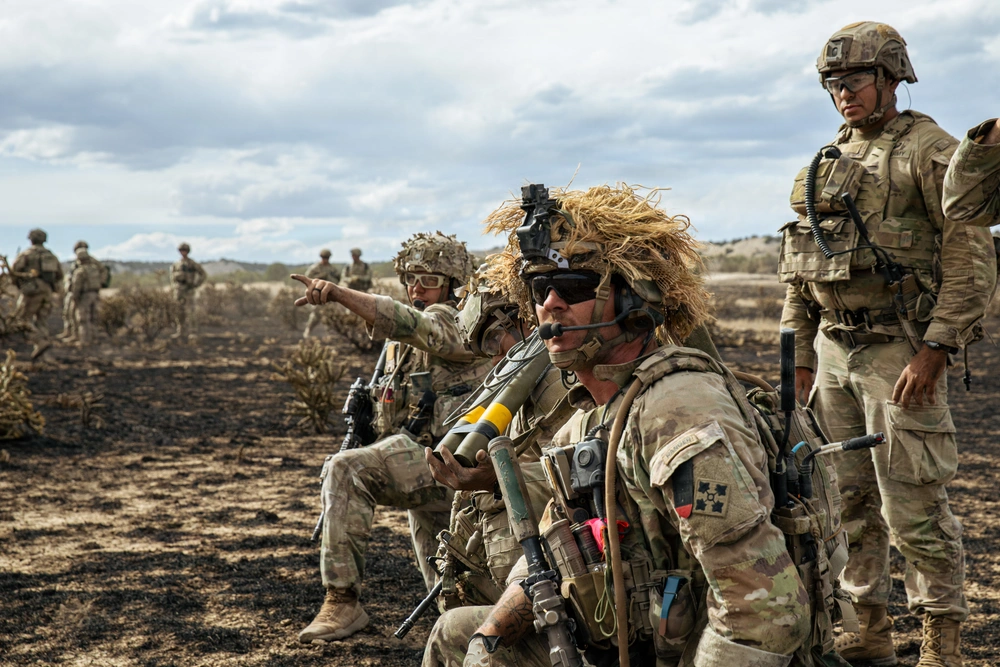
On the operational assessment front, continuous evaluation comes to life through ATEC’s direct support to unit integration events that place NGC2 prototypes in the hands of operational forces under realistic conditions. Over the past year, two vendor teams developed complementary NGC2 architectural approaches based on the mission needs of two operational units: the Ivy Sting/Ivy Mass series with the 4th Infantry Division employed one approach, and the Lightning Surge series with the 25th Infantry Division employed the other. Rather than competing, the two divisions and vendor teams cross-pollinate Soldier feedback and data from different units, missions and theaters. With ATEC collection integrated directly within each prototype, system data is harvested in near real-time and fed into cloud-based analytics, enabling evaluators to identify trends and anomalies as events unfold. Across both series, ATEC has delivered data-driven assessment reports within one to two weeks of event completion, a dramatic improvement over traditional months-long timelines.
Complementing these operational assessments, the NGC2 program established an integration environment within the Combined Joint Systems Integration Laboratory (CJSIL) at Aberdeen Proving Ground, Maryland, partnering closely with U.S. Army Combat Capabilities Development Command (DEVCOM) Command, Control, Communications, Computers, Cyber, Intelligence, Surveillance and Reconnaissance (C5ISR) Center. This integration space provides a long-term, system-of-systems testbed where program offices, ATEC and the science and technology community can continuously iterate, accelerating capability transition to operational units.
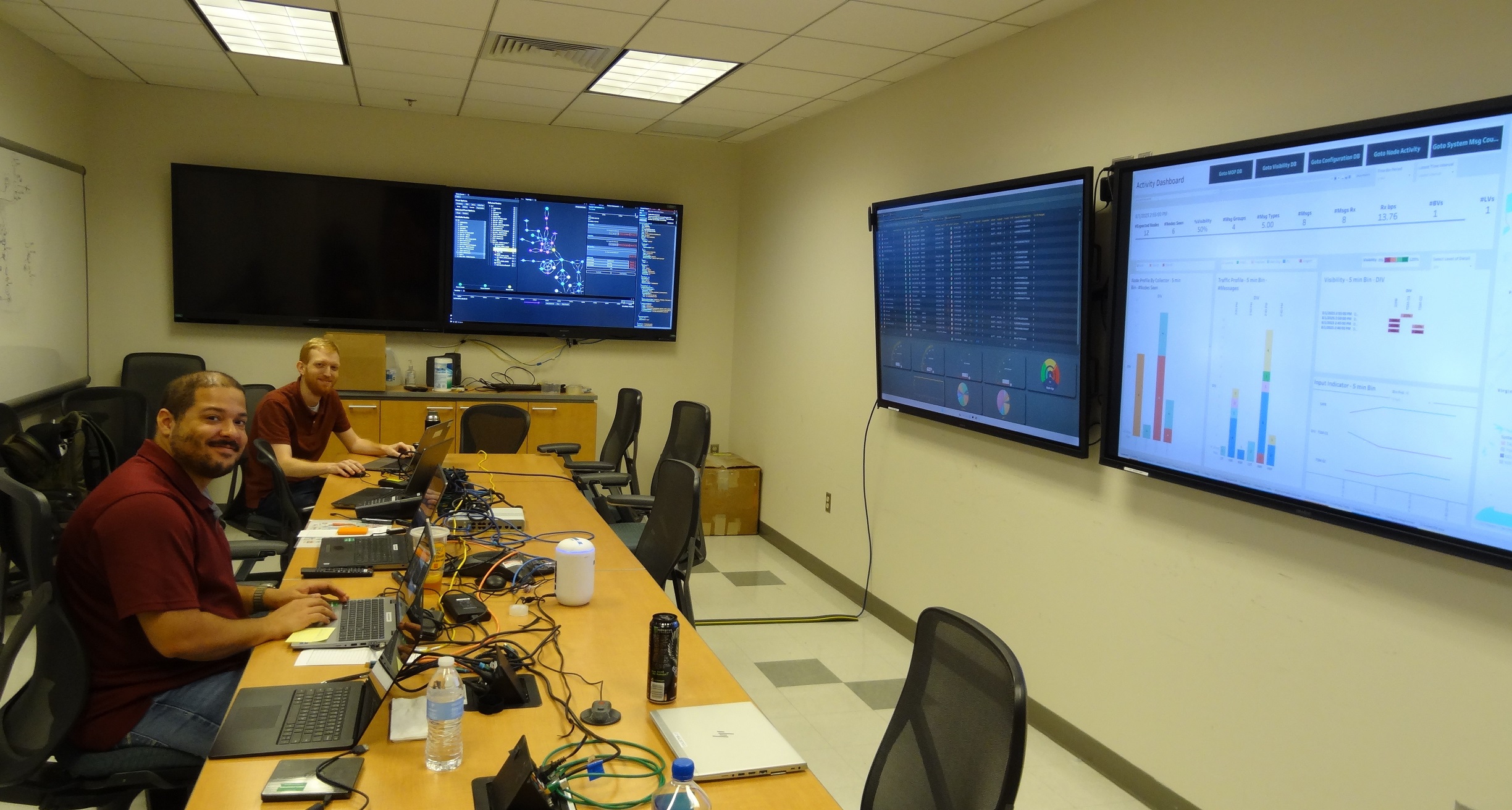
Laboratory-based risk reduction at the CJSIL included the first-ever Data Layer Assessment of the NGC2 prototypes, carried out from October 2025 to February 2026. At the heart of NGC2 lies the data layer, which enables seamless data access, governance, orchestration and integration across tactical nodes. The assessment independently characterized both vendor teams’ architectures, examining data normalization, synchronization and suitability for operations from enterprise cloud to the tactical edge, including under denied, disrupted, intermittent and limited connectivity conditions. This is a unique military requirement: commercial-first technologies assume reliable network access, but on the battlefield they must continue functioning even as adversaries deliberately degrade or deny the network. The assessment team employed a thorough, multi-method approach combining vendor-provided architecture documentation review, technical demonstrations and independent laboratory-based stimulation under multiple network conditions. ATEC has also kept safety testing agile, leveraging emerging technologies to deliver safety releases early and often so they never become a bottleneck.
DIGITAL TRANSFORMATION: THE ATEC DATA MESH
Conducting assessments at the speed and scale NGC2 demands requires modern digital infrastructure, and that is precisely what the ATEC Data Mesh provides. Built on Microsoft Azure with accreditation up to the Secret level, this cloud-hosted data management and analytics platform changes how evaluation data is collected, stored, analyzed and shared across the entire Army test and evaluation enterprise. Unlike the integrated data layer of NGC2, the ATEC Data Mesh is not a tactical warfighting capability; it is an evaluation platform that speeds continual, integrated assessment and the delivery of emerging NGC2 prototype capabilities. It is built around a guiding principle: enable any analyst to access any data, anywhere, to discover, reduce, analyze and visualize.
The ATEC Data Mesh leverages automated pipelines to ingest data from diverse sources, including lab instrumentation, field collection systems, vendor-provided telemetry, and operational observations, making it available for near-real-time analytics. Rather than waiting weeks or months to compile and analyze data manually, ATEC analysts can now access streaming data, run queries and generate insights while events are still underway. This capability was instrumental during the Ivy Sting/Ivy Mass and Lightning Surge operational events and the Data Layer Assessment, enabling the Data Collection, Reduction and Analysis (DCRA) team to identify trends, anomalies and key findings rapidly. Increasingly, ATEC is layering AI onto this foundation to accelerate routine, repeatable tasks such as data reduction and report generation, freeing analysts to focus on higher-order evaluation and judgment. For NGC2 specifically, this means that performance metrics, reliability trends and even security findings can be aggregated automatically across laboratory and field events in near real-time, supporting regression testing and earlier identification of potential vulnerabilities.
The platform also gives evaluators tools for data visualization, statistical analysis and collaborative reporting. Dashboards allow stakeholders, from bench-level analysts to senior leaders, to drill into specific metrics or view high-level summaries. Working closely with C5ISR Center subject matter experts and the program office, the ATEC team exposed data live as it streamed in during test events, helping analysts add context in the moment rather than reconstructing events after the fact. These dashboards proved to be more than a tool for evaluators: the units themselves adopted them, displaying them on the main screens in their Mission Training Centers and daily operational briefs to understand their own network health and troubleshoot issues. This validated a principle at the core of ATEC’s approach: build the tooling once, and it can serve testing, training and operations alike.
Rather than relying on invasive instrumentation suites that can disrupt the pace of unit operations, ATEC’s data collection method for NGC2 taps into the interfaces, protocols and application logs already available within the systems under evaluation, from tactical radios to software-defined networks, tactical edge compute nodes and mission command applications, all in near real-time. Developed with support from C5ISR Center experts, this non-intrusive approach ensures that ATEC can collect the data it needs while allowing Soldiers to integrate with the technology naturally.
COLLABORATION THAT DRIVES RESULTS
None of what ATEC accomplished in NGC2 happened in isolation. The continuous evaluation campaign is the product of deliberate, structured collaboration among stakeholders who each shape ATEC’s evaluation products. The Portfolio Acquisition Executive (PAE) for Command and Control and Counter Command and Control defines the decision space that assessment activities must answer, and every finding ATEC produces informs the PAE’s decisions. The NGC2 product owner, the Command and Control Future Capability Directorate, shapes the evaluation framework and defines the focus areas that guide assessment activities, keeping the evaluation anchored to warfighter requirements rather than abstract technical benchmarks.
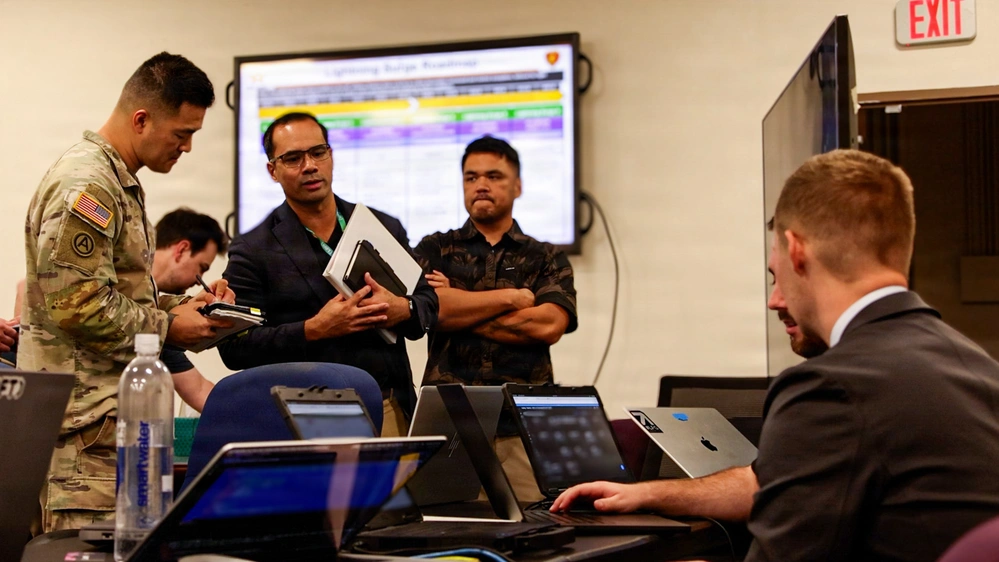
As the acquisition lead, the CPE for Command and Control Information Network (C2IN) ensures assessments focus on capability validation, optimization of decision-making and integration of Soldier-developed and updated tactics, techniques, and procedures. The DEVCOM C5ISR Center provides the lab environment at Aberdeen Proving Ground and contributes technical expertise to the DCRA team, whose testers, engineers and analysts work side by side with ATEC to execute test threads, collect data, and analyze results.
The ATEC Data Mesh serves as the collaborative digital backbone that ties this team together. Rather than working independently and exchanging data through manual transfers, stakeholders from across the NGC2 enterprise are onboarded directly into the Data Mesh cloud environment. DEVCOM centers, program offices, CPEs, vendors and even the 4th and 25th Infantry Divisions access the same data, contribute their own analytics and build data products from a common foundation. This model of shared access has proven to be one of the most powerful outcomes of ATEC’s digital transformation, breaking down barriers between organizations and enabling a pace of insight generation impossible through conventional means.
One of ATEC’s most critical roles is serving as the independent voice that distills complex findings into clear, actionable insights for senior leadership. ATEC’s evaluation products translate the technical complexity of NGC2 into findings mapped directly to the evaluation framework’s focus areas. This data is not a downselect between vendors; rather, it enables the PAE and other senior leaders to understand what each commercial solution does, how well it meets the warfighter’s operational needs, and where risks and opportunities exist. By maintaining its independence, ATEC ensures its insights are technically rigorous and operationally grounded, with particular attention to the security and resilience demanded when adopting commercial-first technologies for military applications. And because every assessment is built on the same authoritative source data, findings can be directly compared and trusted across the team.
CONCLUSION
The work pioneered through NGC2 is proving to be more than a single program success story. ATEC has embraced key innovations in its approach, including the continuous evaluation campaign model, the ATEC Data Mesh, collaborative analytics and non-intrusive data collection methods. The efficiencies have been demonstrated across Ivy Sting/Ivy Mass, Lightning Surge and the Data Layer Assessment events, where the work of collecting data in the laboratory and field has itself produced reusable capabilities such as real-time dashboards. This success is a blueprint for the broader portfolio of Army modernization programs. As ATEC matures its digital infrastructure, expands data standards, and integrates AI and machine learning into the Data Mesh to automate data reduction and optimize test design, it is building an enterprise that can match the pace and complexity of any program the Army pursues.
ATEC is not just keeping pace with the Army’s modernization priorities. It is leading the way in transforming how the Army tests and evaluates the systems of tomorrow.
For more information, go to https://atec.army.mil or https://cpec2in.army.mil/Contact-Us/.
Mason Rowe serves as the chief data and analytics officer within the Digital Modernization Directorate at ATEC, headquartered at Aberdeen Proving Ground, Maryland. He holds an M.S. in computer engineering from Syracuse University and a B.S. in computer science from the University of Delaware.
Recent Posts
Read more of our recent Behind The Frontlines Posts.

Protect Your Time – Tiffanie Bachar

Army Acquisition Hall of Fame Welcomes Four New Inductees in 2026
CECOM ASIC Secures, Accelerates Tactical Communications