
William (Bill) Parker-Combes
COMMAND/ORGANIZATION: U.S. Army Capability Program Executive Enterprise Software and Services/Project Manager Logistics and Finance
TITLE: PM LOG-FIN implementation director and systems engineering director
YEARS OF SERVICE IN AAW: 17
YEARS OF MILITARY SERVICE: 24
DAWIA CERTIFICATIONS: Advanced, program management; Practitioner, engineering and technical management
EDUCATION: M.S. in engineering systems, Naval Postgraduate School; B.S. in computer science, Monmouth University
AWARDS: The International Society of Logistics’ Logistician of the year, Greater Washington Area Chapter (2016); Achievement Medal for Civilian Service (2007); Army Superior Unit Award (2000)
by Cheryl Marino
William (Bill) Parker-Combes’ career with the Army Acquisition Workforce (AAW) highlights the power of continuous learning and adaptability. Joining in the 2000s as a software developer, he consistently embraced change, expanded his skills, and stepped into every challenge with curiosity and drive. Today, that same mindset led him to serve as both the Project Manager Logistics and Finance (PM LOG-FIN) implementation director and the systems engineering director—roles that reflect not just his technical expertise, but his commitment to evolving with the mission.
In this dual role, Parker-Combes is responsible for leading the technical direction, solution design and day-to-day work of the PM LOG-FIN program, working closely with the technical integration provider (prime contractor) and the multifunctional capabilities team (functional sponsor), to meet what the Army needs from PM LOG-FIN.
“My role includes managing a team of skilled solution architects who understand the challenges of past systems and implementations and are focused on creating a streamlined logistics process with integrated financial tools that are audit compliant,” he said, using the Software Acquisition Pathway (DoDI 5000.87) and Agile practices through the Scaled Agile Framework (SAFe) to deliver smaller, usable parts of the system to users faster than traditional methods. “Our team is committed to building a user-friendly system that saves Soldiers and civilians time, reduces training needs and speeds up fielding schedules.”
But what he values most is bringing a project to completion. “We’re asked to do a lot of things, and sometimes those projects or deliverables get shelved,” Parker-Combes said. “Getting to see something to completion, even if it’s shutting down an aging system, brings me great satisfaction in the support I provide to the Army and its mission.”
In the early 2000s, Parker-Combes (along with others at Fort Monmouth’s Logistics Readiness Center) became part of the AAW. At the time, he was a software developer helping to build a standard for interactive electronic technical manuals; building, with contractor support, the programs and style sheets to create content and turn it into web-based hyperlinked products that could support embedded products like 3D drawings and interface with things like onboard diagnostics.
Parker-Combes worked on the Logistics Modernization Program (LMP), a core initiative using a modern, integrated enterprise resource planning system to replace legacy systems for inventory management and depot operations, for 12 years, and during that time occasionally heard senior architects express frustration at what they perceived as poor decision-making. “My goal is to avoid having any of those stories myself,” he said. “Of course I’d also love to deliver capabilities faster, at less cost and in a way that provides more time to users and supports auditability.”
In 2006, when Fort Monmouth was preparing to close due to the latest Base Realignment and Closure (BRAC), Parker-Combes was handpicked (in his division) to apply for the Executive Leader Development Program.
“The Army Communications-Electronics Command [CECOM] designed the program to create a new group of leaders to help the BRAC transition, as the expectation was that many folks would not make the move. It was a two-year program with rotational assignments, leadership classes, professional coaching, quarterly mentoring from senior leaders, 360 and other assessments and site visits to many of CECOM’s other locations. Each of those things had great value, along with the camaraderie of the class itself,” Parker-Combes said. “Making the decision to apply to that program was not an easy one for someone who really loved programming.”
To further his education, Parker-Combes earned his master’s degree in engineering systems through the Master’s Degree Program offered by the Naval Postgraduate School (NPS), and managed by the Director of Acquisition Career Management Office. He also completed the Civilian Education System advanced course in 2022.
“As someone who’s worked with software and defense business systems, I can say that NPS is highly geared toward hardware-based weapon systems, so it was very hard for me in that way. That said, it made me realize that systems engineering (SE) is really the focus of a PMO [Project Management Office], and you can either say that your SE team supports the entire PMO, or everything in the PMO is supporting SE. For LMP, we actually created a separate SE division that was distinct from the technical management division, and I found that to be a very useful distinction,” he said.
“Working for a PMO has its tough days and easier days, but it’s a job that directly helps Soldiers, and that gives me a lot of pride,” he said, adding that he knows many consultants who could work somewhere else (or have), but they find real purpose in supporting the military. “In other words, even when the job is hard, I remind myself that no one is shooting at me, and that helps me stay calm. Knowing that the Soldiers we support are in dangerous situations motivates me to give my best effort every single day.”
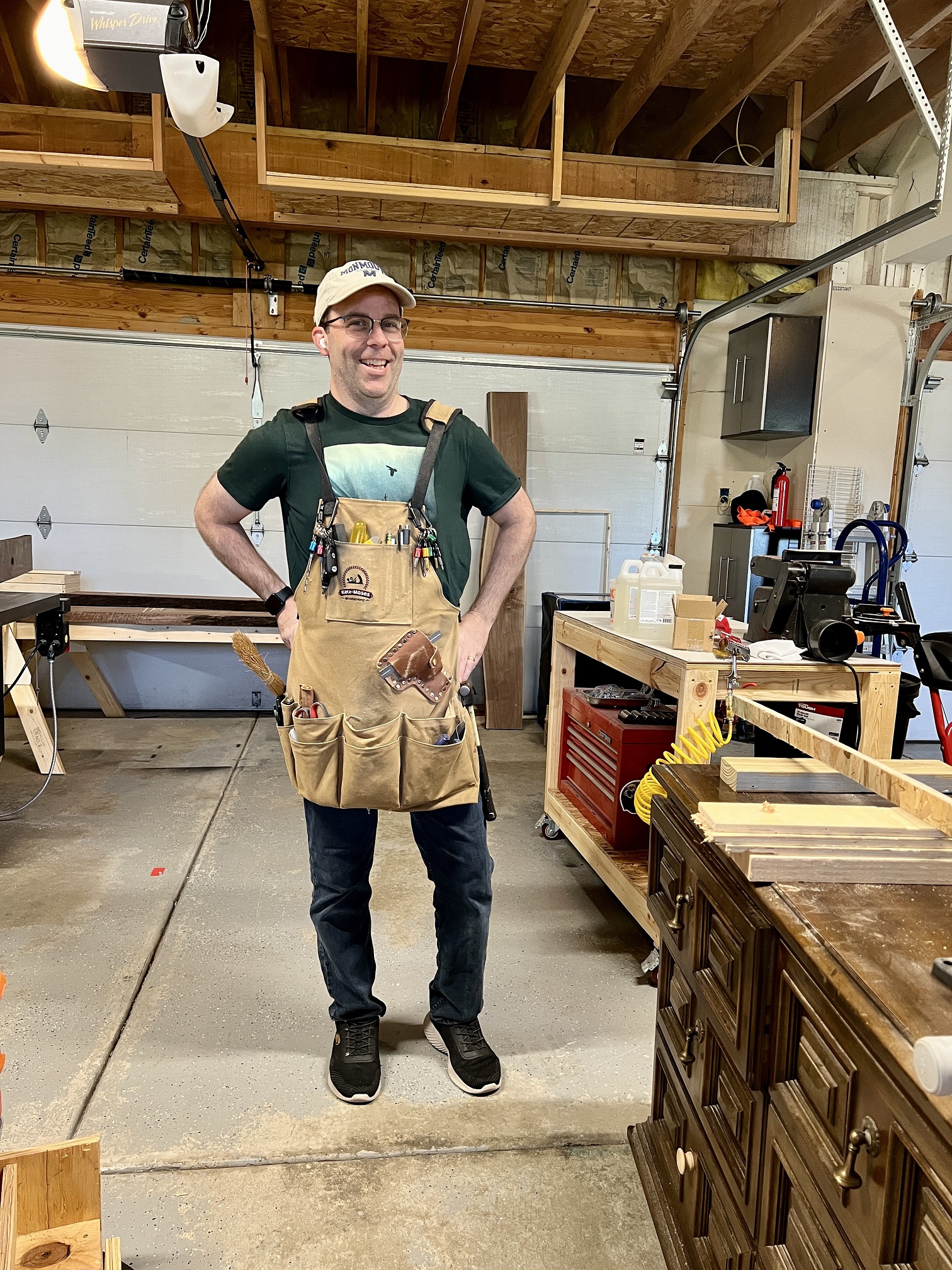
Outside of work, Parker-Combes has led a Cub Scout troop and has been president of his homeowner’s association, but now that his kids are grown, he spends his free time as a woodworker. “Crafting products with my hands provides a great balance I’ve been missing while typing on a keyboard,” he said. “Woodworking has nothing in common with my day job, other than I get to strive for perfection without 80 meetings a week.”
Overall, Parker-Combes believes everyone in the Army is motivated by desire to do their best, and just “trying to do the right thing.” Which, he said, is “a very heartening thought that tempers my feelings when I don’t agree with people.”
“Faces of the Force” highlights the success of the Army Acquisition Workforce through the power of individual stories. Profiles are produced by the Behind The Frontlines team, working closely with public affairs officers to feature Soldiers and civilians serving in various Army acquisition disciplines. For more information, or to nominate someone, go to https://asc.army.mil/web/army-btf/.
Subscribe to BTF – the premier source of Army acquisition news and information.
For question, concerns, or more information, contact us here.
RELATED NEWS

Acquisition is a Team Effort – Brice Ott

Protect Your Time – Tiffanie Bachar