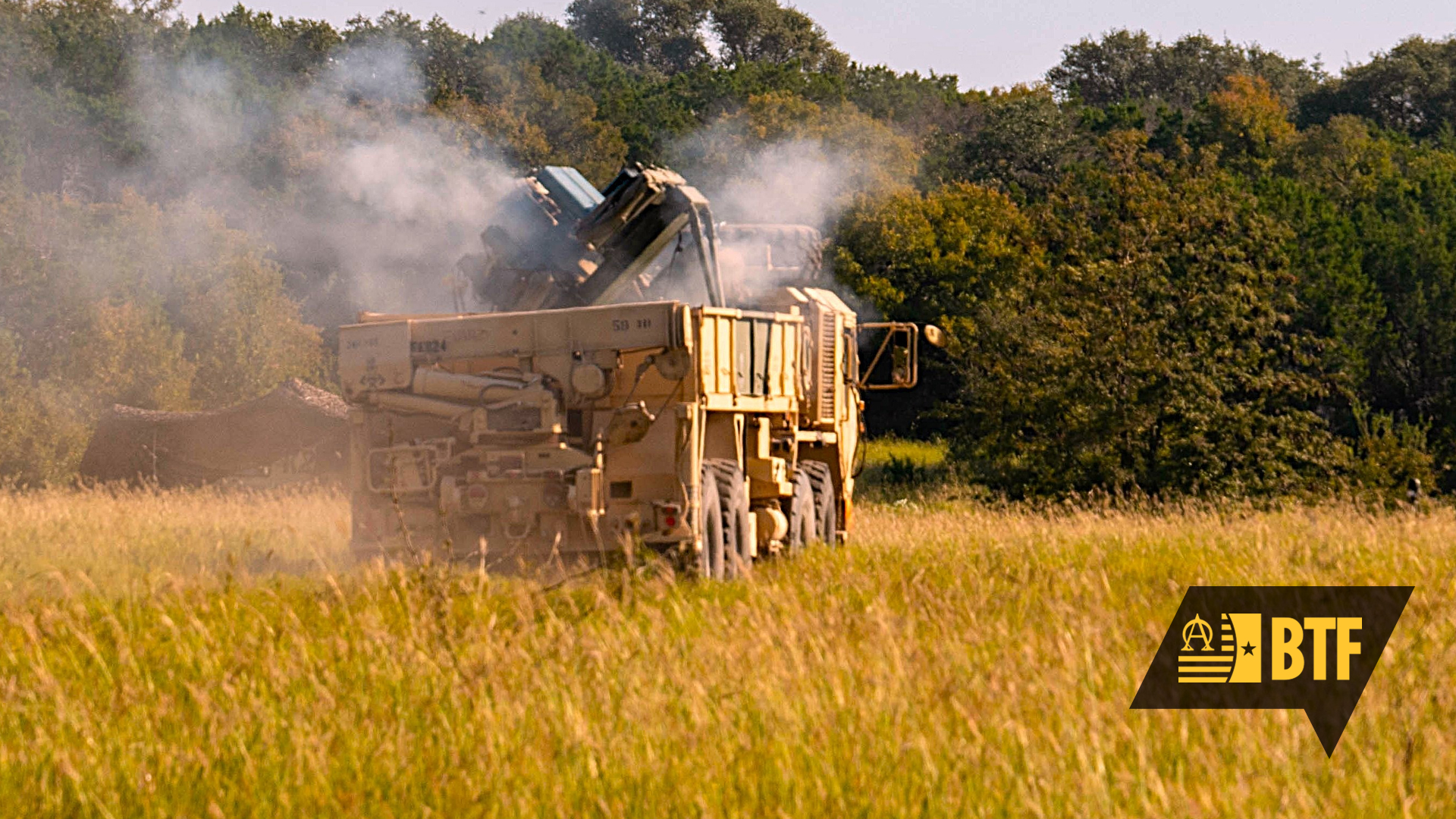
A military vehicle demonstrates the M139 Volcano system’s precision deployment capabilities during a live-fire exercise. (Photo by Spc. Hector Blanco, 1st Cavalry Division)
EMPOWERING GLOBAL PARTNERSHIPS: FACILITATING FOREIGN MILITARY SALES FOR THE M139 VOLCANO SYSTEM
by Capt. Jordan Dawsey, Jesse Cohen, Kerin Nussbaum and Paul Corona
The M139 Volcano System is a rapidly deployable anti-vehicular mine dispensing system that counters enemy mobility and provides strategic advantages in diverse operational scenarios. Mounted on a variety of platforms, the Volcano can quickly deploy scatterable mines to create obstacles that deny enemy movement and shape the terrain to meet mission objectives. With its ability to dispense 960 mines in a single mission, the Volcano System offers flexibility and effectiveness in terrain-shaping operations, making it a critical capability for both the U.S. Army and its international partners.
Beyond its technical capabilities, the M139 serves as a powerful tool for fostering global partnerships and advancing international defense collaboration. By enabling partner nations to acquire the Volcano, the U.S. strengthens their alliances, enhances interoperability and ensures that allied forces are equipped to address evolving security challenges. The Multi-National Volcano Demonstration, held at Fort Hood, Texas, from September 29 to October 3, 2025, exemplifies how the Volcano System is not only an asset but also a catalyst for building stronger, more resilient global defense network.
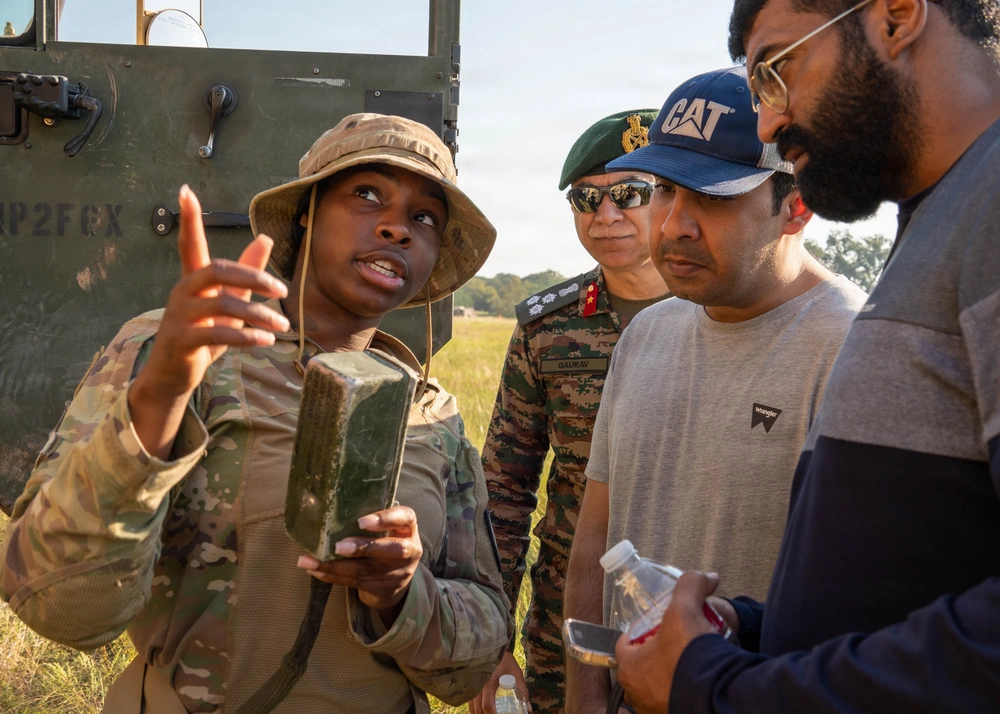
Spc. Lameka Byrd, 36th Engineer Brigade, explains the functionality of a terrain-shaping munition to a group of observers during a field demonstration. (Photo by Spc. Hector Blanco, 1st Cavalry Division)
A COLLABORATIVE EFFORT FOR GLOBAL DEFENSE
The Multi-National Volcano Demonstration marked a significant milestone in fostering international collaboration for those assigned with the responsibility of shaping the terrain of the battlefield. Co-hosted by the U.S. Army and Northrop Grumman, the event brought together representatives from four countries, three industry partners and multiple U.S. Army stakeholders. While the event showcased the force-multiplying capabilities of the M139 Volcano system, and provided a platform for global partnerships, it also underscored the strategic benefits these collaborations bring to the United States, including strengthening its industrial base, enhancing interoperability and ensuring the sustainability of critical defense technologies.
Spanning four days, the demonstration was meticulously organized with the invaluable support of the 36th Engineering Brigade. The agenda was designed to offer participants a comprehensive understanding of the M139 Volcano system. Northrop Grumman Defense Systems of Plymouth, Minnesota presented the technical specifications and capabilities of the system ensuring attendees gained a thorough understanding of its potential applications.
The event featured two major parts, each tailored to address the diverse needs and interests of the participants. The first component was a full day of briefings and discussion centered around the M139 Volcano capability. Interactive question-and-answer sessions allowed attendees to engage directly with experts, fostering a collaborative environment and encouraging the exchange of ideas and experiences among international partners, industry representatives and U.S. Army officials. These discussions provided valuable insights into operational considerations and the strategic advantages of the Volcano system. The second component comprised of a live viewing of the M139 Volcano alongside a detailed explanation of its operation. Both components contributed to the overarching goals of providing foreign partners with a greater understanding of the system and fortifying existing relationships.
LOOKING AHEAD: FUTURE OPPORTUNITIES FOR COLLABORATION
The foreign military sales (FMS) process provides partner nations with access to terrain-shaping technologies like the M139 Volcano system but more importantly, it also delivers significant benefits to the United States. By facilitating international sales, the U.S. strengthens its defense industrial base, ensuring the continued production of critical systems and components. This approach reduces the financial burden on domestic budgets by leveraging foreign investments to sustain production lines. Additionally, the enhanced interoperability achieved through these collaborations ensures that U.S. forces are better prepared to operate alongside allies in complex, multidomain environments.
Attendees at the event were provided with a detailed explanation of the steps involved in pursuing a letter of request (LOR) and implementing an FMS case in the future. The event additionally included a brief but informative discussion on complementary technologies that could be of interest in other future cases, such as the XM343 Standoff Activated Volcano Obstacle system and the M4 Selectable Lightweight Attack Munition. These innovative systems provide additional options for military operations, underscoring the importance of integrating advanced technologies to address evolving threats and enhance operational effectiveness, highlighting the Army’s commitment to innovation and adaptability.
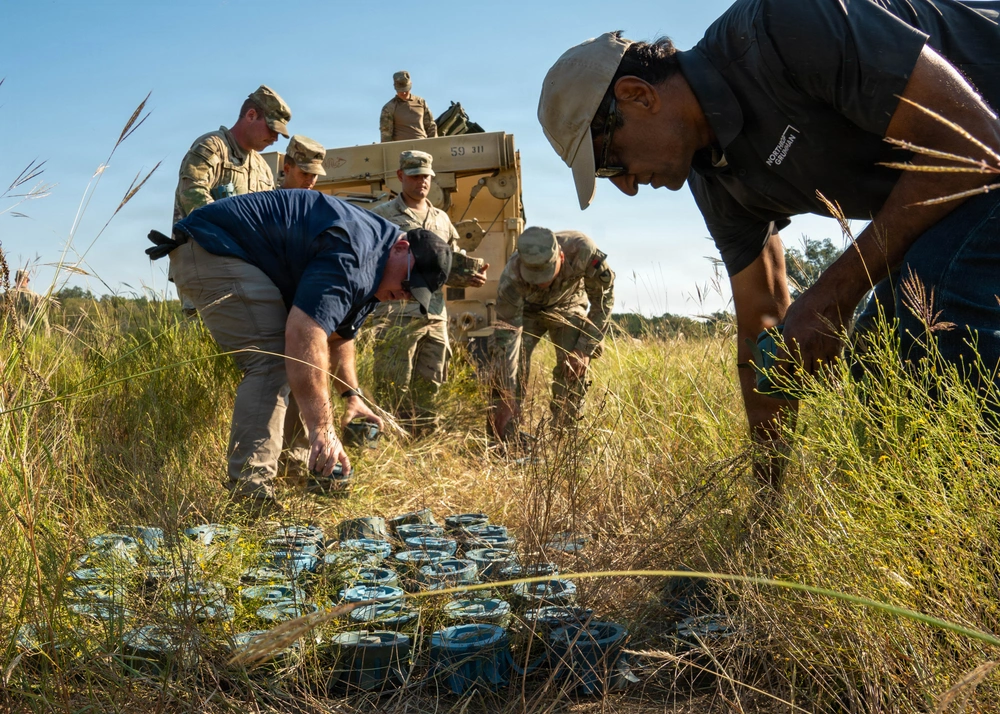
Personnel inspect and organize deployed M139 inert munitions (M88R) to evaluate their placement and functionality in the field. (Photo by Spc. Hector Blanco, 1st Cavalry Division)
ALIGNING WITH ACQUISITION TRANSFORMATION INITIATIVES
The M139 Volcano System exemplifies the collaboration between two Capability Program Executives (CPE) within Portfolio Acquisition Executive Agile Sustainment and Ammunition’s (PAE AS&A) portfolio, bringing together vehicles managed by CPE Combat Logistics and munitions developed under the Terrain Shaping Obstacles Portfolio in CPE Ammunition and Energetics. This collaboration exemplifies the power of the Army Transformation Initiative, ensures seamless interoperability between platforms and munitions, enhances operational effectiveness and streamlines logistics for both U.S. and partner forces. By leveraging the expertise of the PAE AS&A team, the Volcano system demonstrates the Army’s ability to deliver integrated solutions that address complex battlefield requirements.
This approach not only strengthens the U.S. industrial base, but also ensures that partner nations benefit from cutting-edge, interoperable technologies. International sales of systems like the M139 Volcano not only strengthens global defense partnerships but also creates economies of scale that reduce production costs and ensure the sustainability of critical defense technologies.
By leveraging foreign investments, the U.S. can avoid prospective domestic funding gaps while maintaining readiness and industrial capacity. These sales also ensure that legacy systems like the Volcano remain in production, preserving critical manufacturing capabilities and supporting the U.S. industrial base. Furthermore, the integration of advanced technologies into shared defense strategies enhances interoperability, ensuring that U.S. forces can operate seamlessly alongside allied nations in joint operations. By leveraging foreign investments, the U.S. can avoid prospective domestic funding gaps while maintaining readiness and industrial capacity.
Col. Vinson Morris, Project Manager Close Combat Systems (PM CCS), remarked, “The Multi-National Volcano Demonstration exemplifies our commitment to fostering international collaboration and ensuring our partners have access to the critical capabilities they need to address evolving security challenges. We are not only advancing security cooperation but also reinforcing the Army’s dedication to delivering innovative solutions that enhance global defense readiness.” This aligns with the mission statement of the U.S. Army Deputy Assistant Secretary of the Army for Defense Exports and Cooperation (DASA(DEC)) office, aiming to “Build capabilities of allies and partners, strengthen relationships with our foreign partners and strengthen the industrial base.”
Enabling and harnessing partner nations to have accelerated delivery of those critical capabilities remains a cornerstone of acquisition reform, and events like the Multi-National Volcano Demonstration directly contribute to this objective by fostering real-time collaboration and streamlining processes.
By providing foreign partners with a comprehensive understanding of the M139 Volcano system and the FMS process, the demonstration directly supports DASA(DEC)’s mission to advance security cooperation and enable partner nations to acquire critical capabilities. The event’s focus on terrain-shaping technologies, such as the M139 Volcano, underscores the Army’s commitment to delivering solutions that address modern battlefield requirements while strengthening interoperability with allied forces. This aligns with the Army Modernization Strategy, which highlights the importance of developing and deploying innovative solutions to maintain overmatch against adversaries.
These efforts are in line with acquisition transformation initiatives that prioritize the development and deployment of cutting-edge solutions to address emerging threats and enhance operational effectiveness.
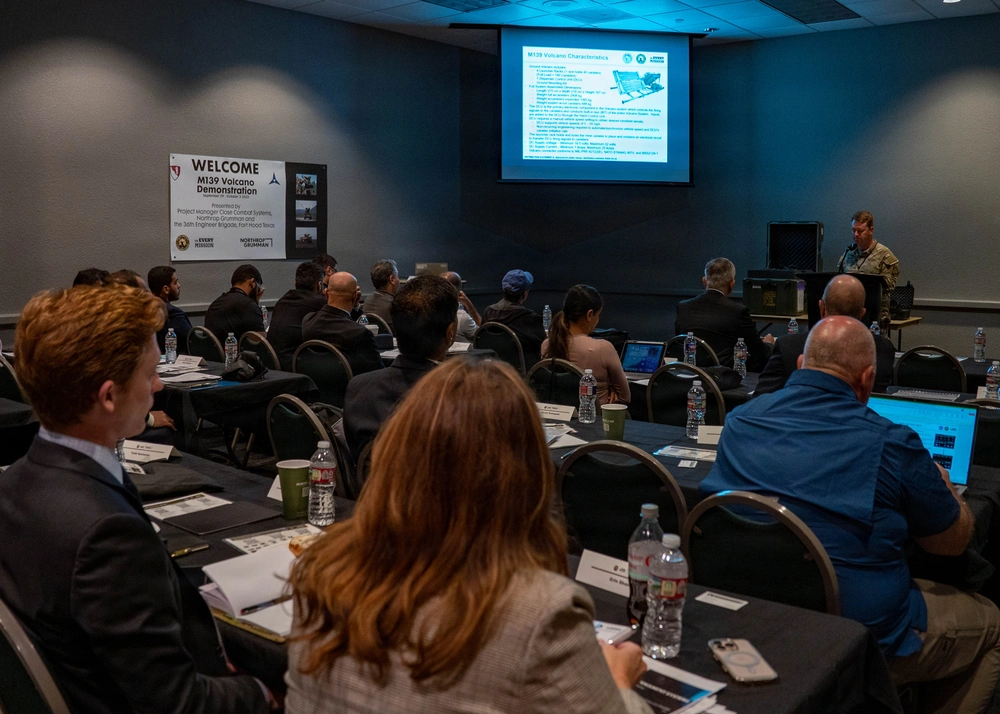
Attendees listen to a detailed presentation on the M139 Volcano system’s characteristics and operational capabilities during a formal briefing session. (Photo by Spc. Hector Blanco, 1st Cavalry Division)
ONE-ON-ONE MEETINGS TO ADDRESS SPECIFIC NEEDS
One of the most impactful aspects of the event was the opportunity for one-on-one meetings between foreign partners and the U.S. government team. These personalized sessions allowed foreign partners to discuss their specific needs, explore potential solutions and gain clarity on the processes required to initiate a LOR. This tailored approach ensured that each participant left the event with actionable insights and a clear path forward. The collaborative relationships with each partner were greatly strengthened by these individualized meetings. Beyond strengthening partnerships, these engagements directly benefit the United States by accelerating the FMS pipeline, generating demand for U.S.-produced systems and ensuring that foreign investments flow into the American defense industrial base.
The emphasis on one-on-one meetings and tailored discussions during the event reflects the Army’s acquisition transformation priorities, which include enhancing transparency, responsiveness and adaptability in defense exports. These personalized engagements not only foster trust and collaboration but also ensure that partner nations can navigate the FMS process effectively, aligning with DASA(DEC)’s goal of creating a more streamlined and partner-focused approach to defense acquisition. Each successful FMS engagement represents a direct investment in U.S. manufacturing capacity and sustaining the production lines that keep critical defense systems like the M139 Volcano operationally viable for U.S. forces. The Defense Security Cooperation Agency Security Assistance Management Manual further outlines the steps and processes involved in FMS, providing a framework for these efforts.
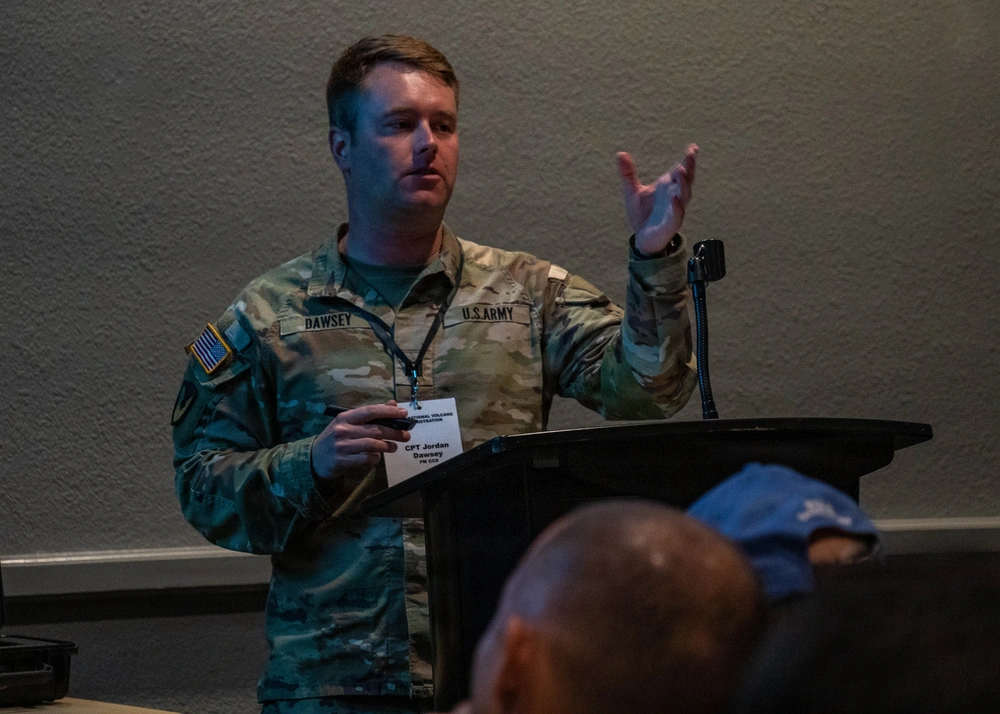
Assistant project manager of Terrain Shaping Obstacles at PM CCS, Capt. Jordan Dawsey, delivers an in-depth explanation of the M139 Volcano system, highlighting its technical specifications and applications. (Photo by Spc. Hector Blanco, 1st Cavalry Division)
THE BENEFITS OF M139 VOLCANO INTERNATIONAL SALES
A key highlight of the event was the detailed presentation of the M139 Volcano system. Participants were given an in-depth understanding of the system’s capabilities, including its ability to dispense 960 mines to create a mine field spanning 120 meters by 1,100 meters. Sustained international interest in the M139 Volcano system ensures that production lines remain active, reducing per-unit costs for the U.S. Army and preserving the domestic manufacturing expertise necessary to support future procurement and modernization efforts.
The demonstration culminated in an inert firing of the Volcano system, showcasing its impressive capabilities. The system successfully deployed 40 canisters, resulting in the placement of 240 M88R inert mines. This live demonstration provided attendees with a firsthand view of the system’s operational effectiveness, leaving a lasting impression. As partner nations procure and field the M139 Volcano system, the U.S. benefits from enhanced interoperability, shared operational data and a broader coalition of allies capable of employing terrain-shaping capabilities alongside American forces in joint and combined operations.
CONCLUSION
The success of the Multi-National Volcano Demonstration is a testament to the power of collaboration and innovation. By bringing together international partners, industry leaders and government agencies, the event fostered a shared commitment to advancing defense technologies and strengthening global security. However, the strategic benefits of these efforts extend far beyond international collaboration as they directly support United States defense priorities.
Through international sales of systems like the M139 Volcano, the U.S. strengthens its industrial base, ensuring the continued production of critical systems and components while reducing the financial burden on domestic budgets. These sales also create economies of scale, driving down production costs and preserving manufacturing capabilities that are vital to national security. These efforts reinforce global readiness while supporting acquisition transformation initiatives. Furthermore, the enhanced interoperability achieved through these partnerships ensures that U.S. forces are better prepared to operate alongside allies in joint operations, reinforcing global readiness and resilience against evolving threats.
The opportunity to demonstrate the key terrain-shaping capabilities of the Volcano system to our foreign partners was crucial. This engagement not only enhanced our relationships among key global defense stakeholders but also encouraged interoperable terrain-shaping operations with multiple close partners. Enhanced interoperability with allied forces is a primary outcome of events like the Multi-National Volcano Demonstration. By fostering shared understanding and operational alignment, the U.S. and its partners are better equipped to address evolving threats and maintain a unified approach to global security challenges.
For more information, go to the Capability Program Executive Ammunition and Energetics website at https://jpeoaa.army.mil/.
CAPT. JORDAN DAWSEY currently serves as the assistant program manager of Terrain Shaping Obstacles at PM CCS. He holds a BBA from Baylor University and an M.S. in geological engineering from Missouri S&T.
JESSE COHEN is a Booz Allen Hamilton contractor operating as a special project officer at PM CCS. He holds an EMBA in technology management from Stevens Institute of Technology and a B.S. in general engineering from the United States Naval Academy.
KERIN NUSSBAUM is a contractor with Booz Allen Hamilton, where she holds the position of project/program management specialist. She holds a B.S. in electrical engineering from Fairfield University in 2017.
PAUL CORONA is a Bowhead contractor operating as an FMS analyst at PM CCS. He holds a BFA from East Stroudsburg University.
Recent Posts
Read more of our recent Behind The Frontlines Posts.