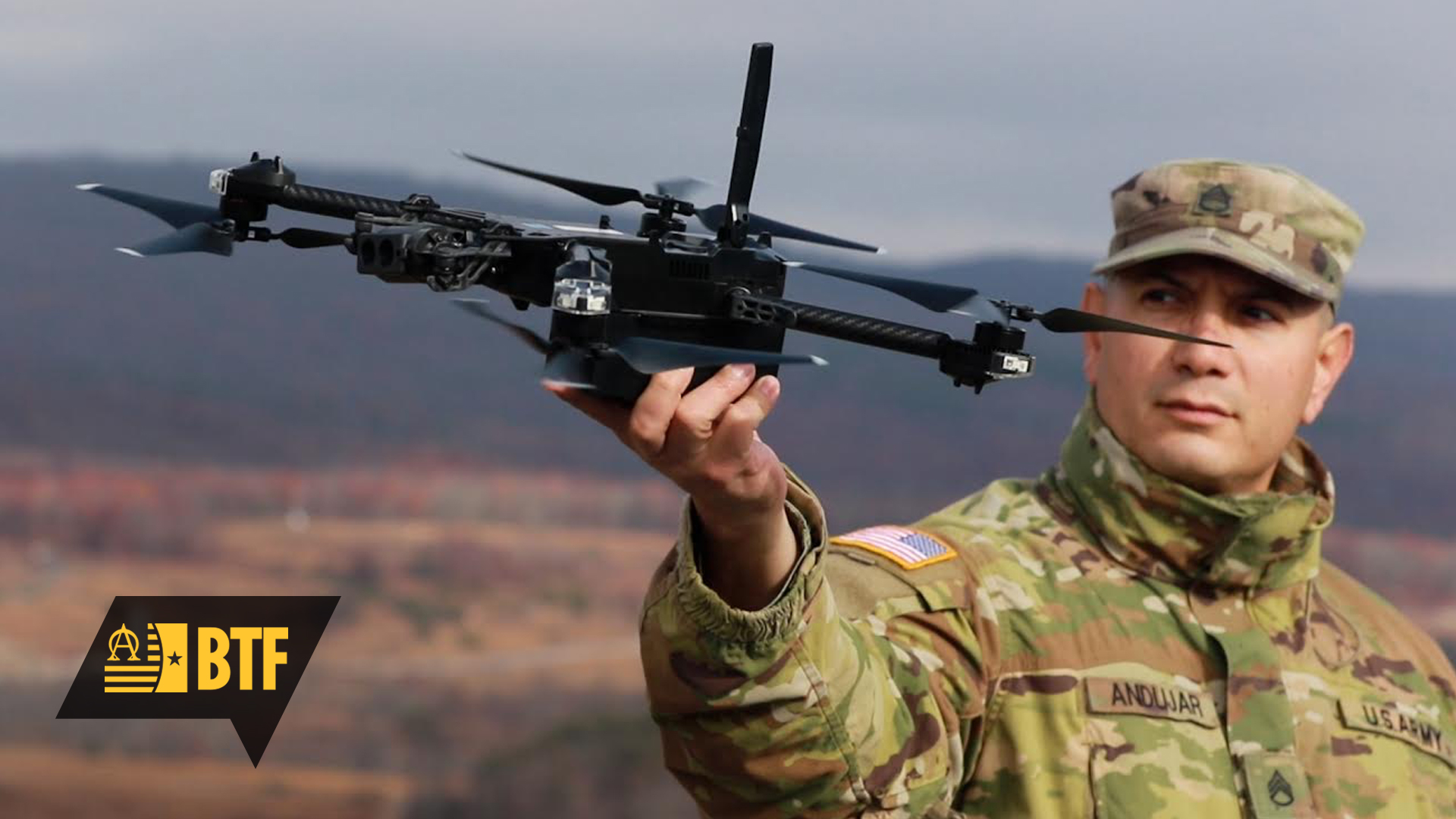
Army acquisition professionals should focus on adopting technologies before developing them—buy commercial off the shelf solutions, like this drone Skydio X2D operated by Staff Sgt. Luis Andujar, to get equipment to Soldiers quickly. (Photo by Sgt. 1st Class Shane Smith, U.S. Army National Guard)
THE FOUR PILLARS OF ARMY ACQUISITION WORKFORCE REFORM
FROM THE DIRECTOR OF ACQUISITION CAREER MANAGEMENT RONALD R. RICHARDSON JR.
The Director of Acquisition Career Management (DACM) Office mission is to recruit, train and retain an agile, adaptive and professional workforce with the acquisition acumen and critical thinking skills to accelerate delivery capability to Soldiers. We embrace change and we have a history of constant reform—so when big changes to the acquisition enterprise and, in particular, the acquisition workforce, were announced in October 2025, it wasn’t surprising.
As we move forward to incorporate these changes into the Army Acquisition Workforce (AAW), there are four imperatives for us to follow: a bias for action, putting commercial solutions first, speed and being outcome-focused.
IMPERATIVES OF REFORM
Maintain a bias for action.
The acquisition enterprise in the past has been focused more on development—ensuring that the product or program is the best it can be before it is fielded. And while that can be beneficial, it can at times keep the workforce bogged down in the development process, instead of fielding capabilities that are needed right now. Therefore, our acquisition philosophy, our culture, needs to shift to an action-focused process. We need to always be looking for ways to innovate and accelerate delivery. The mindset needs to shift to entrepreneurial thinking, taking prudent risks and transparency in communication—understanding how risk affects your cost, schedule and performance, and then being able to take those prudent, responsible risks to go faster, to get more capability and to work with nontraditional entities to buy down that risk and deliver capability.
Risk management should become a part of each acquisition professional’s daily workflow. It should be first and foremost in your mind and adding steerage to your program, and not something that’s briefed once a quarter as part of a program review.
Speed is king.
Speed is imperative in the Army acquisition strategy. Secretary of War Pete Hegseth has emphasized that the force cannot wait—our adversaries are outpacing us on the battlefield. We need to get capabilities into the hands of Soldiers much faster. In the tortured triangle of cost, schedule and performance, the schedule is what really matters. We must create a mindset of speed in the AAW and provide the tools and training to achieve it—because when you go fast, you inherently take on risk. We also need leaders that support their workforce by underwriting the risk in order to enable this speed.
Focus on the outcome.
Our job as an integral part of the Army modernization enterprise is to ensure that no American Soldier is ever in a fair fight, anywhere. We must continue to innovate so that Soldiers have greater range, better protection and better situational awareness than their adversaries.
The outcome we’re looking for is simple: the right kit in the hands of Soldiers at the right time. Perfection is the enemy of good enough. We need to develop capabilities with appropriate Soldier feedback and push out each new iteration quickly. We can’t wait for perfect; if we wait, we’re left wanting. We have to teach a mindset that favors outcome over process and we have to make that transition quickly.
Put commercial solutions first.
In the past, the workforce focused on long-term development of capabilities, like the big five of the 1980s—including the Abrams, the Bradley and the Patriot—but we don’t have that kind of time anymore. We need to shift our mindset from development first to development last—as in adopt, adapt, develop. If we can’t adopt a capability, adapt one. Development should generally be a last resort. Buying something off the shelf and fielding it immediately, with minimal modification, is the preferred option.
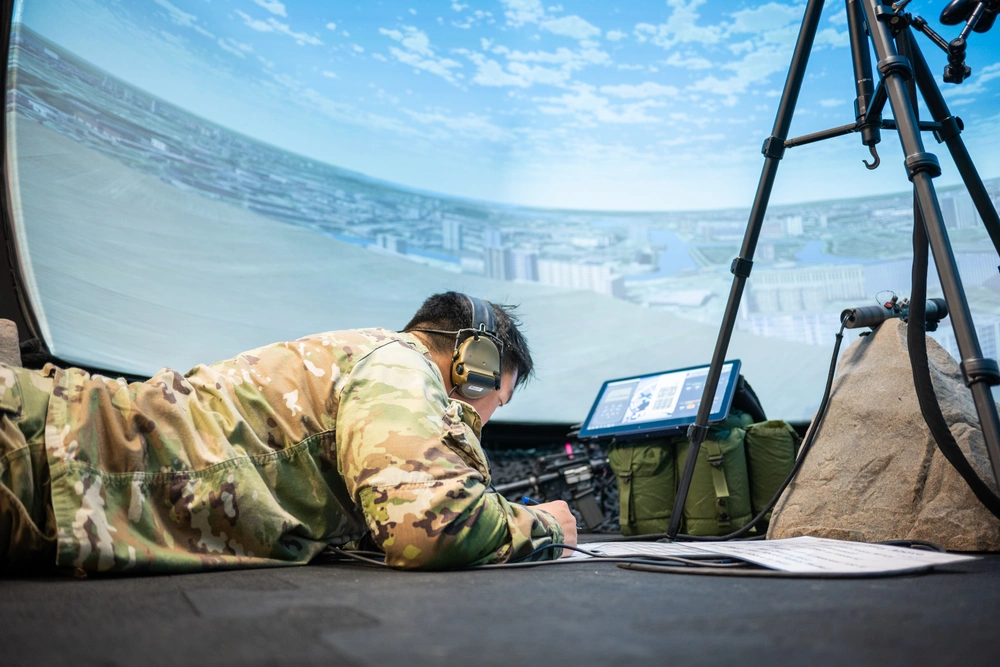
Training opportunities for acquisition professionals should lean into simulations or role-play frameworks in the future. In this photo, Sgt. 1st Class Alvin Escobar, 5th Security Forces Assistance Brigade, makes observations during a joint fires training simulation in September 2025. (Photo by Spc. Elijah Magaña, 5th Security Force Assistance Brigade)
THE PILLARS WORKING TOGETHER
Much of the work we do is already aligned with those four pillars. Now, we need to focus on hammering home how to best achieve those goals, through tools and training. Historically, many of the measurement tools in acquisition have been backward looking, which isn’t particularly useful in managing a program. But implementing predictive modeling and artificial intelligence can help flag future obstacles, manage risk and generally assist our workforce in finding more effective and efficient solutions for the warfighter.
When I attended the Data Driven Leadership Course at Carnegie Mellon a couple of years ago, one of the speakers was the chief of data analytics for American Eagle. That company has dashboards and other predictive tools to help identify what fashion trends will be three years from now, so that stores will have the latest fashions in time for holiday shoppers. That’s the kind of functionality we need in Army acquisition—predictive tech—to manage risks and accelerate delivery.
From a training perspective, we need to move away from classroom-based PowerPoint lectures and into simulations, gaming and other interactive training tools. Using real-world scenarios and having acquisition professionals role-play through a specific situation in a “choose your own adventure” scenario is immeasurably more engaging and helpful to their development in the long term. Like any dress rehearsal, having rehearsed various scenarios make our acquisition professionals better able to react and make real-time adjustments in their projects or programs when the time comes.
In the near term, that means we’ll be re-looking the Back-to-Basics reforms and assessing what critical skills and knowledge each functional area needs at which level, and then making those adjustments to the programs and curriculum. There’s also a new emphasis within the Warfighting Acquisition University on cross-functionality—ensuring that the senior-level courses have a more diverse functional population. For example, the advanced program management courses will bring in multifunctional logisticians, contracting, test and engineering folks to provide a more diverse look at the subject matter. There will likely be a lot of change in the curriculum over the next six to eight months.
The Training with Industry (TWI) program and Public Private Talent Exchange (PPTE) are other avenues that we can use to improve workforce skills. Fulfilling capability needs with commercial solutions means the workforce needs to better understand our industry partners, and vice versa. Traditionally, those programs have been about six months to a year long—moving forward, we need to cycle faster so we’re looking at ways to shorten time away while maximizing the value.
CONCLUSION
I know this is a lot of change all at once, with more changes still to come. But the AAW is professional, adaptable and dedicated to our mission—a mission where we can see results and understand how our work impacts others’ lives. This is a worthwhile endeavor, and one of the most rewarding parts of being an acquisition professional. Yes, we’ve taken some losses. Yes, there’s still some turbulence ahead. But I believe we have a solid vision of how we’ll come out on the other side. We’ve heard from both the White House and the Secretary of War that the acquisition workforce is a national asset—we’ve been recognized for our importance to the warfighter, and we’re being asked to reset, reimagine and be better. And we can always be better.
For those who opted to leave, we wish them only the best. For those of you who stayed—thank you! Thank you for your continued dedication to the mission. We’re in a good place now; stay with us and help us do great things for our Soldiers.