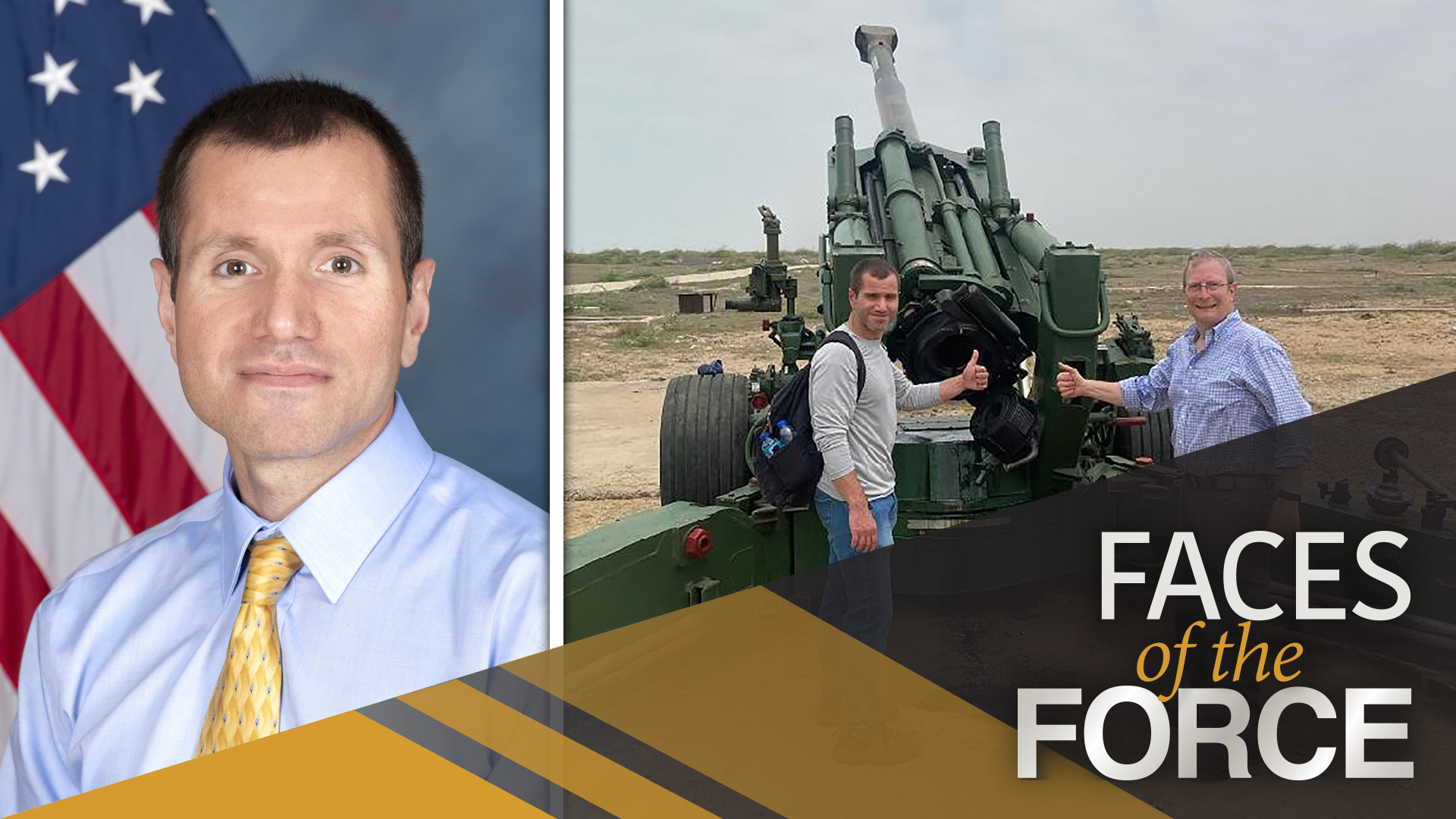

Kristian S. Kleinbach
COMMAND/ORGANIZATION: Portfolio Acquisition Executive Agile Sustainment and Ammunition, Project Manager Combat Ammunition Systems, Product Manager Precision Attack
TITLE: Chief engineer, Product Manager Precision Attack Cannon Munitions
YEARS OF SERVICE IN AAW: 20
DAWIA CERTIFICATIONS: Practitioner in engineering and technical management
EDUCATION: M.E. in electrical engineering, Stevens Institute of Technology; B.S. in electrical and computer engineering, Lafayette College
AWARDS: Project Manager Combat Ammunition Systems Engineer of the Year (2026, 2016); Honorable Order of St. Barbara (2024); Superior Civilian Service Award (2017); Achievement Medal for Civilian Service (2012, 2010)
by Cheryl Marino
Kristian Kleinbach brings a people-first perspective to leadership in a highly technical field. He strongly believes that in-person interactions are essential to maintaining professionalism and mutual respect, noting that workplace courtesy can erode when communication becomes entirely electronic. His approach emphasizes the value of face-to-face engagement in building stronger, more effective teams.
“Remember the human,” he said. “Our jobs often have us working virtually with others, especially since 2020 when telework came into prominence during Covid. I have noticed that people find it easier to treat others poorly when they are considered to be disembodied voices on the phone, or in email. Folks are forgetting that they are communicating with other thinking, feeling humans, each with their own lives, motivations and challenges. All of those elements can affect how you interact with them.”
He believes that by getting to know your team as “actual humans” you’ll invariably foster a better working relationship with them. “If your data connection allows, turn on the camera. If your budget allows, schedule major reviews to be in-person and get people together,” he explained. “Making those personal connections, however small, will make working with your team that much easier.”
As chief engineer for the Product Manager Precision Attack Cannon Munitions (PM PACM), Kleinbach leads teams of multidisciplinary scientists and engineers in developing, fielding and producing precision-guided cannon artillery munitions for the Army and our foreign partners. These munitions provide lethal precision fires options for the warfighter, which, he said, “reduce the time to kill, cost per kill and logistics train for cannon artillery compared to other options.”

“The greatest satisfaction I have is the feeling that my work is truly making a difference,” he said. “I know that the harder I work, the more capable and reliable these munitions will be. That is what keeps me motivated.”
Kleinbach was recruited by the U.S. Army Combat Capabilities Development Command, Armaments Center (formerly the Armament Research, Development and Engineering Center) at Picatinny Arsenal, New Jersey, directly from his undergraduate engineering program at Lafayette College. “My grandfather played a crucial role in my decision,” he said. “He served in World War II, and his vivid stories of how his unit was sometimes overmatched and outranged by the enemy made me realize that I could put my engineering talents to use to benefit the warfighter.”
Kleinbach’s first acquisition position was as an electrical engineer on the M982 Excalibur Program, and he said the most appealing aspect of this work was the positive, motivated culture of the office.
“Our teams were working through significant and concurrent development and test efforts, and we were able to quickly iterate designs to find and fix failures,” he said.
“My goal is to provide cutting-edge precision munitions to the warfighter, and I think our team is achieving that. We are pushing the state-of-the-art of what can be safely and reliably integrated into an artillery projectile that is accelerated to hundreds of meters per second in a matter of milliseconds, and the team is making significant progress with our contractor partners,” Kleinbach said. “With one product in active production and another in development, there is a lot to be excited about right now.”
The most important points in his career have been linked to warfighter interaction. “Every time we get in the room with them, it helps to ‘ground’ the team and remind us why we do this job,” he said. “I remember meeting with a member of a unit that employed our munitions in Iraq some years back, and he thanked us, and said that they were able to put fewer infantry in harm’s way that day because they were able to engage the enemy with our munition. That moment will stick with me for the rest of my life.”
The most recent career development program Kleinbach took was called “Understanding the Defense Industry,” offered by the University of North Carolina Kenan-Flagler Business School’s Executive Development Program. “It was a superb overview of how modern defense companies have evolved to their current form, how they operate, their incentives, their metrics and how to gain valuable insights by investigating publicly available records,” he said. “I took the training in June of 2024 and would wholeheartedly recommend it to anyone who is interested in understanding how large defense companies operate and wants to ‘get inside their heads’ a bit.”
Outside of work, Kleinbach said he’s known as a committed husband of 17 years, father of two girls (aged 12 and 7 years) and a hobbyist astrophotographer.

“While I haven’t had time for much in the way of hobbies lately, astrophotography has a lot in common with my job as an engineer. The required skillset is similar, including extreme attention to detail and process control, understanding the correct input conditions required, adapting to unexpected issues and the work ethic and perseverance to achieve the desired outcome. I even learned a bit about image processing along the way,” he explained.
“Finding and sticking to your own personal work-life balance is important,” Kleinbach said. He’s found that it’s easy to get pulled into whatever project is happening in the office, and cell phones and laptops ensure that he can do that work whenever and wherever it is needed. It has also established an implicit expectation of availability outside of working hours.
“Sometimes it is difficult for me to unplug, especially when I know my feedback could be of importance,” he said. “Our lives are so busy that it’s easy to forget to work on your relationships at home. My wife is the heart and soul of our family and deserves my attention. My kids will only be young once, and each year of their lives brings some amazing and different development that I don’t want to miss. I know I’ll regret it if I do.”
“Faces of the Force” highlights the success of the Army Acquisition Workforce through the power of individual stories. Profiles are produced by the Behind The Frontlines team, working closely with public affairs officers to feature Soldiers and civilians serving in various Army acquisition disciplines. For more information, or to nominate someone, go to https://asc.army.mil/web/army-btf/.
Subscribe to BTF – the premier source of Army acquisition news and information.
For question, concerns, or more information, contact us here.
RELATED NEWS
Remember the Human – Kristian S. Kleinbach
Collaboration is Key – Joseph M. Carson IV