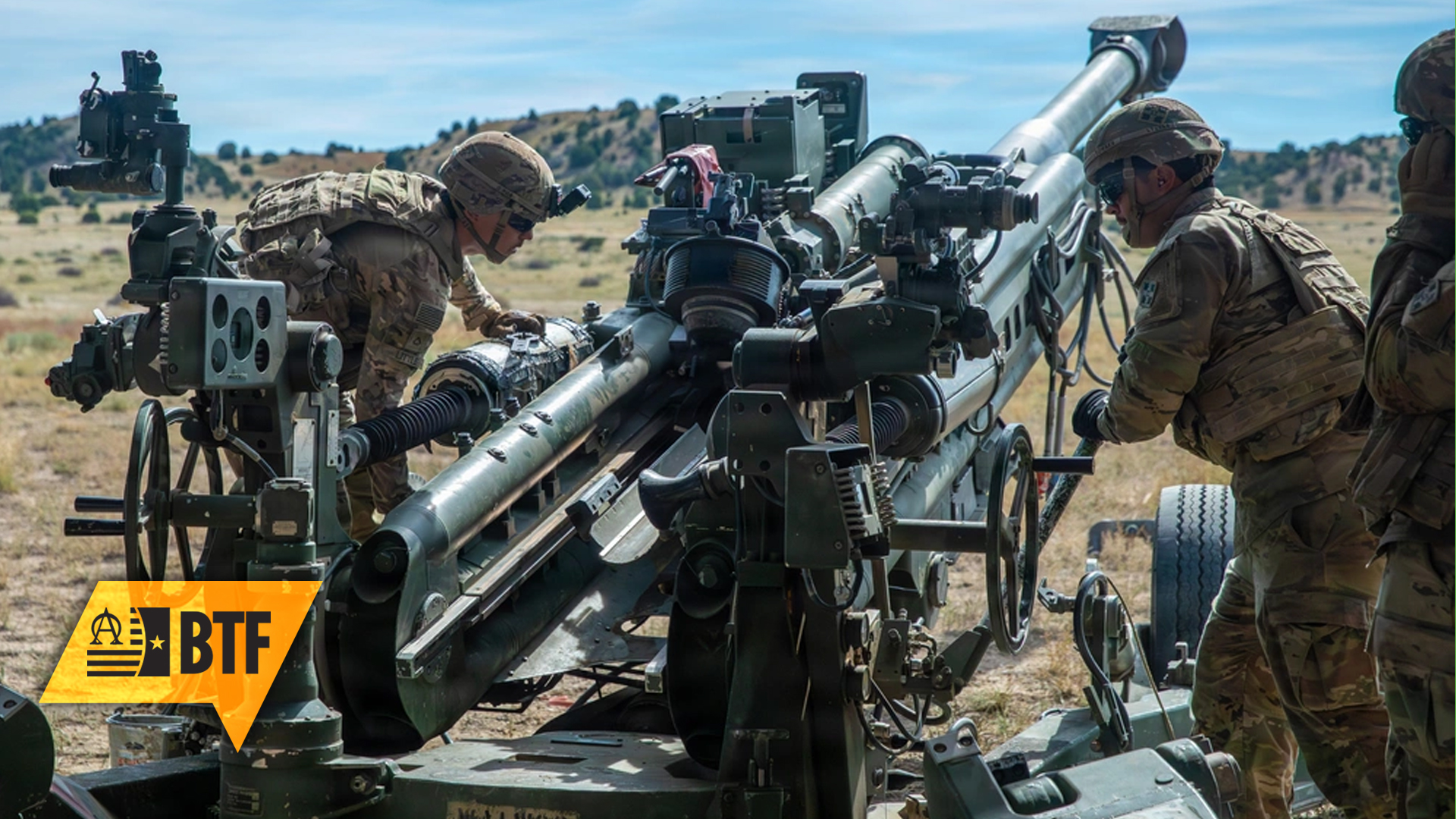
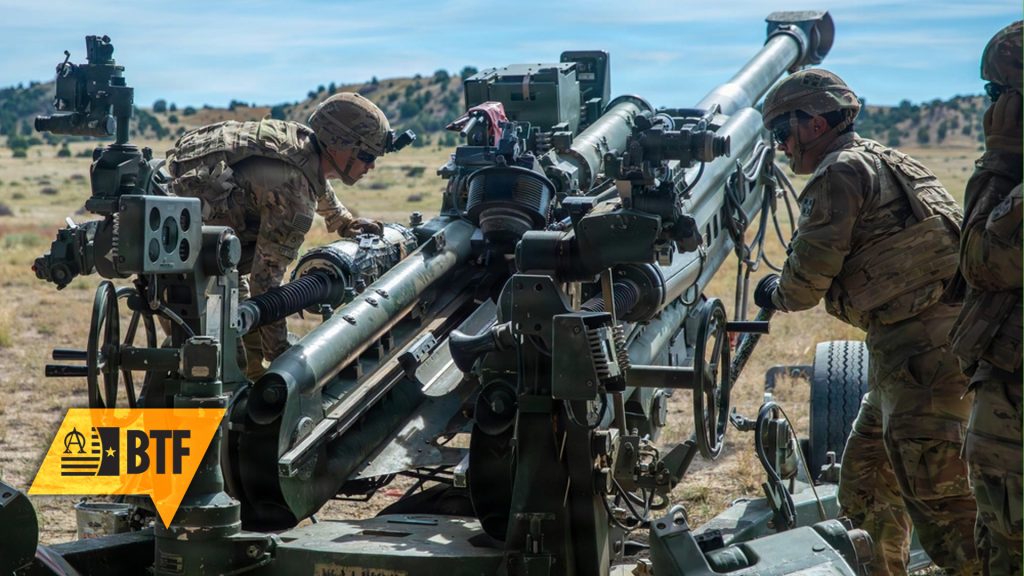
Pfc. Lucious Little, left, and Pfc. Luis Alberto Torres, both cannon crewmembers assigned to Charlie Battery, 2nd Battalion, adjust an M777 howitzer during artillery execution suite training on Fort Carson, Colorado, Oct. 7, 2026. The MTC, designed to replace the M777 howitzer, is expected to reduce the amount of manual labor required of Soldiers. (Photo by Sgt. Charlyn Abuyo, 14th Public Affairs Detachment)
by Rebecca Wright
As the battlefield evolves through advances in weapon systems, technology and acquisition strategies, Army acquisition professionals face unique challenges in delivering capabilities and supporting mission readiness. The Army is meeting these challenges through faster acquisition processes, rapid fielding and continuous learning.
The Department of War is preparing both the acquisition workforce and its warfighters for success on the modern battlefield. This requires delivering equipment faster and ensuring it is fully supported and ready for operational use.
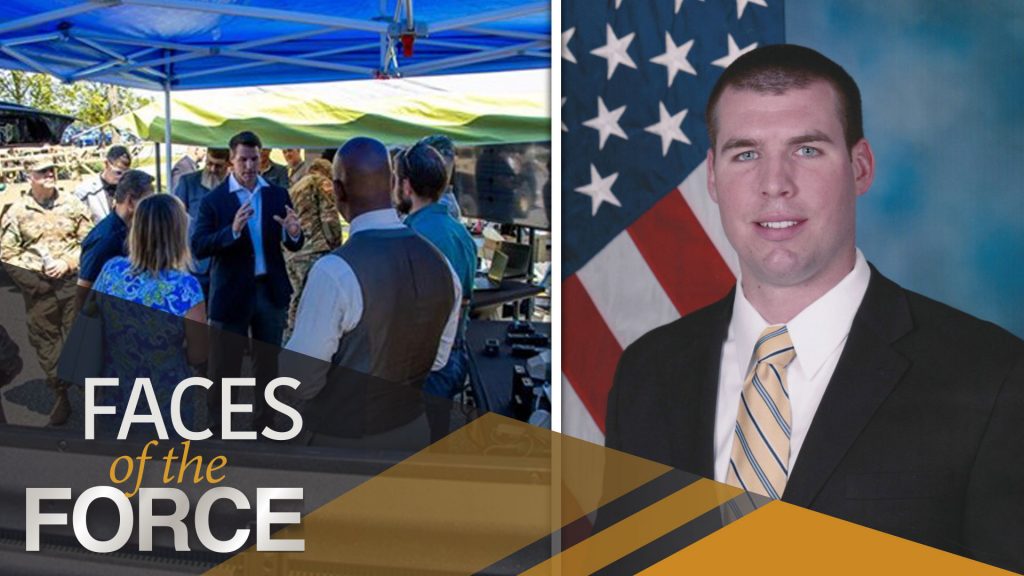
Through a congressional mandate, the Warfighting Acquisition University (WarU) has launched a new initiative called Field Training Teams. Consisting of experienced acquisition professionals, these embedded teams work directly with organizations and program offices to support organizational objectives through tailored training, coaching, consultation and complex problem-solving.
TRAIN THE TRAINER
WarU’s Field Training Teams support the force from multiple angles. Instead of operating in a one-size-fits-all fashion, WarU supports each organization based on mission needs and challenges through Field Training Teams that provide support to program managers, program office personnel and stakeholders. By equipping program managers and program offices with operational knowledge, that expertise can then be shared across their organizations. “We are almost in a ‘train-the-trainer’ kind of role. Our interface is the program office. It’s up to the program office to manage user touch points,” said Christopher Jefferson, a Field Training Teams lead with WarU. “Instead of WarU just teaching classes of 30 people coming from all different program offices, why not also embed us so they can ask pointed questions and get feedback that is tailored to them?”
Jefferson explains that under the Field Training Team construct, training is different than what personnel may experience in a WarU classroom by offering customized training specifically to what a program office needs. “When I teach a WarU class … my messaging has to go to someone who might be a tester, someone who might be a logistician, someone who might be a PM [program manager], someone who may have one year of experience and someone who may have 30 years of experience. So, that’s a broader audience. Under Field Training Teams, we look at ‘Ok. What do you need? What is the experience of your team? Where are they weak?’ And then the training is tailored to their specific needs,” said Jefferson.
As an alternative to hiring more contractors, the Field Training Teams are leveraging the government’s own internal experts comprised of retired military, former Senior Executive Service members and engineers with decades of combined experience. These experts are embedded into program offices to assist in acquisition strategies, troubleshooting contracting hurdles and source-selection planning. “WarU has all these seasoned professionals, so I think it is about leveraging that expertise, giving that back to the program offices and also helping WarU stay current,” said Jefferson.
THE MOBILE TACTICAL CANNON PROGRAM
With WarU’s customized consulting, coaching and mission-focused support, the true test of the Field Training Team’s success comes from the program offices executing the deployment of new weapons and technologies.
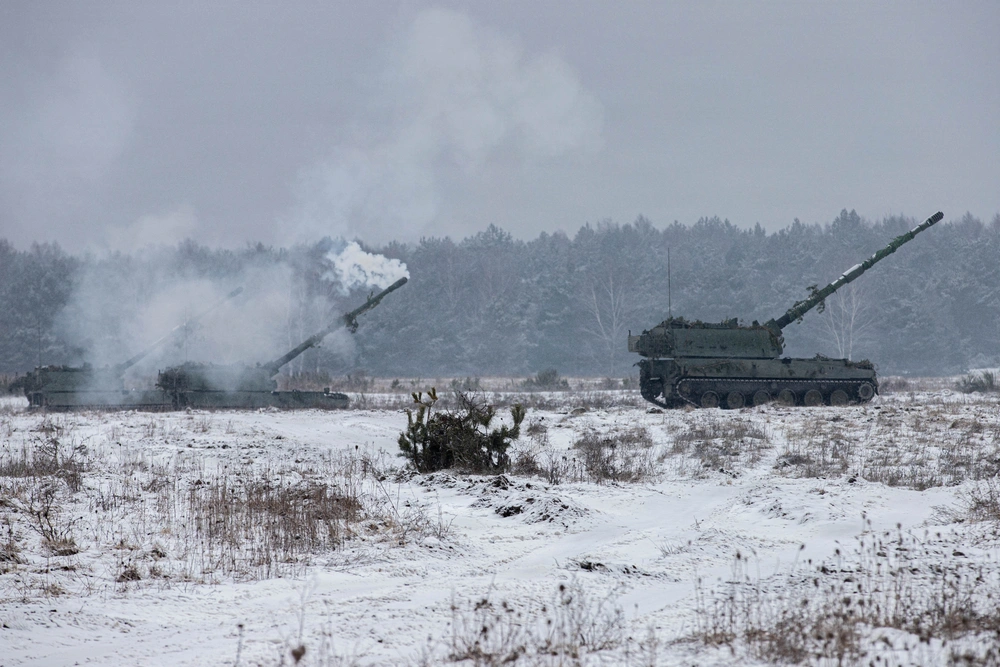
The XM1776 Mobile Tactical Cannon (MTC) program illustrates how the Field Training Teams support program offices during rapid prototyping. The MTC is the Army’s newest wheeled self-propelled howitzer prototype, intended to replace the M777 towed artillery platform in select formations. The MTC program is part of the Army’s ongoing continuous transformation effort to rapidly deliver war-winning capabilities to the Soldier. Under an award using an other transaction authority, Hanwha Defense USA will provide the Army with up to 18 wheeled Self-Propelled Howitzer Systems for Soldier testing and feedback.
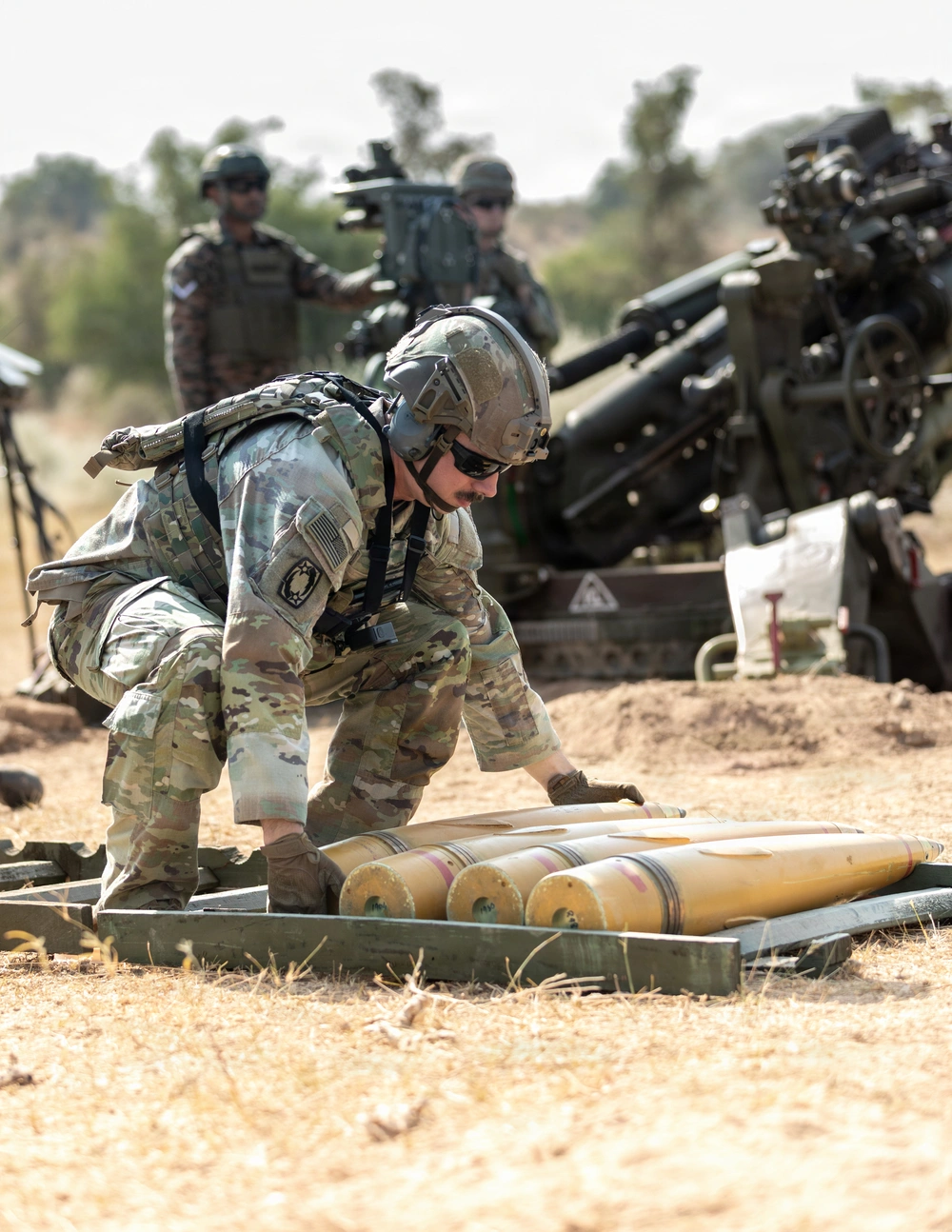
Lt. Col. Michael Pesano is the product manager for Self-Propelled Howitzer Modernization at Capability Program Executive Offensive Fires working with Jefferson and the Field Training Team. “This program is set up to replace the M777 towed artillery in select formations in the future,” said Pesano. “Right now, we’re in the MTA RP [Middle Tier Acquisition Rapid Prototyping] phase. During this phase, we will evaluate and characterize the system, integrate it into the Army network, gather Soldier feedback and identify changes to ensure it delivers operational value. We will present these findings to senior leaders to inform a future production decision.”
THE PROGRAM OFFICE PERSPECTIVE
From the program office’s perspective, the value provided by the Field Training Team experts extends far beyond just one-time training. Embedded within the program office, they work hand-in-hand with the MTC team to provide ongoing expertise, support and continuity.
Pesano explains that the WarU partnership began in the fall of 2025 when the MTC team was preparing to send out their Request for Prototype Proposal (RPP). The Field Training Team reviewed the RPP and continued providing guidance and support after the award to Hanwha Defense USA.
He continued describing that the Field Training Teams are integrated into the program office’s integrated product teams and working groups, providing expertise on engineering, contracting, budget program objective memorandum planning, intellectual property and any additional support needed while the MTC team moves through the rapid prototyping phase. “With the Field Training Team, they’re aligned and tied to the program. You get that continuity and direct support when you need it,” said Pesano. “So bottom line is, you know they are there to support the program … with training, consulting, providing recommendations and just being that objective third party to say, ‘Hey, your
plan makes sense or it doesn’t’.”
CONCLUSION
This new approach through WarU is breaking the mold of traditional training environments. Instead of being confined to classroom lectures and reading straight from a textbook, the Field Training Teams bring joint-service experience directly to the programs they support by offering collaborative and creative expertise that is highly adaptable to each program.
Ultimately, the Field Training Teams are designed to help strengthen the workforce, provide guidance, help with decision-making and most importantly, support the warfighter. Pesano also emphasized the breadth of experience available through WarU.
“WarU is incredibly important because they get to see across all the services,” said Pesano. “Their teams are made-up of experts in every functional area across every service … all that expertise and experience is in one location that you can immediately tap into.”
As the MTC program advances through rapid prototyping toward a future production decision, its partnership with WarU’s Fielding Training Team shows how working together can help accelerate programs and deliver capabilities faster to the warfighter. By bringing experienced acquisition professionals directly into program offices, this model gives teams ongoing support to navigate challenges and maintain momentum.
For more information, go to https://www.waru.edu/guidebook/ftt-and-fts/strategic-partnership-through-field-training-teams.
REBECCA WRIGHT is a writer and editor at the U.S. Army Acquisition Support Center’s Director of Acquisition Career Management Office at Fort Belvoir, Virginia. Before USAASC, she served as an explosive ordnance disposal technical writer at NSWC Indian Head. She has more than 16 years of experience writing and editing for the DoW and the U.S. Department of Justice.
Recent Posts
Read more of our recent Behind The Frontlines Posts.
FIELD TRAINING TEAMS ACCELERATE THE MOBILE TACTICAL CANNON PROGRAM

Keep Pushing the Needle – Anand Bahadur

JIATF-401 LEADS A NEW ERA IN COUNTER-SUAS DEFENSE