
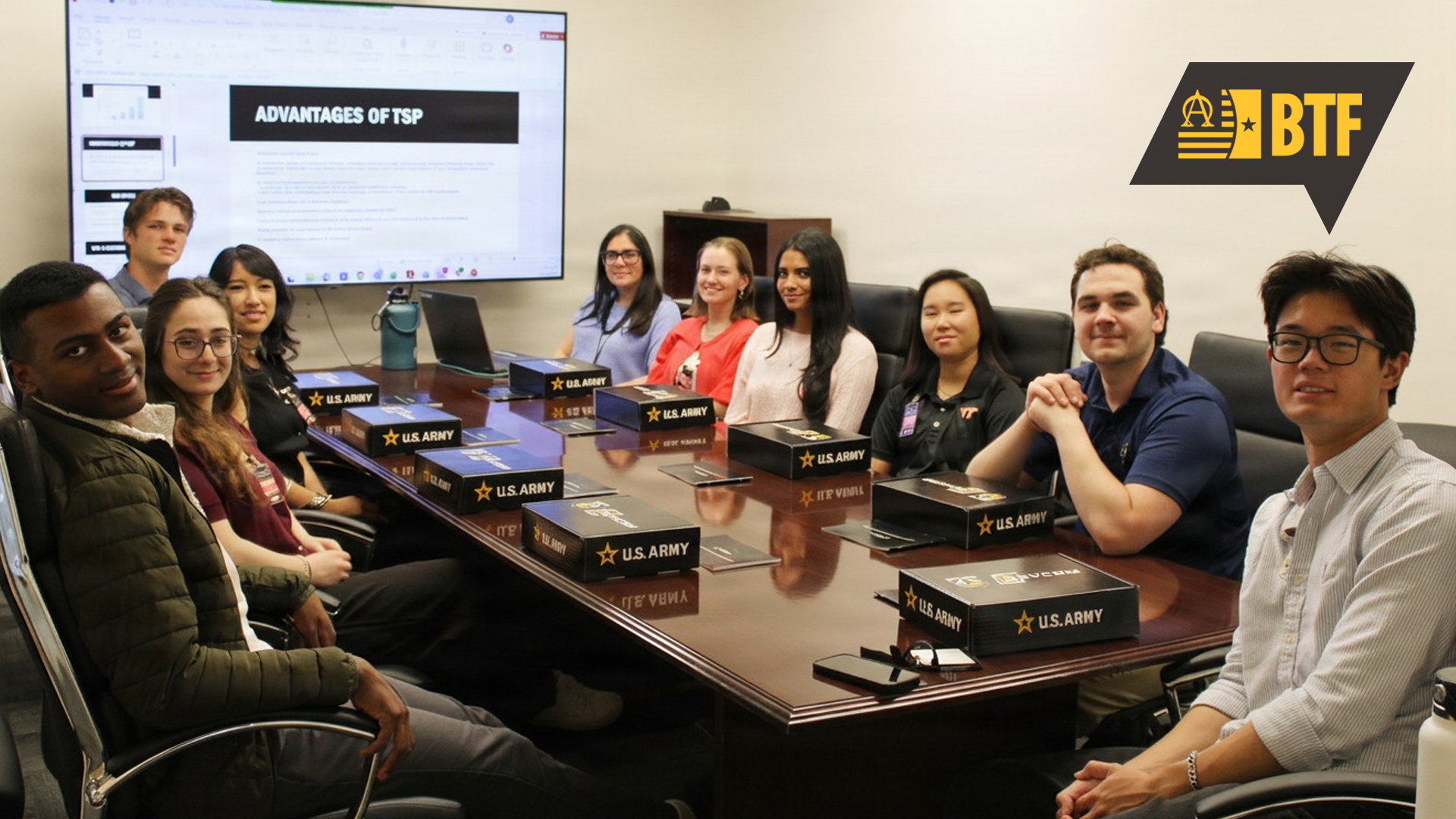
SMART scholars toured the centrifuge facility at the U.S. Army Engineer Research and Development Center (ERDC) in Vicksburg, Mississippi, in June 2026. The DoW’s SMART Program fully funds students’ degrees and provides guaranteed civilian employment, bringing highly skilled technical talent to cutting-edge research facilities like ERDC. (Photo by Justus Reed, U.S. Army Corps of Engineers, ERDC)
by John Hickman
The 1102 contract specialist series has a compound problem: there aren’t enough of us and we are getting older. Generating a pipeline of young talent with analytical, scientific and artificial intelligence (AI) integrated critical thinking skills to steward the profession is the solution to that problem. Promoting and generating awareness of programs like Science, Mathematics and Research for Transformation (SMART) Scholarship-for-Service Program and the Defense Civilian Training Corps, to feed that solution is imperative to the future of federal procurement, and the defense of our Nation.
There are only 25,857 contract specialists in the Department of War (DoW), handling 54% of the department’s budget. The total population of warranted contracting officers is comparable to the population of the endangered Florida manatee. How do we rekindle an endangered species? The same way conservationists have been doing it for decades: create a habitat and grow the next generation. In my own efforts to solve this at the grass roots level, I had no idea the length of road and the struggles I would face to get just one of these brilliant minds. The realization that we need thousands more is daunting.
CREATE A HABITAT
The DoW has a program called the SMART Scholarship-for-Service Program, which unfortunately, is not on the education.org website’s comprehensive list of scholarships. The SMART Program was enacted as part of the 2006 National Defense Authorization Act to further address the lack of science, technology, engineering and mathematics (STEM) experts in the DoW. The program expanded the Education and Economic Security Act signed into law by former President Ronald Reagan in 1984. SMART offers fully paid collegiate experience—which can be entered into any year (senior in high school through a master’s program)—summer internships and a guaranteed role in an agency once completed, in exchange for a civil service commitment, year for year. SMART is also available for current federal employees seeking advanced degrees. This year’s application window ends December 4.
Contract specialists need more than just a basic understanding of cost and price analysis (e.g., forensic accounting); they need to know how to read materials markets indices, leverage AI to model future risk profiles for economic price adjustment clauses and make equitable negotiations in an other transaction authority. They need to intuitively know the logic, algorithms and statistics that lead to efficient tool usage to make calculated decisions.
How many of you need more business systems analysts? Future 1102 leaders need analytical and modeling skills to predict forecasts with accuracy, orchestrate acquisition strategy boards that examine trendline metrics, make 4-to-8-year predictions on contract capacity utilization, assess market research results for useful data, analyze probabilities and make logical, data-driven policy.
Yes, the degree paths are STEM based, and yes, they cater to engineers and not 1102s. However, mathematics, data science and analytics, information sciences and computer science are all on the list. These are the skills that 1102s need that the 1102 development programs don’t offer. The days of, “I need to take an Excel class” are over. You don’t need to know how to write a formula anymore. You need to know how to code an AI agent to give you the data you need. 1102s need SMART Scholars.
GROW THE NEXT GENERATION
I took this approach in 2026. The U.S. Army Corps of Engineers, Omaha District typically uses local and Army Civilian Career Management Activity talent to fill our pipeline. The pipeline takes two years with an office of nearly a hundred personnel and an attrition rate of about 13%. I spend considerable effort maintaining that pipeline. I saw mathematics as one of the majors in SMART and I raised my hand to get a scholar.
I was unprepared. There were thousands of applicants, and my deadline was short.
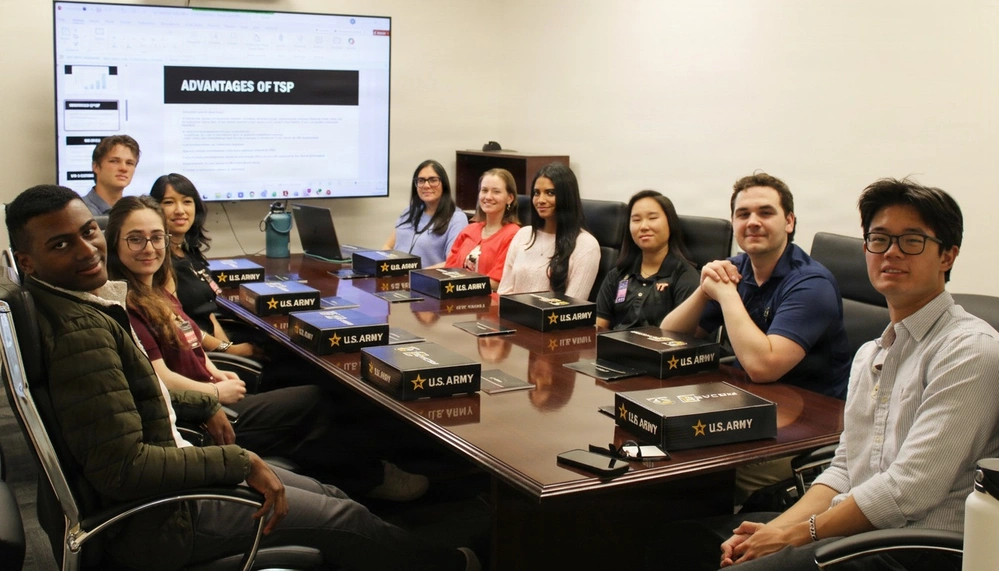
Once I was done breathing through a paper bag at the sheer volume of applicants, I started filtering and reading. One particularly stood out: Annabelle Du. The applicant had a passion for math and wanted to solve problems. I set up an interview. She was quiet, obviously nervous to talk to me, but she was sharp. Du listened to my questions intently, answered directly and was respectful and honest. She was a senior in high school, yet to be accepted to college. Once I got her to laugh a little bit, she humbly opened up about being the captain of her debate team, president of her national honor society and spent her free time reading self-help books. When I mentioned the prospect of moving to Omaha after graduation, Du was unfazed. She was a perfect fit.
The interview process took about a month, spanning through January and February of this year, and then final approval of the selection occurred in April. I kept in contact with Du and the program paid for a meet and greet. She showed up like a consummate professional. She outdressed many of our senior leaders, was equipped with a notebook and a pen and listened with quiet focus as I walked her through the district’s cubicle jungle. I let her sit with leaders and contracting officers in our various branches where they told her about invasive species, flood and drought mitigation efforts, property restoration and contaminant removal, new critical infrastructure projects and disaster response efforts. She was engaging and unafraid to ask questions, such as “what is a levee?” It was a great first impression.
This spring she was accepted to Johns Hopkins University. I am proud of her and I only met her once. Du demonstrated potential, an intent to learn, a desire to integrate into the team and strong integrity. She will travel to Omaha during summers for a paid internship during her college years and then will join us full time, upon graduation, into our development program. That’s when the real work begins. I will train a Johns Hopkins mathematics graduate on how to write a contract. More importantly, I will have the duty to teach her what it means to be a public servant, that what we do matters and how we solve the Nation’s toughest challenges. I have plenty of tools at my disposal to do that. But she will arrive with skills I can’t teach—analytical and logic skills that are cutting edge, the kind of calculated critical thinking that comes from the discipline she just spent four years crafting.
From an organizational leadership perspective, this took some foresight. I had to be okay with realizing I won’t have a fully formed contract specialist for seven years; her last year of high school, four years in college and then two years on-the-job getting credentialed from the Warfighting Acquisition University (WarU). However, what I will receive at the beginning of the on-the-job part of the pipeline, is a contract specialist with entry level experience already baked in, and an analytical mind that the future of the career field needs. I had to think strategically to augment my normal two-year pipeline.
The SMART Program is not perfect. The follow-on WarU education to her four-year degree is an added challenge and the SMART Program is missing an intermediary for the employer. SMART has great financial support and excellent talent acquisition, but there is a gap where I still carry the burden of attempting to economize three months of information packed into a time when Du needs a mental break. I need something to bridge that gap while class is in session. The Defense Civilian Training Corps (DCTC) offers experiential learning and project-based internships to develop entry level talent for the acquisition workforce since 2023 at a rate of about 85 students per year. But they have their work cut out for them to place DCTC graduates in DoW jobs because the program lacks centrally managed and resourced billets. As a result, DoW is losing talent even after it’s developed.
The Department needs more early talent wins, especially to achieve revolutionary acquisition reforms; No single talent pipeline is going to close the gap.
CONCLUSION
The call to action is clear: 1102 leaders need to help create a habitat and make younger specialists. The SMART Program and DCTC are designed to recruit younger federal civilians. As their employers, habitat creation is our job. Our missions are interesting, impactful and historic. Many of those in the younger generations want to make a difference; they want to be a part of something bigger. We can make that dream a reality, but USAJobs isn’t going to do it. We need strategic leaders, and more importantly, we need new skills in the career field.
I want to look for other SMART Scholars and hire DCTC interns in the coming years; but I am only one person. The 1102 series need thousands more like Du. I hope I am not the only contracting professional looking at these programs. I know there are more candidates with brilliant minds and a heart for public service that need a scholarship with and a guaranteed job afterward. I know there are leaders who are willing to shape and hire analytical thinkers, AI integrators and problem solvers.
Be one.
For more information, go to https://www.smartscholarship.org/smart/en.
JOHN HICKMAN is the deputy chief of contracting with the U.S. Army Corps of Engineers, Omaha District. He holds a Master of Studies in Law from The George Washington University, an MBA from Columbia College and a B.S. in business administration from Columbia College. He is a retired First Sergeant from the U.S. Army after 23 years of service.
CONTRIBUTOR: Karen Thorton, a research fellow with the Acquisition Innovation Research Center, a director on the Procurement Round Table, where she serves on the Acquisition Workforce committee.
Recent Posts
Read more of our recent Behind The Frontlines Posts.
Aligned for Impact – John Franklin
HIRING CONTRACTING SPECIALISTS, THE SMART WAY

Acquisition is a Team Effort – Brice Ott