
Stay informed with the latest news, opportunities, and career development resources from the Director, Acquisition Career Management (DACM) Office.
For tailored news, select one of the tabs below:
CLOSING SOON

TWO MASTER’S DEGREE OPPORTUNITIES
The application window for two new Naval Postgraduate School master’s degree programs will soon be closing on March 10:
- Master of Science in Acquisition – Contract Management, Curriculum 835.
The MSA-CM degree program provides an advanced education in the concepts, methodologies and analytical techniques necessary for the successful management of acquisition and contracting within complex organizations.
- Master of Science in Acquisition – Program Management, Curriculum 836.
The MSA-PM degree program educates students to be acquisition program managers and leaders of people and resources within federal organizations. Graduates gain the leadership and decision-making skills necessary to effectively deliver warfighting capabilities by balancing program cost, schedule, technical performance, risk and supportability. No previous program management experience is required for admission.
These 24-month distance learning programs are online with live interaction between the professor and students; Zoom participation is required for class sessions. Applications are being accepted in CAPPMIS/AAPDS and the Army Director, Acquisition Career Management (DACM) Office sponsors the full cost of tuition and up to $250 per course for books. Participants incur a two-year continued service agreement after graduating from the program.
For additional details and how to apply go to:
OPEN NOW

DEVELOP SKILLS, DELIVER VALUE – DEFENSE CIVILIAN EMERGING LEADER PROGRAM
Now through April 30, the Defense Civilian Emerging Leader Program (DCELP) is open to Army civilians GS-07 through GS-12 (or equivalent). DCELP is recognized as a foremost leadership development initiative for civilians, comprising a structured series of four (4) week-long residential modules, various assessment tools, activities for knowledge transfer, participant-led writing and briefing assignments, and individual coaching sessions. DCELP provides high performance/high potential employees with the opportunity to receive structured leader development through an experiential learning program.
Please note that the “Big 3” DCELP cohort is only open to Acquisition, Financial Management and Human Resources functional communities. The “Open” cohort is open to all functional communities and solicited through commands. The Army Acquisition Workforce is encouraged to apply to the “Big 3” cohort.
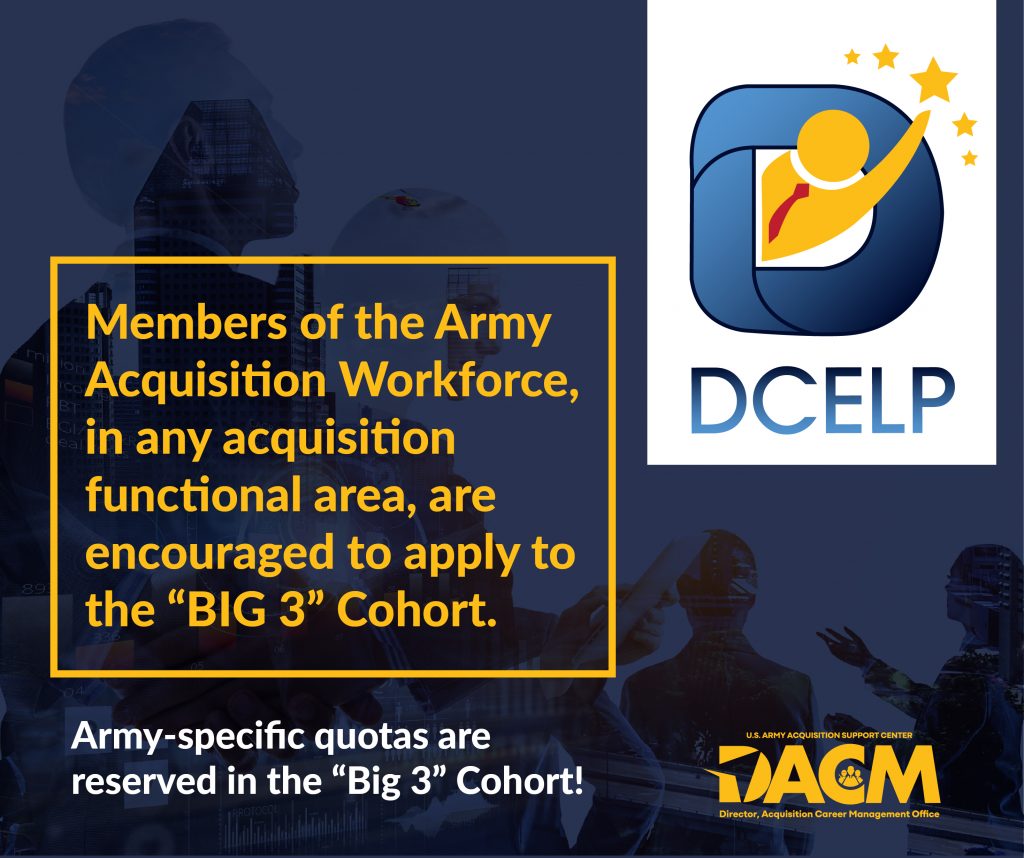
As one of the options under the Enterprise Civilian Talent Development Programs (ECTDP), DCELP enhances knowledge of fundamental leadership skills and prepares employees to assume increased responsibilities and more complex roles within their organizations and commands.
DCELP is aligned with and supports the competencies defined in DoDI 1400.25, Volume 410 “DoD Civilian Personnel Management System: Training, Education, and Professional Development”. As depicted on the DoD Civilian Leader Development Continuum in DoDI 1430.16, DCELP establishes a competency-based approach for deliberate development, emphasizing the concepts of:
- Leading self
- Leading teams and projects
- Leading people
Participants will dive into learning activities such as:
- Reflection exercises
- Leadership assessments
- Mentoring and peer coaching
- Real world applications of lessons learned
- Completing a 5-minute oral presentation
- Developing a personalized leadership roadmap and action plan
- Demonstrating and expanding leadership skills
- Final capstone project
Each seminar is separated by a two-week interval, allowing participants to return home between sessions to apply their learning and work on assignments before returning to the training location for the next seminar. This blended approach balances intensive on-site learning with practical application and reflection in their operational work environments.
The tentative program location is at the National Center for Employee Development in Norman, Oklahoma. Prospective applicants are strongly encouraged to contact their component, service, or agency training representative to learn more about any additional organization-specific requirements. DCELP is administered by the Civilian Human Resources Agency (CHRA), Army Civilian Career Management Activity (ACCMA). Applications are being accepted now through April 30.
For more information about DCELP and other ECTDP offerings, go to the ECTDP webpage here.
For extensive DCELP details and how to apply, go to the ACCMA Talent Development Application Portal.

LEARN TODAY, LEAD TOMORROW – ENTERPRISE CIVILIAN TALENT DEVELOPMENT PROGRAMS
Applications to the Enterprise Civilian Talent Development Program (ECTDP) are to be submitted directly through the Army Civilian Career Management Activity (ACCMA). While the U.S. Army Acquisition Support Center (USAASC) only assists with ECTDP applications for the USAASC Direct Reporting Unit, these programs are open and available to the entire Army Acquisition Workforce for GS-07 through GS-15 and equivalent level employees. ECTDP offers a variety of selections that help prepare Army civilians assume positions of greater responsibility through exceptional training. Entry, mid- and senior-level offerings include:
- Executive Leader Development Program
- Defense Civilian Emerging Leader Program
- Senior Managers Course in National Security Leadership
- Defense Senior Leader Development Program
- The Eisenhower School
- Naval War College
- Army War College, resident and distance education
- White House Leadership Development Program
Applications are being accepted now through April 30. For more information about all ECTDP offerings, visit the ECTDP webpage here. For extensive details and how to apply, go to the ACCMA Talent Development Application Portal.
TWO OPPORTUNITIES – FISCAL YEAR 2028 PROJECT / PRODUCT MANAGER AND PRODUCT DIRECTOR
The fiscal year (FY) 2028 Centralized Selection List (CSL) and FY28 Army Acquisition Centralized Selection Board (CSB) opportunities are accepting application packets now through April 17.The Army Acquisition Professional Development System (AAPDS), which is housed within the Career Acquisition Management Portal, enables those civilians who are interested and eligible to “opt-in” to multiple CSB/CSL opportunities using a single portal and one application packet, making the application process easier and more streamlined.
The purpose of the centralized selection process is to identify a pool of high performing and high potential acquisition professionals to lead and manage acquisition programs to meet the mission and vision of the Army acquisition enterprise. Best-qualified individuals will be selected for specifically identified acquisition command/key billet and director positions.
Please note the following updates to the training completion requirement: https://asc.army.mil/web/centralized-selection-list/#announcements.
The CSL point of contact is Maj. Timothy Hancock at timothy.q.hancock.mil@army.mil and the CSB point of contact is Christina Lindh at christina.n.lindh.civ@army.mil.
COMING SOON
LEARNING NEVER GOES OUT OF STYLE – NEXT ROUND OF ACQUISITION LEADERSHIP CHALLENGE PROGRAM OPENS IN APRIL
Coming soon! The Acquisition Leadership Challenge Program (ALCP) harnesses self-awareness as the tool for enhancing leadership, innovation and professional development by demonstrating how individual preferences and behaviors affect the ways we interact with coworkers and are viewed by others. Program participants will understand how accepting individual differences can produce a stronger group and a leadership corps that’s capable, collaborative and creative. Depending on which option is selected, ALCP is open to civilian and military Army Acquisition Workforce (AAW) members in various grades/ranks, including Science and Technology Reinvention Laboratories (STRLs) term employees.
- ALCP B “Beginnings” – ALCP B assists new hires in building a solid foundation for effective and efficient acclimation into the federal and acquisition workforce by introducing participants to their behavioral preferences and leadership tendencies, giving them the “big picture” of three consistent challenges faced by professionals. ALCP B is a 1.5-day virtual module open to civilian AAW members at the GS-7 through GS-11 or equivalent levels.
- ALCP I – ALCP I focuses on the individual, with emphasis on who they are, their behavioral preferences and leadership tendencies and if those preferences work for them now and for the long term. A model for understanding the dynamics of leadership is presented with facilitated participant understanding of how a variety of psychological instruments results indicate how an individual approaches leadership challenges in a variety of scenarios. The specific challenges of change, decision making and conflict resolution are addressed. ALCP I is a 2.5-day virtual module open to civilian and military AAW members at the GS-12, GS-13, O-3, O-4, E-6 and E-7 or equivalent levels.
- ALCP II – ALCP II focuses on the major challenge for new organizational leaders; to incorporate individual talents into a cohesive workforce. To be prepared to do so they need to understand the motivations, needs and interest of other people. The goal is to bring each participant to a heightened self-awareness and to build intrinsic and extrinsic value to their organization. ALCP II is a 2.5-day virtual module open to civilian supervisors and military AAW members at the GS-14, GS-15, SES, O-5, O-6, E-7 and E-8 or equivalent levels.
- ALCP III – ALCP III is an opportunity for further sequential development of advanced leadership skills. The goal is to provide a focus on mentoring, coaching and feedback skill development as well as to measure and assess influence style and work engagement profiles. Increased participant engagement is employed, including specific goal setting and comparison of improvements made in their leadership style and effectiveness through use of the Campbell Leadership Index (360). ALCP III is a 2.5-day virtual module open to civilian supervisors and military AAW members at the GS-14, GS-15, SES, O-5 and above, E-8 and E-9 or equivalent levels.
The process for enrollment into ALCP I is nomination-based. The Army Director, Acquisition Career Management Office ALCP program manager will coordinate directly with Organization Acquisition POCs (OAPs) to fill quotas.
Acquisition career management advocate nominations should be provided to the designated command’s lead OAP. Each command/organization will be provided with quotas to ALCP offerings.
REMINDER

PLAN AHEAD FOR DAWIA PRACTITIONER-LEVEL CERTIFICATION GRACE PERIOD EXPIRATION!
The five-year grace periods for Practitioner level certification will begin to expire in February 2027. To avoid last-minute challenges, it is critical to plan ahead and schedule your required courses now if you haven’t already.
The acquisition functional areas (AFAs) with Practitioner-level certifications are Program Management (PM), Engineering and Technical Management (ETM), Test and Evaluation (T&E), Business Financial Management (BUS-FM) and Business Cost Estimating (BUS-CE).
Anticipated High Demand:
As the grace period expiration dates approach, we expect a significant increase in course registrations. Delaying your enrollment may result in limited class availability, putting you at risk of not meeting certification requirements. Certification is a condition of employment; you must meet your acquisition position’s certification requirements to maintain compliance.
Key Points:
As a professional member of the Army Acquisition Workforce, it is important that you know your certification requirements. The following are additional PM Practitioner certification considerations:
- PM Practitioner requirements include passing PMT4890V—a comprehensive exam—to meet certification requirements.
- All required courses must be completed before taking the exam.
- If you fail the exam, there is a 30-day waiting period before retaking it.
- You are allowed a maximum of three attempts within a 12-month period.
- If you fail the exam and have not taken one of the prep courses, you are required to successfully complete either PMT 4810 or PMT 4800V prior to your next attempt.
- The PM Practitioner level updated Fiscal Year (FY) 2026 Certification requirements are in effect now.
- On Oct. 1, 2026, the exam will incorporate the updated FY26 certification course content.
Action Required:
- Check your grace period expiration. Log into CAPPMIS and review your individual development plan (IDP) to confirm your grace period expiration date.
- Schedule your courses now to secure your spot and avoid potential delays.
- Plan your certification timeline carefully, especially for PM certification, to account for prerequisites and exam retake policies.
- Don’t wait—take action today to ensure you meet your DAWIA Practitioner certification requirements on time!
For assistance, please submit a help desk ticket and an acquisition career manager will respond to your inquiry:
OPPORTUNITIES
VIRTUAL SUMMIT – ACCELERATING WARFIGHTING CAPABILITIES
Registration is now open for the Naval Postgraduate School’s 23rd Annual Acquisition Research Symposium and Innovation Summit that will take place on May 6-7. This year’s theme is “Accelerating Warfighting Capabilities”. In keeping with recent executive orders and department memoranda, panels will explore and promote innovative ways to enhance readiness, deter adversaries and increase warfighting capabilities by reviving the defense industrial base, reforming the acquisition process and rapidly fielding emerging technologies.
Featured panels will include:
- Putting the Industrial Base on a Wartime Footing
- Engineering the Software-Defined Enterprise
- Engineering Resilience in Contested Logistics
- Accelerating Surge Capacity and Fleet Integration
- Shaping the Future of Acquisition Talent
- Preserving Human Agency and Market Integrity in the AI Era
- Leveraging Acquisition for Strategic Advantage
- Scaling Modernization through New Funding and Engineering Models
- Revitalizing Industrial Surge and Manufacturing Security
- Collaborative Development for Immediate Warfighting Advantage
- Reimagining Munitions Acquisition for the Industrial Age
This virtual webinar event will be held on Microsoft Teams. Register today, spots are limited.
RESOURCES
KNOWLEDGE MATTERS – FEDERAL ACQUISITION REGULATION OVERHAUL RESOURCES
The Revolutionary Federal Acquisition Regulation (FAR) Overhaul (RFO) initiative has made significant strides in its goal of returning the FAR to its statutory roots, rewriting it in plain language and removing most of its non-statutory rules. To assist in educating the workforce, acquisition.gov provides several resources including the FAR Companion, practitioner albums, and FAQs. Additionally, Defense Acquisition University (DAU) provides RFO Comparison Documents for the workforce with concise summaries of the key changes introduced by the RFO across all FAR parts accompanied by a playlist of the “CONNECT Live” RFO Webinars! For access to these resources and more, browse and bookmark the following RFO-related pages:
- Revolutionary FAR Overhaul
- FAR Companion Version 2.0
- Practitioner Albums: Training and Non-Regulatory Materials
- RFO – Frequently Asked Questions
- RFO Comparison Tool
- Collection of “CONNECT Live” RFO webinars
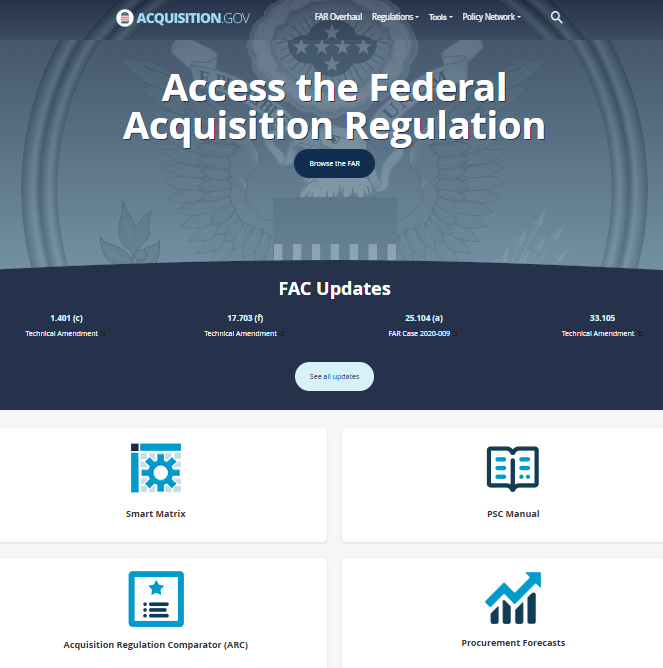
While we’re on the topic of the acquisition overhaul, the “Behind The Frontlines” article below, by Rebecca M. Wright, writer and editor at the U.S. Army Acquisition Support Center, covers the impact of the updated FAR on Army acquisition.

The updated FAR will increase efficiency, saving both time and money, resulting in quicker delivery of mission-critical supplies to Soldiers in the field—like Pfc. Ian Alvarado, 11th Airborne Division, pictured here at Allen Army Airfield, Fort Greely, Alaska, January 25, 2025. (Photo by Sgt. 1st Class Matt Kuzara, 11th Airborne Division)
OVERHAUL OF THE FEDERAL ACQUISITION REGULATION AND ITS IMPACT TO ARMY ACQUISITION
by Rebecca M. Wright
In April 2025, President Donald Trump signed Executive Order 14275, “Restoring Common Sense to Federal Procurement.” This order aims to improve how government agencies purchase products and services by mandating an overhaul of the Federal Acquisition Regulation (FAR). The FAR is the primary directive used by executive agencies in their acquisition of supplies and services with appropriated funds.
Issued in 1983, and taking effect in 1984, the FAR has been revised frequently to keep in line with changing priorities, policies and modernization. The original FAR exceeds over 2,000 pages and is perceived to be too lengthy, complicated and inefficient. Executive Order 14275 instructs returning the FAR to its “statutory roots” by streamlining the acquisition process—removing unnecessary regulations and policy, promoting the acquisition of commercial products and simplifying it with what is referred to as the Revolutionary FAR Overhaul (RFO).
A PHASED APPROACH
Traditionally updated and maintained by the Federal Acquisition Regulatory Council, commonly referred to as the FAR Council, which includes representatives from the General Services Administration, the Department of War and the National Aeronautics and Space Administration, the latest overhaul is currently being updated in partnership with the Office of Federal Procurement Policy. The FAR is being modernized and streamlined using a phased approach. In Phase I, the FAR Council and the Office of Federal Procurement Policy collaborated to amend the FAR to reduce its complexity. This included removing any provisions that were not required by statute or did not support national defense, rewriting the FAR in plain language and encouraging agencies to buy commercially available products.
As revisions are made to the FAR, they are published on the Revolutionary FAR Overhaul webpage located on acquisition.gov. Completed between April and October 2025, these revisions—also referred to as agency deviations—allowed government agencies to begin using the revisions immediately before the formal process is officially adopted. This also provided agencies with the opportunity to test out the new processes and provide feedback for consideration during the deviation phase.
Phase II of the RFO began in October 2025 consisting of the formal rulemaking process and permanently amending the FAR. During this process, the FAR Council is gathering all the revisions made in the RFO along with lessons learned and feedback received from agencies during Phase I to make any improvements to the draft revisions. Once these draft revisions are complete, they will be published as a Notice of Proposed Rulemaking, or NPRM, in the Federal Register. This allows for public comments to be submitted from government agencies, contractors, industry, law firms, etc. By law, the FAR Council must review and consider all comments that have been submitted and determine if any of the comments warrant additional revisions to the FAR draft. Upon final decisions on all comments received and any revisions that need to be made, the FAR Council will publish the Final Rule in the Federal Register.
Read the entire article here.

RECENTLY SIGNED DACM POLICIES
On Feb. 4, two Army Director, Acquisition Career Management (DACM) memorandums were signed:
The Army Acquisition Workforce Centralized Selection List (CSL) Program Policy and Procedures and the Student Loan Repayment Program (SLRP) Policy and Procedures.
- The CSL memo establishes policy and procedures for civilian Army Acquisition Workforce (AAW) CSL positions and the selection board process. It applies to all civilian GS-13 through GS-15 (and broadband equivalent) AAW professionals who apply to and are selected to fill an Army acquisition CSL position. – CSL Memo
- The SLRP memo establishes policy for the Student Loan Repayment Program (SLRP) and outlines procedures for the application and selection process. – SLRP Memo
- The Fiscal Year 2026 Army Acquisition Workforce Standards memo was signed on February 18. This memo is published every fiscal year and outlines the standards that the Army Acquisition Executive has set for AAW professionals and their parent organizations. These standards comply with Defense Acquisition Workforce Improvement Act (DAWIA) statutory requirements and Army Director, Acquisition Career Management (DACM) policies. Topics covered in this memo include expectations regarding DAWIA certification grace periods, individual development plans, continuous learning points, Senior Rater Potential Evaluation, acquisition ethics training, and associated compliance rates across the AAW. – FY26 Workforce Standards
Also signed on February 18 were the Army Acquisition Active Component Advanced Civil Schooling (ACS) Program Policy and Procedures memo and the Army Acquisition Training with Industry (TWI) Policy and Procedures memo.
- The ACS memo establishes responsibilities, policy and procedures for application, selection and participation in the ACS program for active component Functional Area 51 (FA51) Officers and Military Occupational Specialty 51C Non-Commissioned Officers (NCOs). – ACS Memo
- The TWI memo establishes responsibility, policy and procedures for Active Component FA51 Officer and 51C NCO participation in the TWI program – TWI Memo
AWARDS
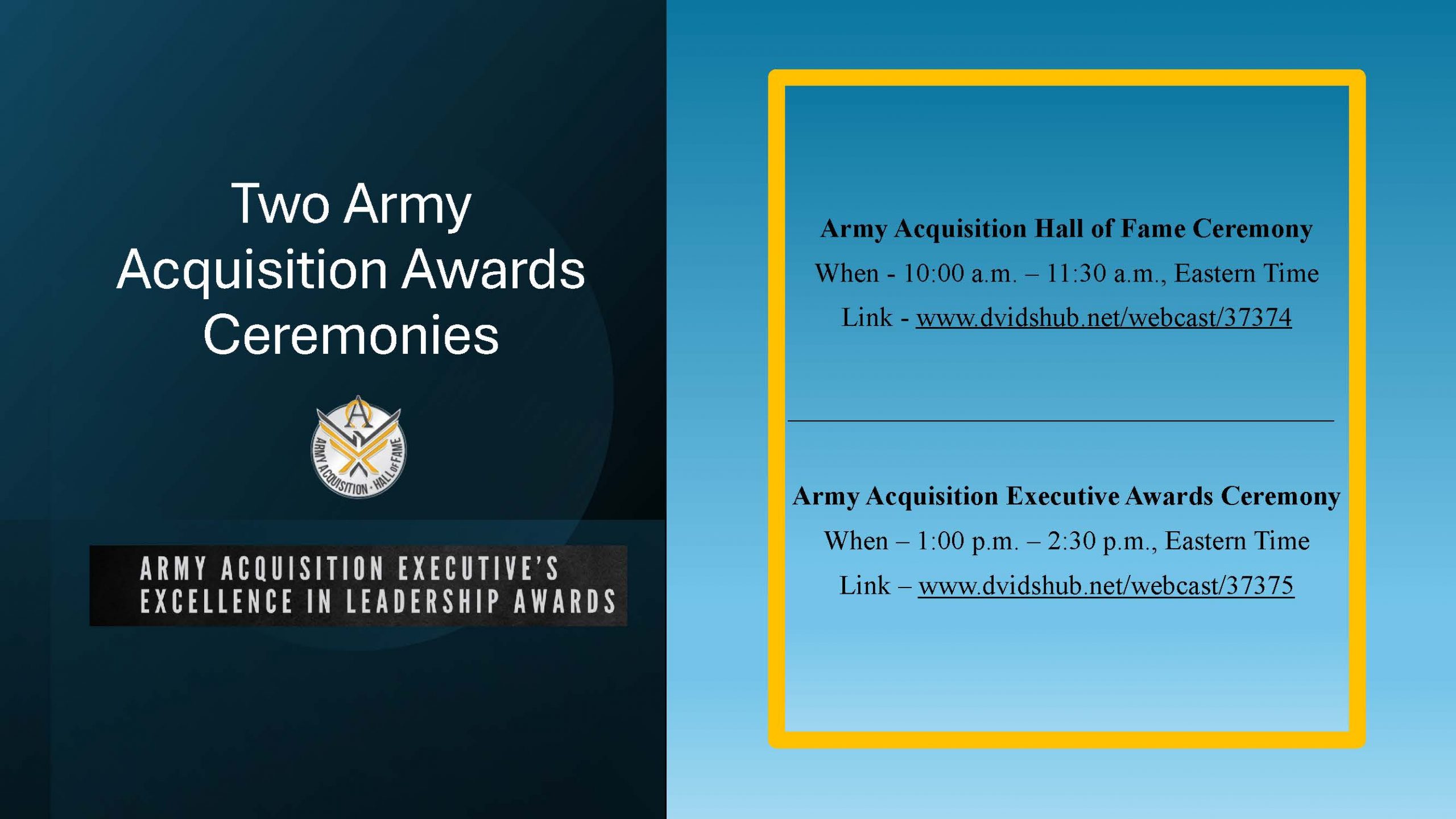
TUNE IN TO TWO ARMY ACQUISITION AWARD CEREMONIES
There are two upcoming acquisition awards ceremonies on the near horizon: The Army Acquisition Hall of Fame ceremony and the Army Acquisition Executive’s Excellence in Acquisition Leadership Awards ceremony. The ceremonies will be livestreamed.
Tune in to the following links on March 4:
Army Acquisition Hall of Fame Ceremony
Army Acquisition Executive’s Excellence in Leadership Awards Ceremony
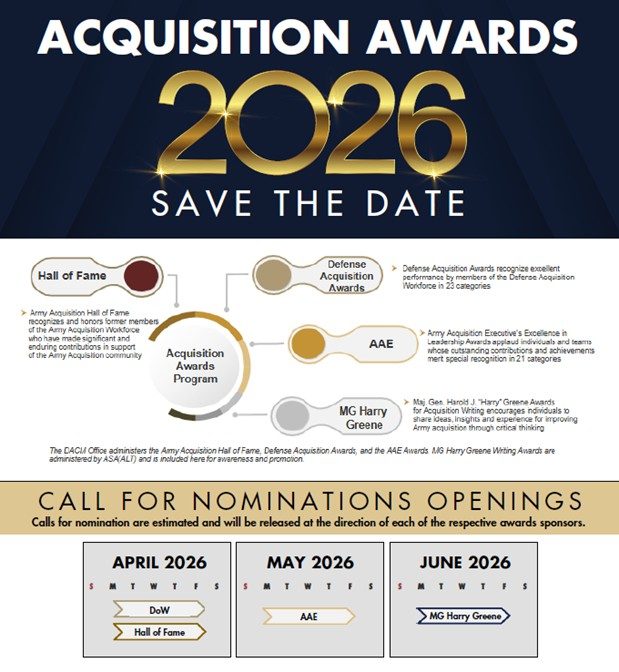
NEW HIRES – TAKE THE AAW ONBOARDING COURSE
If you were recently hired into the Army Acquisition Workforce (AAW), you’ll want to sign up for the “Welcome to the Army Acquisition Workforce” course. This course should be completed within the first few months of joining the acquisition workforce as it offers a dynamic overview of:
✔ The AAW
✔ Training and certification standards
✔ Tools and resources
✔ Career models
✔ Development and leadership opportunities
✔ Staying connected
To access and begin taking the course, navigate to the Army Training Information System (ATIS) Learning home page at https://learn.atis.army.mil/moodle. (Chrome or Edge browsers are recommended.)
- Login to EAMS-A-Single Sign-On (CAC login).
- Click the CATALOG tab.
- Locate the “Welcome to the Army Acquisition Workforce” course in the list of Published courses, or enter the course name in the Search field, and click the search icon.
- Select the Register & Launch button, which will take you directly where you can launch the Learning Assignment(s) required for the course.
There is a downloadable resources guide included with the course. You are highly encouraged to download and save a copy of this guide. Once you have closed the course topic, your completion will show up on your ATIS LEARNING MY CERTIFICATES page.
Take The Course Here


SUBSCRIBE TO “BEHIND THE FRONTLINES” NEWS!
The new Behind The Frontlines (BTF) online news outlet focuses on all things Army acquisition. BTF delivers timely news on a rolling basis featuring content on Army acquisition processes, procedures, capabilities, services and equipment all tailored to support you, our Army Acquisition Workforce. Subscribe today!
OPEN NOW
FISCAL YEAR 2027 51C ACTIVE COMPONENT RECLASSIFICATION
Now through April 12, non-commissioned officers (NCOs) interested in military occupational series (MOS) 51C (Contracting) can submit their application packets to the Reclassification Panel. MOS 51Cs are all about providing procurement support for a unit’s requirements and serving the commander as a business adviser—ensuring they get what’s needed, on time, to support the mission. The Army has a continuously increasing need for contingency contracting officers, and their contributions are viewed as a critical asset.
All Soldiers will be notified via email of their approval or disapproval status within 90 days after the conclusion of each review panel. Board results will also be published after all applicants have been notified directly on the USAASC website.
Upon acceptance into MOS 51C, Soldiers must coordinate with their current MOS Talent Manager to request a branch release, and with U.S. Human Resource Command (HRC) to secure a class seat in the Army Acquisition Transition Course (AATC). MOS 51C will be officially awarded upon successful completion of the required training. Acceptance letters remain valid for four months from the date of receipt.
For details and how to apply, go to the Reclassification Process page here.
NCO points of contact are listed here.
COMING SOON
LEARNING NEVER GOES OUT OF STYLE – NEXT ROUND OF ACQUISITION LEADERSHIP CHALLENGE PROGRAM OPENS IN APRIL
Coming soon! The Acquisition Leadership Challenge Program (ALCP) harnesses self-awareness as the tool for enhancing leadership, innovation and professional development by demonstrating how individual preferences and behaviors affect the ways we interact with coworkers and are viewed by others. Program participants will understand how accepting individual differences can produce a stronger group and a leadership corps that’s capable, collaborative and creative. Depending on which option is selected, ALCP is open to civilian and military Army Acquisition Workforce (AAW) members in various grades/ranks, including Science and Technology Reinvention Laboratories (STRLs) term employees.
- ALCP B “Beginnings” – ALCP B assists new hires in building a solid foundation for effective and efficient acclimation into the federal and acquisition workforce by introducing participants to their behavioral preferences and leadership tendencies, giving them the “big picture” of three consistent challenges faced by professionals. ALCP B is a 1.5-day virtual module open to civilian AAW members at the GS-7 through GS-11 or equivalent levels.
- ALCP I – ALCP I focuses on the individual, with emphasis on who they are, their behavioral preferences and leadership tendencies and if those preferences work for them now and for the long term. A model for understanding the dynamics of leadership is presented with facilitated participant understanding of how a variety of psychological instruments results indicate how an individual approaches leadership challenges in a variety of scenarios. The specific challenges of change, decision making and conflict resolution are addressed. ALCP I is a 2.5-day virtual module open to civilian and military AAW members at the GS-12, GS-13, O-3, O-4, E-6 and E-7 or equivalent levels.
- ALCP II – ALCP II focuses on the major challenge for new organizational leaders; to incorporate individual talents into a cohesive workforce. To be prepared to do so they need to understand the motivations, needs and interest of other people. The goal is to bring each participant to a heightened self-awareness and to build intrinsic and extrinsic value to their organization. ALCP II is a 2.5-day virtual module open to civilian supervisors and military AAW members at the GS-14, GS-15, SES, O-5, O-6, E-7 and E-8 or equivalent levels.
- ALCP III – ALCP III is an opportunity for further sequential development of advanced leadership skills. The goal is to provide a focus on mentoring, coaching and feedback skill development as well as to measure and assess influence style and work engagement profiles. Increased participant engagement is employed, including specific goal setting and comparison of improvements made in their leadership style and effectiveness through use of the Campbell Leadership Index (360). ALCP III is a 2.5-day virtual module open to civilian supervisors and military AAW members at the GS-14, GS-15, SES, O-5 and above, E-8 and E-9 or equivalent levels.
The process for enrollment into ALCP I is nomination-based. The Army Director, Acquisition Career Management Office ALCP program manager will coordinate directly with Organization Acquisition POCs (OAPs) to fill quotas.
Acquisition career management advocate nominations should be provided to the designated command’s lead OAP. Each command/organization will be provided with quotas to ALCP offerings.
OPPORTUNITIES
VIRTUAL SUMMIT – ACCELERATING WARFIGHTING CAPABILITIES
Registration is now open for the Naval Postgraduate School’s 23rd Annual Acquisition Research Symposium and Innovation Summit that will take place on May 6-7. This year’s theme is “Accelerating Warfighting Capabilities”. In keeping with recent executive orders and department memoranda, panels will explore and promote innovative ways to enhance readiness, deter adversaries and increase warfighting capabilities by reviving the defense industrial base, reforming the acquisition process and rapidly fielding emerging technologies.
Featured panels will include:
- Putting the Industrial Base on a Wartime Footing
- Engineering the Software-Defined Enterprise
- Engineering Resilience in Contested Logistics
- Accelerating Surge Capacity and Fleet Integration
- Shaping the Future of Acquisition Talent
- Preserving Human Agency and Market Integrity in the AI Era
- Leveraging Acquisition for Strategic Advantage
- Scaling Modernization through New Funding and Engineering Models
- Revitalizing Industrial Surge and Manufacturing Security
- Collaborative Development for Immediate Warfighting Advantage
- Reimagining Munitions Acquisition for the Industrial Age
This virtual webinar event will be held on Microsoft Teams. Register today, spots are limited.
RESOURCES
KNOWLEDGE MATTERS – FEDERAL ACQUISITION REGULATION OVERHAUL RESOURCES
The Revolutionary Federal Acquisition Regulation (FAR) Overhaul (RFO) initiative has made significant strides in its goal of returning the FAR to its statutory roots, rewriting it in plain language and removing most of its non-statutory rules. To assist in educating the workforce, acquisition.gov provides several resources including the FAR Companion, practitioner albums, and FAQs. Additionally, Defense Acquisition University (DAU) provides RFO Comparison Documents for the workforce with concise summaries of the key changes introduced by the RFO across all FAR parts accompanied by a playlist of the “CONNECT Live” RFO Webinars! For access to these resources and more, browse and bookmark the following RFO-related pages:
- Revolutionary FAR Overhaul
- FAR Companion Version 2.0
- Practitioner Albums: Training and Non-Regulatory Materials
- RFO – Frequently Asked Questions
- RFO Comparison Tool
- Collection of “CONNECT Live” RFO webinars
While we’re on the topic of the acquisition overhaul, the “Behind The Frontlines” article below, by Rebecca M. Wright, writer and editor at the U.S. Army Acquisition Support Center, covers the impact of the updated FAR on Army acquisition.
The updated FAR will increase efficiency, saving both time and money, resulting in quicker delivery of mission-critical supplies to Soldiers in the field—like Pfc. Ian Alvarado, 11th Airborne Division, pictured here at Allen Army Airfield, Fort Greely, Alaska, January 25, 2025. (Photo by Sgt. 1st Class Matt Kuzara, 11th Airborne Division)
OVERHAUL OF THE FEDERAL ACQUISITION REGULATION AND ITS IMPACT TO ARMY ACQUISITION
by Rebecca M. Wright
In April 2025, President Donald Trump signed Executive Order 14275, “Restoring Common Sense to Federal Procurement.” This order aims to improve how government agencies purchase products and services by mandating an overhaul of the Federal Acquisition Regulation (FAR). The FAR is the primary directive used by executive agencies in their acquisition of supplies and services with appropriated funds.
Issued in 1983, and taking effect in 1984, the FAR has been revised frequently to keep in line with changing priorities, policies and modernization. The original FAR exceeds over 2,000 pages and is perceived to be too lengthy, complicated and inefficient. Executive Order 14275 instructs returning the FAR to its “statutory roots” by streamlining the acquisition process—removing unnecessary regulations and policy, promoting the acquisition of commercial products and simplifying it with what is referred to as the Revolutionary FAR Overhaul (RFO).
A PHASED APPROACH
Traditionally updated and maintained by the Federal Acquisition Regulatory Council, commonly referred to as the FAR Council, which includes representatives from the General Services Administration, the Department of War and the National Aeronautics and Space Administration, the latest overhaul is currently being updated in partnership with the Office of Federal Procurement Policy. The FAR is being modernized and streamlined using a phased approach. In Phase I, the FAR Council and the Office of Federal Procurement Policy collaborated to amend the FAR to reduce its complexity. This included removing any provisions that were not required by statute or did not support national defense, rewriting the FAR in plain language and encouraging agencies to buy commercially available products.
As revisions are made to the FAR, they are published on the Revolutionary FAR Overhaul webpage located on acquisition.gov. Completed between April and October 2025, these revisions—also referred to as agency deviations—allowed government agencies to begin using the revisions immediately before the formal process is officially adopted. This also provided agencies with the opportunity to test out the new processes and provide feedback for consideration during the deviation phase.
Phase II of the RFO began in October 2025 consisting of the formal rulemaking process and permanently amending the FAR. During this process, the FAR Council is gathering all the revisions made in the RFO along with lessons learned and feedback received from agencies during Phase I to make any improvements to the draft revisions. Once these draft revisions are complete, they will be published as a Notice of Proposed Rulemaking, or NPRM, in the Federal Register. This allows for public comments to be submitted from government agencies, contractors, industry, law firms, etc. By law, the FAR Council must review and consider all comments that have been submitted and determine if any of the comments warrant additional revisions to the FAR draft. Upon final decisions on all comments received and any revisions that need to be made, the FAR Council will publish the Final Rule in the Federal Register.
Read the entire article here.
RECENTLY SIGNED DACM POLICIES
On Feb. 4, two Army Director, Acquisition Career Management (DACM) memorandums were signed:
The Army Acquisition Workforce Centralized Selection List (CSL) Program Policy and Procedures and the Student Loan Repayment Program (SLRP) Policy and Procedures.
- The CSL memo establishes policy and procedures for civilian Army Acquisition Workforce (AAW) CSL positions and the selection board process. It applies to all civilian GS-13 through GS-15 (and broadband equivalent) AAW professionals who apply to and are selected to fill an Army acquisition CSL position. – CSL Memo
- The SLRP memo establishes policy for the Student Loan Repayment Program (SLRP) and outlines procedures for the application and selection process. – SLRP Memo
- The Fiscal Year 2026 Army Acquisition Workforce Standards memo was signed on February 18. This memo is published every fiscal year and outlines the standards that the Army Acquisition Executive has set for AAW professionals and their parent organizations. These standards comply with Defense Acquisition Workforce Improvement Act (DAWIA) statutory requirements and Army Director, Acquisition Career Management (DACM) policies. Topics covered in this memo include expectations regarding DAWIA certification grace periods, individual development plans, continuous learning points, Senior Rater Potential Evaluation, acquisition ethics training, and associated compliance rates across the AAW. – FY26 Workforce Standards
Also signed on February 18 were the Army Acquisition Active Component Advanced Civil Schooling (ACS) Program Policy and Procedures memo and the Army Acquisition Training with Industry (TWI) Policy and Procedures memo.
- The ACS memo establishes responsibilities, policy and procedures for application, selection and participation in the ACS program for active component Functional Area 51 (FA51) Officers and Military Occupational Specialty 51C Non-Commissioned Officers (NCOs). – ACS Memo
- The TWI memo establishes responsibility, policy and procedures for Active Component FA51 Officer and 51C NCO participation in the TWI program – TWI Memo
AWARDS
TUNE IN TO TWO ARMY ACQUISITION AWARD CEREMONIES
There are two upcoming acquisition awards ceremonies on the near horizon: The Army Acquisition Hall of Fame ceremony and the Army Acquisition Executive’s Excellence in Acquisition Leadership Awards ceremony. The ceremonies will be livestreamed.
Tune in to the following links on March 4:
Army Acquisition Hall of Fame Ceremony
Army Acquisition Executive’s Excellence in Leadership Awards Ceremony
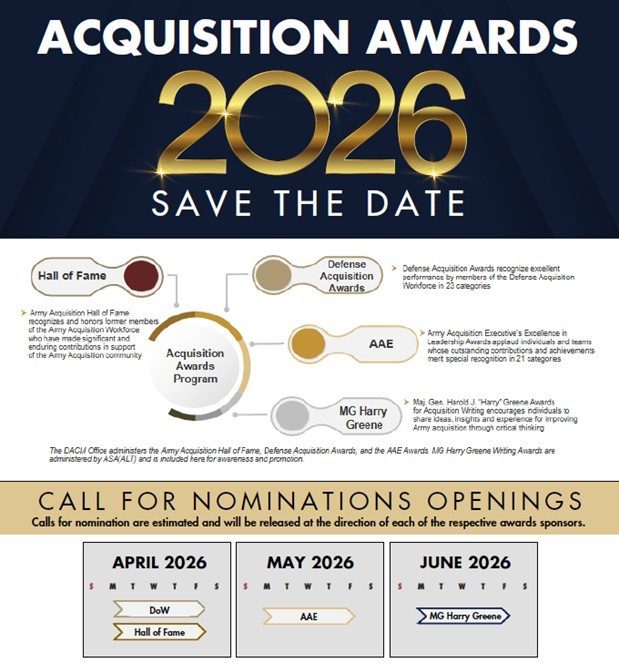
NEW HIRES – TAKE THE AAW ONBOARDING COURSE
If you were recently hired into the Army Acquisition Workforce (AAW), you’ll want to sign up for the “Welcome to the Army Acquisition Workforce” course. This course should be completed within the first few months of joining the acquisition workforce as it offers a dynamic overview of:
✔ The AAW
✔ Training and certification standards
✔ Tools and resources
✔ Career models
✔ Development and leadership opportunities
✔ Staying connected
To access and begin taking the course, navigate to the Army Training Information System (ATIS) Learning home page at https://learn.atis.army.mil/moodle. (Chrome or Edge browsers are recommended.)
- Login to EAMS-A-Single Sign-On (CAC login).
- Click the CATALOG tab.
- Locate the “Welcome to the Army Acquisition Workforce” course in the list of Published courses, or enter the course name in the Search field, and click the search icon.
- Select the Register & Launch button, which will take you directly where you can launch the Learning Assignment(s) required for the course.
There is a downloadable resources guide included with the course. You are highly encouraged to download and save a copy of this guide. Once you have closed the course topic, your completion will show up on your ATIS LEARNING MY CERTIFICATES page.
Take The Course Here
SUBSCRIBE TO “BEHIND THE FRONTLINES” NEWS!
The new Behind The Frontlines (BTF) online news outlet focuses on all things Army acquisition. BTF delivers timely news on a rolling basis featuring content on Army acquisition processes, procedures, capabilities, services and equipment all tailored to support you, our Army Acquisition Workforce. Subscribe today!
OPEN NOW
TWO OPPORTUNITIES – FISCAL YEAR 2028 PROJECT / PRODUCT MANAGER AND PRODUCT DIRECTOR
The fiscal year (FY) 2028 Centralized Selection List (CSL) and FY28 Army Acquisition Centralized Selection Board (CSB) opportunities are accepting application packets now through April 17.The Army Acquisition Professional Development System (AAPDS), which is housed within the Career Acquisition Management Portal, enables those civilians who are interested and eligible to “opt-in” to multiple CSB/CSL opportunities using a single portal and one application packet, making the application process easier and more streamlined.
The purpose of the centralized selection process is to identify a pool of high performing and high potential acquisition professionals to lead and manage acquisition programs to meet the mission and vision of the Army acquisition enterprise. Best-qualified individuals will be selected for specifically identified acquisition command/key billet and director positions.
Please note the following updates to the training completion requirement: https://asc.army.mil/web/centralized-selection-list/#announcements.
The CSL point of contact is Maj. Timothy Hancock at timothy.q.hancock.mil@army.mil and the CSB point of contact is Christina Lindh at christina.n.lindh.civ@army.mil.
COMING SOON
LEARNING NEVER GOES OUT OF STYLE – NEXT ROUND OF ACQUISITION LEADERSHIP CHALLENGE PROGRAM OPENS IN APRIL
Coming soon! The Acquisition Leadership Challenge Program (ALCP) harnesses self-awareness as the tool for enhancing leadership, innovation and professional development by demonstrating how individual preferences and behaviors affect the ways we interact with coworkers and are viewed by others. Program participants will understand how accepting individual differences can produce a stronger group and a leadership corps that’s capable, collaborative and creative. Depending on which option is selected, ALCP is open to civilian and military Army Acquisition Workforce (AAW) members in various grades/ranks, including Science and Technology Reinvention Laboratories (STRLs) term employees.
- ALCP B “Beginnings” – ALCP B assists new hires in building a solid foundation for effective and efficient acclimation into the federal and acquisition workforce by introducing participants to their behavioral preferences and leadership tendencies, giving them the “big picture” of three consistent challenges faced by professionals. ALCP B is a 1.5-day virtual module open to civilian AAW members at the GS-7 through GS-11 or equivalent levels.
- ALCP I – ALCP I focuses on the individual, with emphasis on who they are, their behavioral preferences and leadership tendencies and if those preferences work for them now and for the long term. A model for understanding the dynamics of leadership is presented with facilitated participant understanding of how a variety of psychological instruments results indicate how an individual approaches leadership challenges in a variety of scenarios. The specific challenges of change, decision making and conflict resolution are addressed. ALCP I is a 2.5-day virtual module open to civilian and military AAW members at the GS-12, GS-13, O-3, O-4, E-6 and E-7 or equivalent levels.
- ALCP II – ALCP II focuses on the major challenge for new organizational leaders; to incorporate individual talents into a cohesive workforce. To be prepared to do so they need to understand the motivations, needs and interest of other people. The goal is to bring each participant to a heightened self-awareness and to build intrinsic and extrinsic value to their organization. ALCP II is a 2.5-day virtual module open to civilian supervisors and military AAW members at the GS-14, GS-15, SES, O-5, O-6, E-7 and E-8 or equivalent levels.
- ALCP III – ALCP III is an opportunity for further sequential development of advanced leadership skills. The goal is to provide a focus on mentoring, coaching and feedback skill development as well as to measure and assess influence style and work engagement profiles. Increased participant engagement is employed, including specific goal setting and comparison of improvements made in their leadership style and effectiveness through use of the Campbell Leadership Index (360). ALCP III is a 2.5-day virtual module open to civilian supervisors and military AAW members at the GS-14, GS-15, SES, O-5 and above, E-8 and E-9 or equivalent levels.
The process for enrollment into ALCP I is nomination-based. The Army Director, Acquisition Career Management Office ALCP program manager will coordinate directly with Organization Acquisition POCs (OAPs) to fill quotas.
Acquisition career management advocate nominations should be provided to the designated command’s lead OAP. Each command/organization will be provided with quotas to ALCP offerings.
REMINDER
PLAN AHEAD FOR DAWIA PRACTITIONER-LEVEL CERTIFICATION GRACE PERIOD EXPIRATION!
The five-year grace periods for Practitioner level certification will begin to expire in February 2027. To avoid last-minute challenges, it is critical to plan ahead and schedule your required courses now if you haven’t already.
The acquisition functional areas (AFAs) with Practitioner-level certifications are Program Management (PM), Engineering and Technical Management (ETM), Test and Evaluation (T&E), Business Financial Management (BUS-FM) and Business Cost Estimating (BUS-CE).
Anticipated High Demand:
As the grace period expiration dates approach, we expect a significant increase in course registrations. Delaying your enrollment may result in limited class availability, putting you at risk of not meeting certification requirements. Certification is a condition of employment; you must meet your acquisition position’s certification requirements to maintain compliance.
Key Points:
As a professional member of the Army Acquisition Workforce, it is important that you know your certification requirements. The following are additional PM Practitioner certification considerations:
- PM Practitioner requirements include passing PMT4890V—a comprehensive exam—to meet certification requirements.
- All required courses must be completed before taking the exam.
- If you fail the exam, there is a 30-day waiting period before retaking it.
- You are allowed a maximum of three attempts within a 12-month period.
- If you fail the exam and have not taken one of the prep courses, you are required to successfully complete either PMT 4810 or PMT 4800V prior to your next attempt.
- The PM Practitioner level updated Fiscal Year (FY) 2026 Certification requirements are in effect now.
- On Oct. 1, 2026, the exam will incorporate the updated FY26 certification course content.
Action Required:
- Check your grace period expiration. Log into CAPPMIS and review your individual development plan (IDP) to confirm your grace period expiration date.
- Schedule your courses now to secure your spot and avoid potential delays.
- Plan your certification timeline carefully, especially for PM certification, to account for prerequisites and exam retake policies.
- Don’t wait—take action today to ensure you meet your DAWIA Practitioner certification requirements on time!
For assistance, please submit a help desk ticket and an acquisition career manager will respond to your inquiry:
OPPORTUNITIES
VIRTUAL SUMMIT – ACCELERATING WARFIGHTING CAPABILITIES
Registration is now open for the Naval Postgraduate School’s 23rd Annual Acquisition Research Symposium and Innovation Summit that will take place on May 6-7. This year’s theme is “Accelerating Warfighting Capabilities”. In keeping with recent executive orders and department memoranda, panels will explore and promote innovative ways to enhance readiness, deter adversaries and increase warfighting capabilities by reviving the defense industrial base, reforming the acquisition process and rapidly fielding emerging technologies.
Featured panels will include:
- Putting the Industrial Base on a Wartime Footing
- Engineering the Software-Defined Enterprise
- Engineering Resilience in Contested Logistics
- Accelerating Surge Capacity and Fleet Integration
- Shaping the Future of Acquisition Talent
- Preserving Human Agency and Market Integrity in the AI Era
- Leveraging Acquisition for Strategic Advantage
- Scaling Modernization through New Funding and Engineering Models
- Revitalizing Industrial Surge and Manufacturing Security
- Collaborative Development for Immediate Warfighting Advantage
- Reimagining Munitions Acquisition for the Industrial Age
This virtual webinar event will be held on Microsoft Teams. Register today, spots are limited.
RESOURCES
KNOWLEDGE MATTERS – FEDERAL ACQUISITION REGULATION OVERHAUL RESOURCES
The Revolutionary Federal Acquisition Regulation (FAR) Overhaul (RFO) initiative has made significant strides in its goal of returning the FAR to its statutory roots, rewriting it in plain language and removing most of its non-statutory rules. To assist in educating the workforce, acquisition.gov provides several resources including the FAR Companion, practitioner albums, and FAQs. Additionally, Defense Acquisition University (DAU) provides RFO Comparison Documents for the workforce with concise summaries of the key changes introduced by the RFO across all FAR parts accompanied by a playlist of the “CONNECT Live” RFO Webinars! For access to these resources and more, browse and bookmark the following RFO-related pages:
- Revolutionary FAR Overhaul
- FAR Companion Version 2.0
- Practitioner Albums: Training and Non-Regulatory Materials
- RFO – Frequently Asked Questions
- RFO Comparison Tool
- Collection of “CONNECT Live” RFO webinars
While we’re on the topic of the acquisition overhaul, the “Behind The Frontlines” article below, by Rebecca M. Wright, writer and editor at the U.S. Army Acquisition Support Center, covers the impact of the updated FAR on Army acquisition.
The updated FAR will increase efficiency, saving both time and money, resulting in quicker delivery of mission-critical supplies to Soldiers in the field—like Pfc. Ian Alvarado, 11th Airborne Division, pictured here at Allen Army Airfield, Fort Greely, Alaska, January 25, 2025. (Photo by Sgt. 1st Class Matt Kuzara, 11th Airborne Division)
OVERHAUL OF THE FEDERAL ACQUISITION REGULATION AND ITS IMPACT TO ARMY ACQUISITION
by Rebecca M. Wright
In April 2025, President Donald Trump signed Executive Order 14275, “Restoring Common Sense to Federal Procurement.” This order aims to improve how government agencies purchase products and services by mandating an overhaul of the Federal Acquisition Regulation (FAR). The FAR is the primary directive used by executive agencies in their acquisition of supplies and services with appropriated funds.
Issued in 1983, and taking effect in 1984, the FAR has been revised frequently to keep in line with changing priorities, policies and modernization. The original FAR exceeds over 2,000 pages and is perceived to be too lengthy, complicated and inefficient. Executive Order 14275 instructs returning the FAR to its “statutory roots” by streamlining the acquisition process—removing unnecessary regulations and policy, promoting the acquisition of commercial products and simplifying it with what is referred to as the Revolutionary FAR Overhaul (RFO).
A PHASED APPROACH
Traditionally updated and maintained by the Federal Acquisition Regulatory Council, commonly referred to as the FAR Council, which includes representatives from the General Services Administration, the Department of War and the National Aeronautics and Space Administration, the latest overhaul is currently being updated in partnership with the Office of Federal Procurement Policy. The FAR is being modernized and streamlined using a phased approach. In Phase I, the FAR Council and the Office of Federal Procurement Policy collaborated to amend the FAR to reduce its complexity. This included removing any provisions that were not required by statute or did not support national defense, rewriting the FAR in plain language and encouraging agencies to buy commercially available products.
As revisions are made to the FAR, they are published on the Revolutionary FAR Overhaul webpage located on acquisition.gov. Completed between April and October 2025, these revisions—also referred to as agency deviations—allowed government agencies to begin using the revisions immediately before the formal process is officially adopted. This also provided agencies with the opportunity to test out the new processes and provide feedback for consideration during the deviation phase.
Phase II of the RFO began in October 2025 consisting of the formal rulemaking process and permanently amending the FAR. During this process, the FAR Council is gathering all the revisions made in the RFO along with lessons learned and feedback received from agencies during Phase I to make any improvements to the draft revisions. Once these draft revisions are complete, they will be published as a Notice of Proposed Rulemaking, or NPRM, in the Federal Register. This allows for public comments to be submitted from government agencies, contractors, industry, law firms, etc. By law, the FAR Council must review and consider all comments that have been submitted and determine if any of the comments warrant additional revisions to the FAR draft. Upon final decisions on all comments received and any revisions that need to be made, the FAR Council will publish the Final Rule in the Federal Register.
Read the entire article here.
RECENTLY SIGNED DACM POLICIES
On Feb. 4, two Army Director, Acquisition Career Management (DACM) memorandums were signed:
The Army Acquisition Workforce Centralized Selection List (CSL) Program Policy and Procedures and the Student Loan Repayment Program (SLRP) Policy and Procedures.
- The CSL memo establishes policy and procedures for civilian Army Acquisition Workforce (AAW) CSL positions and the selection board process. It applies to all civilian GS-13 through GS-15 (and broadband equivalent) AAW professionals who apply to and are selected to fill an Army acquisition CSL position. – CSL Memo
- The SLRP memo establishes policy for the Student Loan Repayment Program (SLRP) and outlines procedures for the application and selection process. – SLRP Memo
- The Fiscal Year 2026 Army Acquisition Workforce Standards memo was signed on February 18. This memo is published every fiscal year and outlines the standards that the Army Acquisition Executive has set for AAW professionals and their parent organizations. These standards comply with Defense Acquisition Workforce Improvement Act (DAWIA) statutory requirements and Army Director, Acquisition Career Management (DACM) policies. Topics covered in this memo include expectations regarding DAWIA certification grace periods, individual development plans, continuous learning points, Senior Rater Potential Evaluation, acquisition ethics training, and associated compliance rates across the AAW. – FY26 Workforce Standards
Also signed on February 18 were the Army Acquisition Active Component Advanced Civil Schooling (ACS) Program Policy and Procedures memo and the Army Acquisition Training with Industry (TWI) Policy and Procedures memo.
- The ACS memo establishes responsibilities, policy and procedures for application, selection and participation in the ACS program for active component Functional Area 51 (FA51) Officers and Military Occupational Specialty 51C Non-Commissioned Officers (NCOs). – ACS Memo
- The TWI memo establishes responsibility, policy and procedures for Active Component FA51 Officer and 51C NCO participation in the TWI program – TWI Memo
AWARDS
TUNE IN TO TWO ARMY ACQUISITION AWARD CEREMONIES
There are two upcoming acquisition awards ceremonies on the near horizon: The Army Acquisition Hall of Fame ceremony and the Army Acquisition Executive’s Excellence in Acquisition Leadership Awards ceremony. The ceremonies will be livestreamed.
Tune in to the following links on March 4:
Army Acquisition Hall of Fame Ceremony
Army Acquisition Executive’s Excellence in Leadership Awards Ceremony
NEW HIRES – TAKE THE AAW ONBOARDING COURSE
If you were recently hired into the Army Acquisition Workforce (AAW), you’ll want to sign up for the “Welcome to the Army Acquisition Workforce” course. This course should be completed within the first few months of joining the acquisition workforce as it offers a dynamic overview of:
✔ The AAW
✔ Training and certification standards
✔ Tools and resources
✔ Career models
✔ Development and leadership opportunities
✔ Staying connected
To access and begin taking the course, navigate to the Army Training Information System (ATIS) Learning home page at https://learn.atis.army.mil/moodle. (Chrome or Edge browsers are recommended.)
- Login to EAMS-A-Single Sign-On (CAC login).
- Click the CATALOG tab.
- Locate the “Welcome to the Army Acquisition Workforce” course in the list of Published courses, or enter the course name in the Search field, and click the search icon.
- Select the Register & Launch button, which will take you directly where you can launch the Learning Assignment(s) required for the course.
There is a downloadable resources guide included with the course. You are highly encouraged to download and save a copy of this guide. Once you have closed the course topic, your completion will show up on your ATIS LEARNING MY CERTIFICATES page.
Take The Course Here
SUBSCRIBE TO “BEHIND THE FRONTLINES” NEWS!
The new Behind The Frontlines (BTF) online news outlet focuses on all things Army acquisition. BTF delivers timely news on a rolling basis featuring content on Army acquisition processes, procedures, capabilities, services and equipment all tailored to support you, our Army Acquisition Workforce. Subscribe today!