
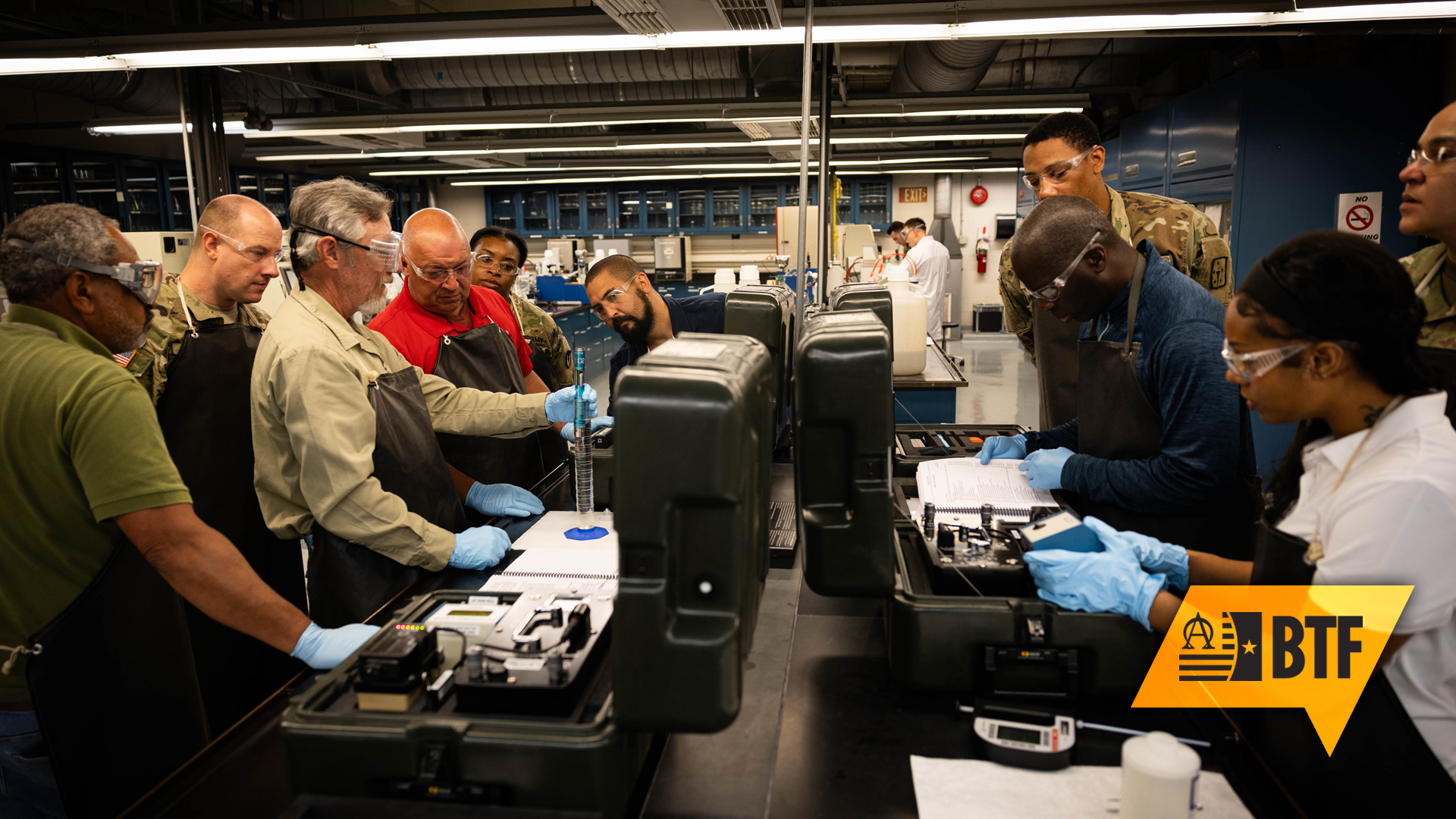
The PEAK’s FUE event was held in early June at Fort Lee, following its Full Material Release on April 28. PEAK is a stand-alone, highly portable testing kit that replaces the legacy Aviation Fuels Contamination Test Kit. (Photo courtesy of PdM PAWS/U.S. Army TACOM Material Fielding and Training Directorate)
by Jennifer Swift
As the Army modernizes its equipment to move and sustain its forces, it is simultaneously overhauling the systems that keep those forces hydrated and fueled. Under the Product Manager for Petroleum and Water Systems (PdM PAWS), part of the Project Manager Expeditionary Energy and Sustainment Systems (PM E2S2) portfolio, four key systems have reached crucial fielding milestones this year.
PdM PAWS and PM E2S2 are part of the Army’s Portfolio Acquisition Executive Agile Sustainment and Ammunition (PAE AS&A). The PAE’s military and civilian acquisition professionals, based primarily out of Michigan, manage a vast range of systems for all Army components spanning the Engineer, Ordnance, Quartermaster and Transportation equipment portfolios. These systems account for roughly 20% of all Army equipment programs. PAE AS&A’s New Jersey-based Army acquisition professionals are responsible for development, procurement and fielding lethal armaments and ammunition, providing joint warfighters and allied partners overmatch capabilities.
“PAWS delivers a significant leap forward in fuel and water agility for all Army components,” said Lt. Col. Peter Syverson, product manager with PAWS. “The continuous demand from the Army and joint partners confirms that PAWS’ systems solve real-world sustainment challenges in every operating environment, whether humanitarian, homeland defense or large-scale combat operations. PAWS is focused on accelerating production and fielding to get these critical assets into Soldiers’ hands faster ensuring liquid logistics is never the limiting factor.”
THE M1251 BULK FUEL DISTRIBUTION SYSTEM
The M1251 Bulk Fuel Distribution System (BFDS) received its Conditional Material Release on Aug. 6, with its first unit equipped (FUE) event held Aug. 10-14, at the U.S. Army Quartermaster School at Fort Lee, Virginia.
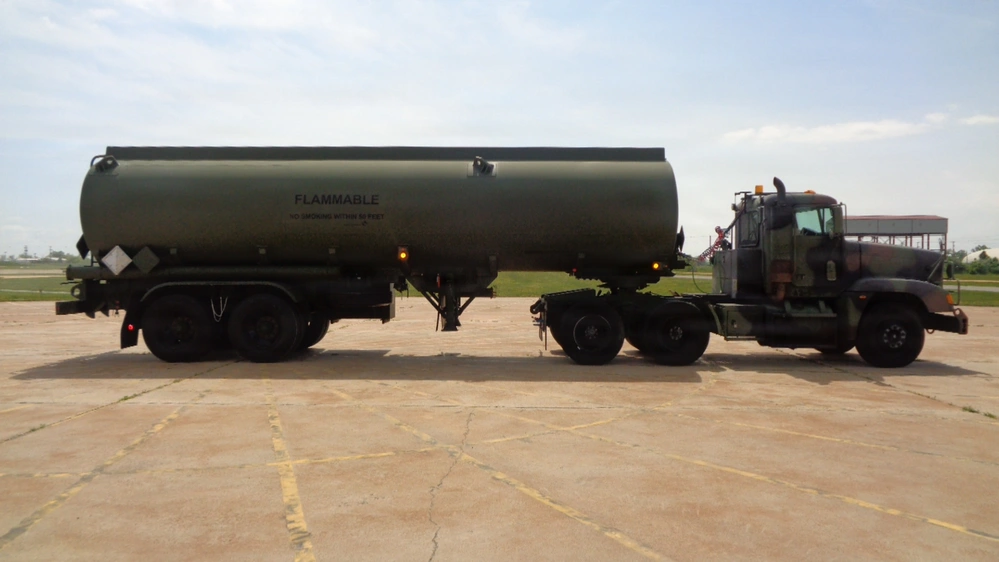
The system replaces the legacy M1062 and partially replaces the M967 tanker trailers within bulk line-haul units. Based on a modified commercial semi-trailer towed by M915A3 or M915A5 prime movers, the BFDS can transport 9,000 gallons of fuel across improved and unimproved roads at normal convoy speeds. The system is compliant with the European agreement concerning the International Carriage of Dangerous Goods by Road for deployment outside the continental United States.
“We are putting 9,000 gallons of fuel directly in your rear-view mirror without slowing down your convoy. The BFDS ensures that when your combat platforms move, your fuel sustainment moves with you at full operational speed,” said Phillip Palajac, assistant product manager, BFDS.
The Army has set an Acquisition Objective of 1,803 BFDS units, with full operating capacity (FOC) projected for fiscal year 2034.
THE HIPPO LOAD HANDLING SYSTEM
Water distribution is receiving a similar mobility boost. The Hippo, a 2,000-gallon potable water tank, received its Conditional Material Release on Aug. 4. Its FUE training was held later in the month at the Quartermaster School.
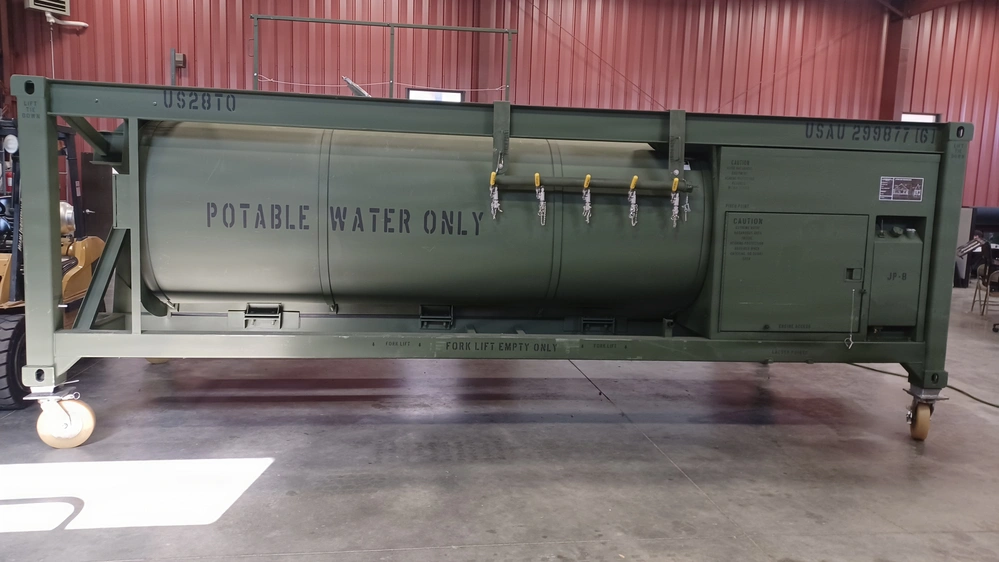
The Hippo integrates a pump, engine, alternator, hose reel, heater and filling stand into a single 20-foot International Organization for Standardization frame. Compatible with the Army’s existing Load Handling System, the Hippo can be loaded or unloaded in just 16 minutes and features a freeze-prevention capability allowing operations down to minus 25 degrees.
Replacing the forward area water point supply system and older fabric tanks, the Hippo provides clean, temperature-controlled water at the tactical edge. The Army plans to procure 3,118 units under a follow-on production contract, with FOC expected by fiscal year 2030.
THE PETROLEUM EXPEDITIONARY ANALYSIS KIT
To ensure the integrity of tactical fuels, PdM PAWS fielded the Petroleum Expeditionary Analysis Kit (PEAK) during an FUE event from June 8–11 at Fort Lee, following its Full Material Release on April 28.
The PEAK is a stand-alone, highly portable testing kit that replaces the legacy Aviation Fuels Contamination Test Kit. It puts lab-quality fuel quality surveillance directly into the hands of Brigade Combat Teams and Support Brigades, evaluating kerosene-based and diesel fuels for ground and aviation systems at the point of consumption.
Instead of waiting days for lab results, Soldiers can now verify fuel safety, additives and grade in minutes, preventing contaminated fuel from seizing tactical engines or grounding aircraft. The Army’s acquisition goal is 1,262 units, reaching FOC by fiscal year 2039.
“A piece of equipment that began fielding in 2026 is the Petroleum Expeditionary Analysis Kit. The PEAK is a gamechanger enabling go/no-go fuel testing in field environment. It will reduce dramatically the number of samples shipped to petroleum labs for testing. The PEAK will augment the Army Petroleum Quality Analysis System – Enhanced (PQAS-E) mobile labs, allowing some of the mandatory fuel quality tests to be completed at the point of dispensing to the consuming combat platforms. The PEAK does not perform all fuel testing requirements but performs those that are most important and most frequent. The PQAS-E remains the Army fuel lab capable of fuel tests required after long term storage and waterborne conveyance,” said Albin Majewski, chief of the Energy, Supply and Services Branch, Sustainment – Future Capability Directorate, U.S. Army Transformation and Training Command.
THE EARLY ENTRY FLUID DISTRIBUTION SYSTEM
For massive throughput, the Army is deploying the Early Entry Fluid Distribution System (E2FDS), a high-speed, flexible tactical pipeline system designed to complement the larger Inland Petroleum Distribution System. The E2FDS received its Conditional Material Release June 6, following a successful FUE cycle with the 339th Quartermaster Company at Camp Humphreys, South Korea, from April 27 to June 12.
The pipeline can be rapidly emplaced at a rate of 25 miles per operational day, extending up to 50 miles. It can pump 850,000 gallons of fuel or 650,000 gallons of raw water per 20-hour operational day.
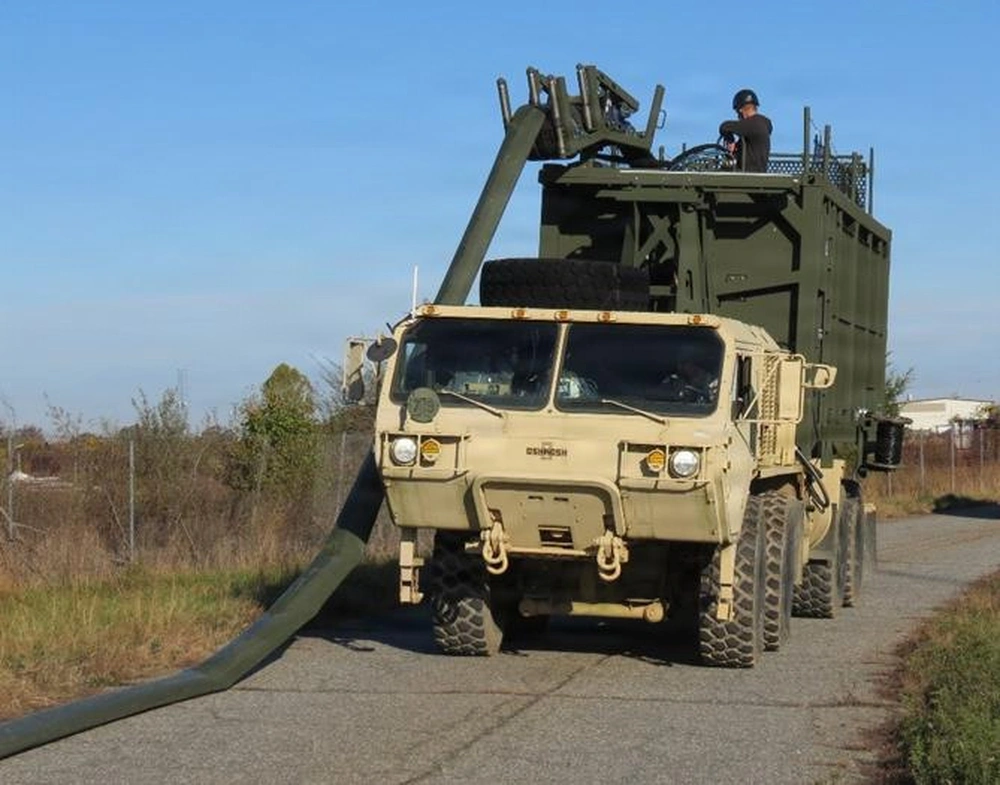
The 339th Quartermaster Company put its five-mile E2FDS set to the test July 15-16 during the Combined Joint Logistics Over the Shore exercise on Dogu Beach in Pohang, South Korea. By pumping bulk liquids directly from offshore platforms to the tactical edge, the system reduces the Army’s reliance on vulnerable road transport.
The Army’s acquisition objective for the E2FDS is 25 systems, with FOC slated for fiscal year 2031.
“In the early 2000s, the Quartermaster (QM) Corps Combat Development Branch under Lt. Col. Stephen Lindahl tied several of the future capabilities to compatibility with Transportation Corp’s Heavy Expanded Mobility Tactical Truck with Load Handling System (HEMTT-LHS). This led to the development of the 2,500-Gallon Tank Rack Module (TRM) and the associated Pump Rack Module. These two systems are now fully fielded. The HEMTT-LHS-compatible 2,000-gallon Water Tank Rack Module, affectionally known as the Hippo, has just resumed fielding under its latest and final contract. Leveraging the versatile HEMTT-LHS as a transporter, these systems enable fuel and water storage mobility to support the troops at the tactical edge. They also allow dispensing of fuel and water respectively directly into consuming platforms and Soldiers’ canteens. The latest QM capabilities—the Early Entry Fluid Distribution System (E2FDS) and the Bulk Fuel Distribution System (BFDS)—support the joint force at the theater level, increasing the throughput of bulk fuel among distribution nodes. These systems recently began fielding,” said Majewski.
CONCLUSION
The rapid development and fielding of these systems rely on deep institutional collaboration. The Tank-automotive and Armaments Command’s Integrated Logistics Center Materiel Fielding and Training team directly supports PAWS fieldings, while the Combined Arms Support Command serves as the Force Modernization Proponent for the sustainment systems.
“Modern warfare demands distributed, high-tempo operations, and sustainment must move at the speed of combat across the entire Total Force. The leap-ahead technology integrated into the PAWS portfolio directly increases endurance, reduces logistics vulnerabilities and ensures warfighters across all components have clean water and clean fuel when and where it matters most,” said Suzanne Archibald, deputy product manager, PAWS. “Given the intense operational demand signal across the enterprise, the Army is evaluating accelerated fielding strategies and expanded procurement targets to close readiness gaps ahead of schedule.”
For more information, go to https://www.cpeae.army.mil.
JENNIFER SWIFT is a public affairs project manager with Portfolio Acquisition Executive Agile Sustainment and Ammunition (PAE AS&A) at the Detroit Arsenal. She has an M.A. in modern history from the University of Toronto and a B.A. in history from Grand Valley State University. Prior to her time with PAE AS&A, she worked as a congressional staffer.
Recent Posts
Read more of our recent Behind The Frontlines Posts.

HIRING CONTRACTING SPECIALISTS, THE SMART WAY

Acquisition is a Team Effort – Brice Ott

Protect Your Time – Tiffanie Bachar