by Dean Angell, DBA
Organizational leaders constantly talk about transformational structures, launch modernization campaigns and redesign processes to pursue efficiency, innovation or competitive advantage. Yet despite decades of research and countless books, studies and industry surveys have repeatedly suggested that most change initiatives either fail outright or never achieve the intended results. Employees resist change, communication breaks down, leaders lose credibility and organizations quietly revert to the old way of doing business. Often, the technical solution itself is not the problem. The problem is the process.
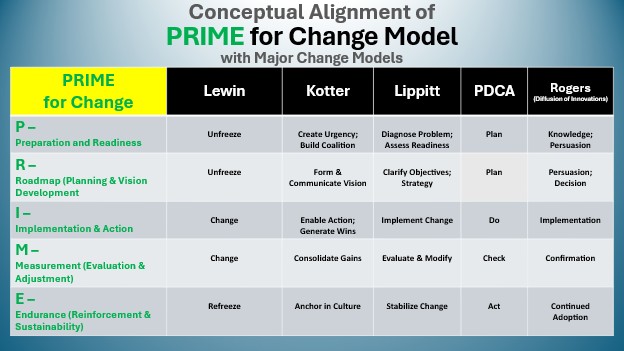
Graphic depicting the alignment of the PRIME for Change model with other change models. (Graphic by the author)
That challenge inspired the development of the PRIME for Change model, a practical framework that simplifies and strengthens organizational change efforts. Rather than replacing existing theories, PRIME synthesizes influential change management models into a single, memorable structure that leaders can apply across organizations, industries and levels of complexity. It balances simplicity with depth and gives leaders a playbook that is easy to remember while still comprehensive enough to guide complex organizational transformation.
Why Change Leadership Matters
Organizational change occurs at every level of an organization. It is not limited to dramatic corporate turnarounds or mergers. A Fortune 500 restructuring may require the same fundamental leadership principles as introducing a new workflow in a department. Effective change leadership prepares people psychologically and operationally for the transition.
The PRIME for Change framework draws from five major change management theories that have shaped leadership thinking for decades.
Lewin’s Change Theory
Psychologist Kurt Lewin introduced one of the earliest and most influential models of organizational change. His model emphasizes simplicity and requires preparation and reinforcement. The framework is built around three stages: unfreezing, changing and refreezing.
Unfreezing prepares the organization to accept that change is necessary. Leaders create awareness of the need for transformation. Changing introduces new processes, behaviors or structures. Finally, refreezing stabilizes the organization and embeds the new practices into the culture and daily operations.
Kotter’s 8-Step Model
John P. Kotter, a change management scholar, expanded the concept of organizational change into a more detailed leadership framework. His model emphasizes urgency, coalition-building, communication, empowerment, short-term wins and cultural reinforcement.
Kotter recognized that change initiatives often fail because leaders focus too heavily on strategy and not enough on people. His framework highlights the importance of communication, momentum and leadership credibility throughout the change process.
Lippitt’s Change Theory
Ronald Lippitt, organizational change theorist, extended Lewin’s ideas by focusing more directly on the role of the change agent. Lippitt’s theory emphasizes diagnosing problems, assessing readiness, building stakeholder relationships and sustaining momentum.
This approach is especially valuable in environments where collaboration and trust are essential to implementation.
The PDCA Cycle
The Plan-Do-Check-Act (PDCA) model, popularized by W. Edwards Deming, quality management pioneer, approaches change through continuous improvement.
Organizations first plan a solution, then implement it on a limited scale, evaluate results and adjust based on feedback. The iterative nature of PDCA makes it particularly effective for operational and process-driven improvements.
Rogers’ Five-Stage Theory
Everett Rogers, creator of the theory Diffusion of Innovations, focused on how individuals adopt innovations. His theory identifies five stages: knowledge, persuasion, decision, implementation and confirmation.
Rogers emphasized that adoption depends heavily on communication, perceived value and the social dynamics surrounding innovation.
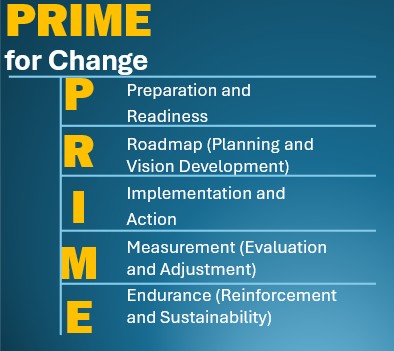
Graphic showing the five steps of the PRIME for Change model. (Graphic by the author)
INTRODUCING PRIME FOR CHANGE
By synthesizing the core themes of preparation, communication, implementation, evaluation and sustainability, the PRIME for Change model serves as a universal tool for strategic planning, execution and diagnostics.
The strength of PRIME lies in its balance between accessibility and completeness. Some change models are easy to remember but too vague to guide complex transformation. Others are highly detailed but difficult for leaders to recall and apply under pressure.
P: Preparation and Readiness
Many change initiatives begin failing long before implementation starts. The preparation and readiness phase involves assessing organizational culture, workforce concerns, operational risks and leadership capacity before major action occurs. Leaders must communicate why change is necessary and create a sense of shared understanding. Without clear communication about the reasons for change, rumors and fear displace employee understanding and engagement.
This phase incorporates the urgency found in Kotter’s model, the unfreezing process in Lewin’s theory, and the readiness assessment emphasized by Lippitt. Organizations often skip this stage because leaders feel pressure to move quickly. However, failing to prepare employees creates anxiety, resistance and distrust.
R: Roadmap and Vision Development
Once readiness exists, organizations need a clear roadmap. This phase focuses on strategic planning, defining objectives, assigning responsibilities, establishing timelines and communicating a compelling vision. The roadmap stage integrates Kotter’s vision development, Lippitt’s planning emphasis and the PDCA planning discipline.
Employees need to understand more than what is changing. They need to understand what success looks like and how the organization intends to get there. A weak roadmap creates operational ambiguity. Leaders may believe they have a plan, but if employees do not understand it, the plan effectively does not exist.
I: Implementation and Action
Implementation is where leadership credibility is truly tested. This stage moves strategy into action. Processes change, structures shift and employees begin operating under new expectations.
Successful implementation also depends on alignment. Compensation systems, reporting structures, training and operational workflows must support the desired outcomes. Importantly, implementation is a deep human process. Employees evaluate whether leaders are competent, fair and committed. Communication must remain constant. Obstacles must be addressed quickly.
M: Measurement and Adjustment
One of the most overlooked dimensions of organizational change is active measurement. Organizations frequently launch initiatives but fail to meaningfully monitor progress. Leaders may track financial data while ignoring employee morale, operational friction or customer frustration.
Measurement allows organizations to adjust before problems become irreversible. It evaluates whether change efforts are achieving intended outcomes, including both quantitative and qualitative indicators. Metrics may include productivity, cost savings, turnover rates, performance improvements or customer satisfaction. Just as important are less tangible indicators such as trust, engagement, collaboration and cultural alignment.
E: Endurance and Sustainability
Many organizations achieve temporary momentum only to revert to old behaviors once leadership attention fades. Endurance focuses on embedding change into organizational culture, systems, policies and leadership practices. Organizations strengthen endurance through reinforcement mechanisms such as training, governance structures, accountability systems and measurable performance standards. Sustainable change becomes part of how the organization operates rather than a temporary initiative. This phase reflects Lewin’s refreezing stage and Kotter’s emphasis on anchoring change in culture.
PRIME IN ACTION: LESSONS FROM THREE ORGANIZATIONAL CASES
The true value of any leadership model lies in application. To evaluate PRIME for Change, three organizational change cases were analyzed: Workforce Realignment, Organizational Structure and Process Change. The Workforce Realignment and the Organizational Structure cases failed to produce constructive and lasting change, whereas the Process Change case was a success and an example to others. Read on to understand why.
Workforce Realignment
In the first case, a large division attempted to restructure its workforce by reducing one job classification while increasing two others. A small internal team developed the plan, but shared little information with the broader organization.
Employees received fragmented details through rumors and unofficial leaks. They feared layoffs. Managers could not answer questions because they lacked the information. Lower-paid employees were required to perform many of the duties as higher-paid workers, creating resentment and morale problems. Attrition increased, and workforce agility declined. Within two years, the organization reversed the restructuring.
From a PRIME perspective, the failure began during Preparation and Readiness, and ultimately, it lacked Endurance because it never became sustainable. Leadership failed to assess workforce concerns or communicate clearly. The Roadmap was equally weak. Employees did not understand the plan, timelines or rationale. Implementation created inequities and operational confusion. Measurement mechanisms were largely absent, allowing dysfunction to continue unchecked.
Organizational Structure
The second case involved a headquarters-directed reorganization separating local employees from those who traveled to remote work locations.
Leadership provided minimal guidance beyond a basic organizational chart. Confusion quickly emerged. Leaders competed for work allocation. Employees became uncertain about their responsibilities. Customers no longer knew whom to contact for support. Morale deteriorated as frontline leaders struggled to resolve problems without direction from headquarters.
Like the Workforce Realignment case, this initiative failed across multiple PRIME dimensions. Preparation was inadequate. The roadmap lacked operational clarity. Implementation produced ambiguity rather than efficiency, and leadership failed to monitor problems actively or adjust the strategy. Two years later, the organization reversed its structure.
Process Change
The third case demonstrated successful change leadership. A large organization needed to redesign an outsourcing process that had become overstaffed, overbudgeted and underperforming.
Leaders assembled an integrated process team composed of personnel from multiple divisions and specialties. Stakeholders and subject matter experts participated throughout the process. Leaders held meetings and conferences with interested partners, solicited feedback, refined proposals and iteratively adjusted plans. The team developed a shared vision centered on balanced incentives, measurable outcomes and improved performance.
The results were significant. The organization achieved approximately 15% cost savings while improving performance metrics by roughly 10%. This initiative succeeded because it aligned strongly with all five PRIME phases. Preparation was deliberate and collaborative. The roadmap was clear and widely communicated. Implementation was disciplined and transparent. Measurement mechanisms were embedded into the process. Endurance was reinforced through contracts, governance systems and performance standards. The success was not accidental. It reflected leadership discipline and process alignment.
WHY PRIME MATTERS?
The lessons from these cases are consistent with what some leaders already suspect: Organizational change often succeeds or fails based not on technical design, but on leadership execution. PRIME matters because it provides leaders with a practical framework for approaching change—well-executed change that builds trust, credibility, alignment and long-term organizational resilience. PRIME recognizes that successful transformation is not a single event; it requires preparation, planning, execution, evaluation and reinforcement working together.
Where existing models are either overly simplified or excessively complex, PRIME bridges the gap between theory and operational leadership. PRIME provides leaders with a structure that is both memorable and actionable.
THE FUTURE OF ORGANIZATIONAL CHANGE
Modern organizations face constant disruption and evolving technology. Economic conditions fluctuate. Global competition intensifies. In this environment, organizations cannot afford to treat change as an occasional event; it must become a core leadership requirement. Organizations need structure, communication and disciplined execution. Employees need trust, clarity and engagement. The PRIME for Change model offers a way to balance those demands. PRIME integrates the strongest principles of change theories into a practical model that provides leaders with a roadmap for navigating both operational and cultural transformation.
CONCLUSION
Organizational change is inevitable, but successful change is far from guaranteed. The difference between failed initiatives and successful transformation is rarely the idea itself. More often, it is how leaders prepare, guide, evaluate and sustain the process. The PRIME for Change model demonstrates that sustainable transformation depends on more than strategy or technical design. It requires leadership discipline, organizational alignment, clear communication, active measurement and long-term reinforcement.
As the PRIME framework suggests, change is about moving deliberately, systematically and sustainably. Leaders and organizations must PRIME for change!
For more information, contact Dean Angell, DBA, at burrel.d.angell.civ@army.mil or buangell@bellevue.edu.
DEAN ANGELL, DBA, is a U.S. Army civilian acquisition professional with more than 25 years of experience in defense acquisition, contracting and program management. In addition to federal service, he serves as an adjunct college professor with Bellevue University, University of Sioux Falls and Norwich University. He earned a DBA from Capella University, an MBA from Bellevue University, and a B.S. in business, information and decision systems from San Diego State University. His expertise includes leadership, strategic management, organizational change, operations and defense acquisition. He holds DAWIA Level III Contracting and Level I Program Management certifications.
Recent Posts
Read more of our recent Behind The Frontlines Posts.

Acquisition is a Team Effort – Brice Ott

Protect Your Time – Tiffanie Bachar

Army Acquisition Hall of Fame Welcomes Four New Inductees in 2026