
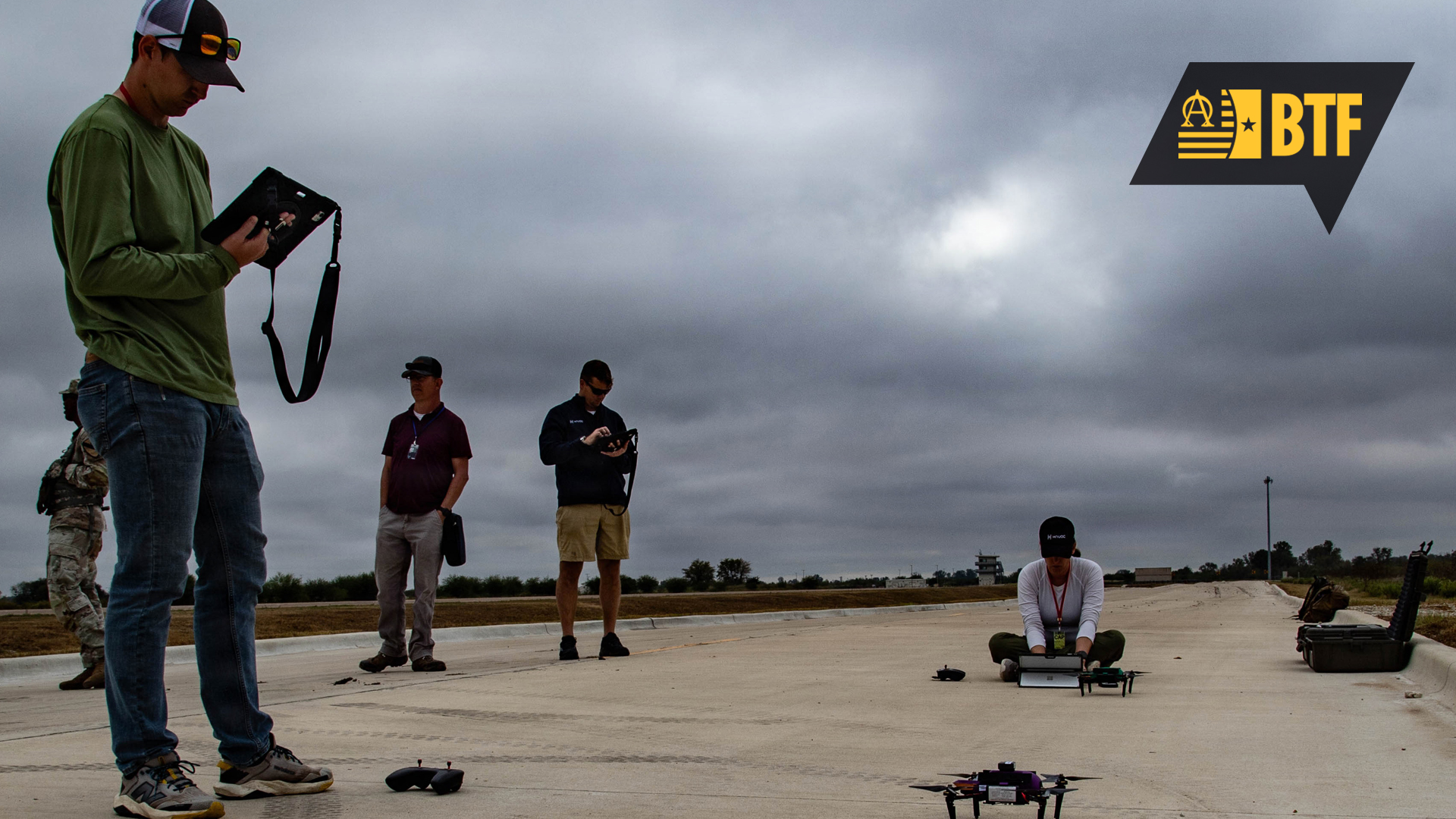
U.S. Army Transformation and Training Command hosted xTechOverwatch for Unmanned Systems October 27-29, 2025, at the Bush Combat Development Center – Innovation Proving Ground in Bryan, Texas, which provided industry partners and academia the ability to continue development integrated within the Army. (Photo by Master Sgt. JaJuan S. Broadnax, U.S. Army Transformation and Training Command)
by Brent G. Ingraham
The character of warfare is changing at a pace few institutions were designed to match. Threats are cheaper, faster and more numerous. Technology that once took decades to mature now evolves in months. Our adversaries know this and are adapting accordingly.
Last fall, the Army undertook the most significant acquisition reform in decades, moving from twelve Program Executive Officers to six Portfolio Acquisition Executives, ahead of congressional mandate, before the guidance was fully written. The reorganization was never the point. The point was speed—and the ability to deliver integrated capability at the pace the battlefield demands.
The results are already visible in the way we deliver capability. When Operation Epic Fury began, we put 13,000 counter-drone interceptors on contract within ten days—systems the Army had never purchased before. Equipment was flowing into theater by day twenty. That only happens when the structural work is already done: streamlined authorities, empowered leaders and a portfolio construct that allows decisions to be made at the right level without waiting for approvals to travel up and back down the chain.
We stopped managing programs and started managing portfolios. That shift, from tracking cost, schedule and performance of individual systems to asking how capability comes together on the battlefield, is what acquisition reform actually means in practice. Every program manager, contracting officer and acquisition professional now operates inside that construct. The cumulative effect of those decisions determines how quickly capability reaches Soldiers.
Speed at that scale requires a different kind of partnership with industry. Here is a distinction worth understanding: Industry has solved many of the foundational technology challenges, including cloud computing, data management, artificial intelligence and scalable software architectures. The Venn diagram between commercial capability and military need is real, and the overlap is significant, but it is not a single circle. Industry is optimized to solve commercial problems at scale. Our responsibility is to partner with industry to apply those technologies to the Army’s unique, mission-critical challenges—and to do it faster than we ever have before.
We have stopped assuming the best solution comes from the same places we have always looked. Through the Pathway for Innovation and Technology and its programs, we have engaged with more than 1,000 companies since last fall, over half of whom had never worked with the Army before—including through FUZE’s direct industry engagement and xTech prize competitions like last month’s Adaptive Strike challenge at the Low-Cost Interceptor Industry Day. The point is not the mechanism. It is the aperture. The Army faces a cost-exchange problem: We cannot defeat every low-cost threat with a high-cost solution. Cost matters because capacity matters—and capacity is a warfighting discussion, not a budget one. We were explicit that companies do not need a complete system. A seeker, a rocket motor, a fire control solution—if you have a key component, we want to hear from you.
That same logic is now extending internationally. In March, we launched the Unmanned Aircraft Systems (UAS) Marketplace, a digital storefront where Army units, government partners and allied nations can identify, evaluate and acquire vetted drone systems at a fraction of the traditional lead time. Last month at Eurosatory, nine NATO allies signed a counter-UAS letter of intent to expand that platform to cover proven counter-drone capabilities. Interoperability is the price of entry. The longer-term vision is broader—a trusted environment where allies can procure not just drones and counter-drone systems, but eventually radars, sensors and other major capabilities, with Soldier feedback shaping what scales.
Operation Jailbreak—the Army’s “Right to Integrate” hackathon held at Fort Carson, Colorado—may be the clearest example of where acquisition reform is actually taking us.
The idea came from a hard observation. Watching how Ukrainian forces had integrated their battlefield systems, sensors, drones and command platforms sharing data in near real time across vendors, without a Soldier manually bridging every gap, it became clear how much opportunity existed to improve our own approach. Too many Army systems, despite being individually capable, operated as isolated islands. Jailbreak was designed to change that.
Walking the floor at Jailbreak, I expected to be struck by the technology. What I actually noticed was engineers from companies that had never met, working through problems together. That was the result of one deliberate choice. Every vendor was asked to send engineers and decision-makers—people with the authority and ability to solve problems on the spot.
What followed was immediate. Four disparate companies connected a ground robot to a weapon system through a shared command-and-control platform within three days. No requirements document would have produced that outcome. By the end of the sprint, over 80 companies and 60 systems that previously could not communicate, now talk to each other. Integration that would have taken years the traditional way took weeks.
The lesson was not that industry could move fast. For decades, Army requirements specified what systems had to do without specifying how they had to connect. Vendors built to the letter of those requirements and delivered exactly what was asked: capable, isolated systems. When we changed the ask—expose your interface, publish your documentation—the integration happened in days.
Jailbreak demonstrated something the Army had long assumed but never systematically acted on: integration is a capability, not an afterthought. The lasting product is the Army’s Application Programming Interface, or API, Marketplace—a centralized, living library of interface documentation replacing 700-page Interface Control Documents written to 1967 standards. Every integration achieved at Jailbreak is documented and available. Our expectation is that future programs begin with these principles from day one. When interfaces are open and documented, you can begin to put artificial intelligence agents into the loop, giving Soldiers faster, better decisions rather than spending cognitive energy bridging disconnected screens. Jailbreak is not a one-time event. It is a model for how we intend to work.
None of this works without a different relationship with risk. Our acquisition culture has historically treated uncertainty as something to be designed out. Over-specify, over-predict, add a review layer for every contingency. But in far too many cases it shifted risk from the acquisition process onto the operational environment, where Soldiers bore the consequences. Delay is not neutral. What I am asking is a different posture. Take calculated risk. Move with urgency. Field the capable solution that can evolve rather than waiting for a perfect one. That posture has to live at every level of this enterprise, not just at the top.
What drives this is not a reorganization chart or a policy directive. It is a workforce that chose to act because the mission demanded it. The threats are still evolving; the work is still ongoing and the framework we built is not an excuse to get comfortable. The ask now is the same as it was last fall: Stay agile and keep pushing past what the process allows toward what the mission requires.
I’m betting on this workforce to keep proving it.
Recent Posts
Read more of our recent Behind The Frontlines Posts.

HIRING CONTRACTING SPECIALISTS, THE SMART WAY

Acquisition is a Team Effort – Brice Ott

Protect Your Time – Tiffanie Bachar