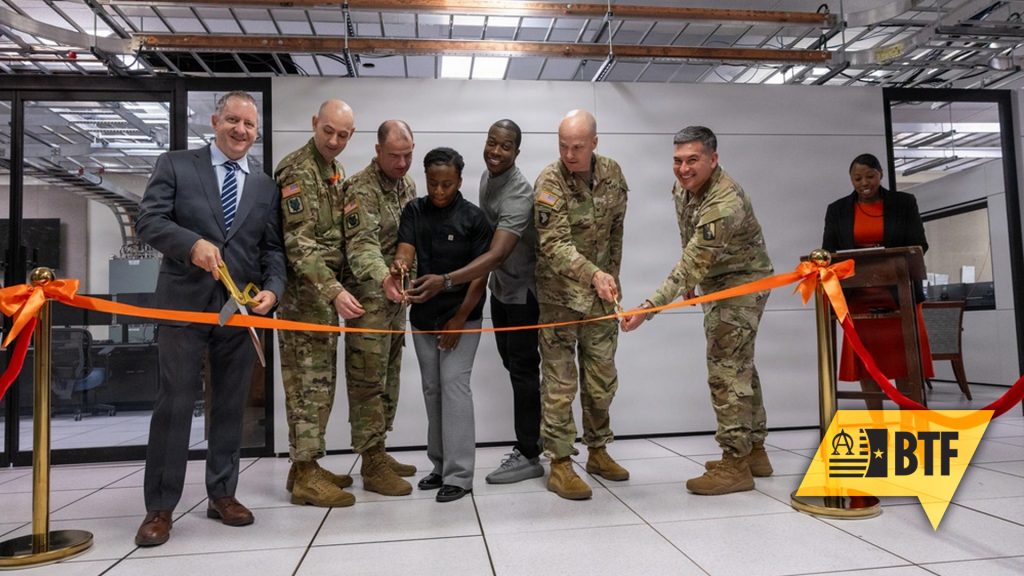
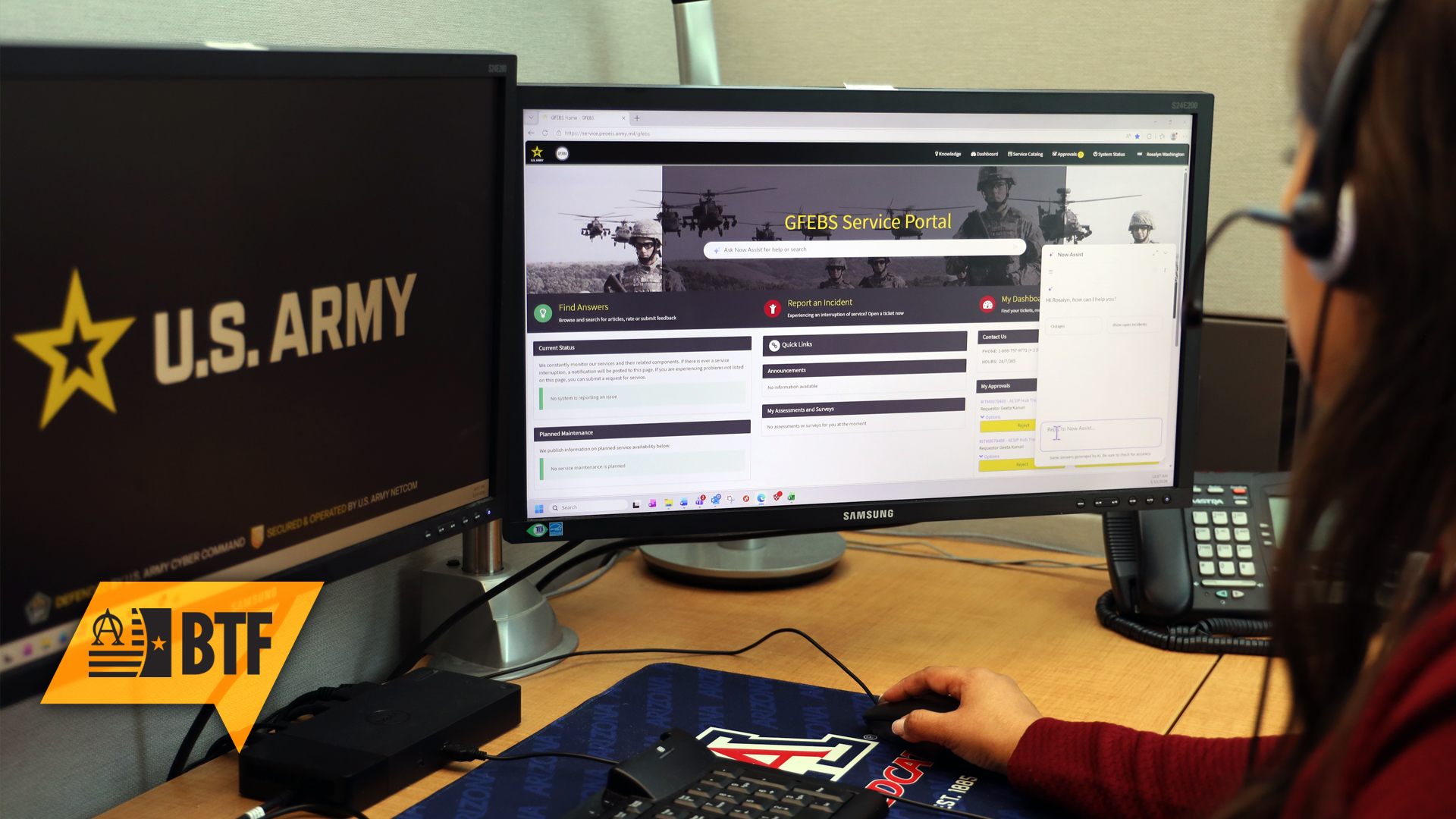
The GFEBS is a mission-essential Army ERP system that manages the Army’s budget and supply chain. The new AI-powered help desk supports users navigating these platforms. (Photo by Kevin Deegan, CECOM)
CECOM ASIC Accelerates Help Desk Support via GenAI Integration
by Kevin Deegan
The Army is wasting no time implementing artificial intelligence (AI) into its enterprise structures.
In recent months, the United States Army Communications-Electronics Command Army Software and Innovation Center (CECOM ASIC) has aggressively incorporated AI capabilities into its Enterprise Help Desk (EHD) that services the Army’s critical Enterprise Resource Planning (ERP) systems—massive software applications that manage and track the Army’s budget and global supply chain.
A subset of AI, Generative AI (GenAI) synthesizes answers from expansive knowledge sources to provide immediate answers to end users. The overarching mission of integrating GenAI into ERP systems is to increase readiness by automating responses for common fixes, enabling analysts to resolve more tickets faster. Because AI can automate routine fixes for users, it gives more time for analysts to prioritize their efforts on complex mission-critical problems.
MODERNIZED HELP DESK
The EHD is the initial line of information technology (IT) support for Soldiers and civilians who need assistance with navigating ERP systems such as the General Fund Enterprise Business System (GFEBS), the Army Enterprise Systems Integration Program (AESIP) and the Global Combat Support System-Army (GCSS-Army).
While Army civilians, like the rest of the world, are immersed in an AI boom, the mandate to get things done faster is a strategic imperative for CECOM ASIC, especially with some of the older—but vital—systems it supports.
The deployment was an aggressive undertaking by CECOM ASIC on a compressed timeline in 2026: GFEBS in January, AESIP in March and GCSS-Army in April. The team used an Agile cadence to perform iterative development via testing, user feedback and improvement on a schedule that kept the team and key stakeholders in constant synchronization.
THE CHALLENGE
Previously, users would submit tickets and wait for a human analyst, who sometimes had to dig through sprawling user manuals. With the newly transformed EHD, users can receive instant AI-powered answers to ERP-related queries.
End users of ERP systems are typically Soldiers and Army civilians.
“Before the AI implementation, if a user needed help, they may have searched an ERP user manual or they may have asked a peer. Now, when the users need help, they can go to their ERP service portal and leverage the AI chatbot to receive immediate answers and reduce wait times,” said Carson Dereski, EHD team lead for CECOM ASIC’s User Engagement and Platforms Branch, Application Capability Management Division.
MEASURABLE IMPACT
CECOM ASIC is not merely providing a new tool. It’s transforming the landscape of Army IT support.
“The AI capabilities support analysts and decrease cost by empowering focus on more complex, high-value tickets, while AI handles the more routine, repetitive tasks,” Dereski said.
CECOM ASIC has noticed how transformation is impacting performance metrics.
“The capabilities are designed to provide greater self-service for end users. While enabling analysts to resolve more tickets faster, we are targeting a minimum 20% reduction in ticket volume and cycle time, and a minimum 20% increase in resolution rate,” Dereski said.
Since the launch in January 2026, there have been over 6,800 user interactions with AI.
With GFEBS, the first system to integrate AI, the team has seen gradual improvement. Pre-implementation in January, the average resolution cycle time was one business day. By March 2026, it had dipped down to just .71 days—a nearly 30% improvement.
QUALITY IN, QUALITY OUT
After successfully rolling out three ERP systems, CECOM ASIC is looking to further optimize AI.
Efficient output still requires an ongoing flow of updated input from experts. AI is not a person; it can only be as smart as the data that drives it.
“I think that knowledge is one of the most important pieces of this effort,” Dereski stated. “We continue to update and integrate knowledge bases into the AI capabilities to provide the most accurate and adequate answers possible to maximize the effectiveness of the AI response for end users and analysts.”
CONCLUSION
CECOM ASIC will continue to build on the Army’s broader modernization strategy through optimized efficiencies that automate routine tasks and support.
For more information, visit the CECOM ASIC website at https://cecom.army.mil/ASIC.
KEVIN DEEGAN provides contract support to the U.S. Army Communications-Electronics Command at Aberdeen Proving Ground, Maryland, as a strategic communications specialist. He holds a B.A. in journalism from Temple University and is certified as a Project Management Professional.
Recent Posts
Read more of our recent Behind The Frontlines Posts.

Acquisition is a Team Effort – Brice Ott

Protect Your Time – Tiffanie Bachar

Army Acquisition Hall of Fame Welcomes Four New Inductees in 2026