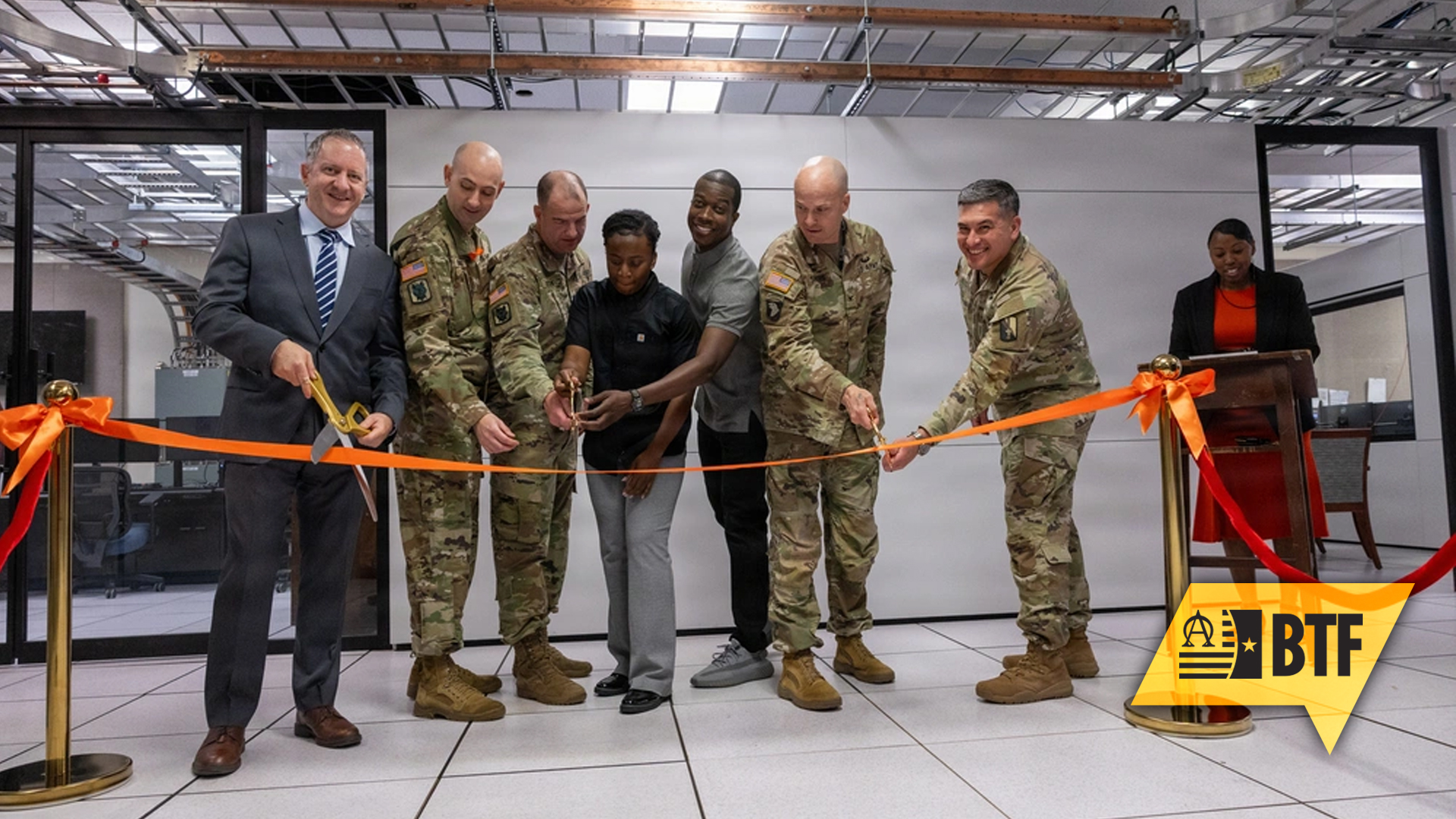
Leaders from PdM WESS, 21st Signal Brigade and 302d Signal Battalion cut the ribbon to unveil the renovated Network Operations Center and introduce new HM&C capabilities. (Photo by Staff Sgt. Amber I. Smith)
by Kevin Deegan
The Communications-Electronics Command Army Software & Innovation Center’s (CECOM ASIC) transformation campaign is enabling satellite communication engineers to operate more rapidly and efficiently.
During the Army’s first operational fielding of Product Manager Wideband Enterprise Satellite Systems (PdM WESS) Hosted Management and Control (HM&C) at Fort Belvoir, Virginia, the team installed and validated software that streamlines satellite operations by allowing Soldiers to troubleshoot critical communication links from a single screen.
During the fielding, CECOM ASIC staff trained operators, moved four existing programs of record onto the HM&C platform, and held an official Fort Belvoir Network Operations Center ribbon-cutting on June 8, 2026.
The newly fielded HM&C aggregates data and tools from multiple systems into a single centralized interface, reducing the number of tools operators must manage. Essentially, the development is an enterprise service that provides management tools to various tactical and strategic systems inside the Satellite Communications (SATCOM) portfolio.
SATCOM operators on the watch floor are a critical long-range link for Soldiers on the battlefield. Previously, a typical operator’s workstation consisted of multiple laptops with each machine connected to tactical hardware—such as a power distribution rack, a precision timing rack, modems or other sustainment network infrastructure—managed by an associated program of record.
With the new platform, operators can access multiple programs of record from one workstation. The team engineered the virtual desktop infrastructure to look identical to what operators were familiar with, reducing training and operational burden on SATCOM technicians.
The single point of access SATCOM operators use is called a zero client. It functions like a “dummy computer” with no local operating system or storage—just a window into a remote server, or in this case, multiple available servers.
“The resulting single-screen interface directly benefits watch-floor operators and warfighters by reducing the ‘cost of attention’ and making actions faster, more consistent and more transparent during time-critical operations,” said Alicia Hughes Hemphill, assistant project manager for Capability Program Executive Command and Control Information Network.
At the administrative level, CECOM ASIC provided over-the-shoulder training for administrators, while operators received training from the team at Tobyhanna Army Depot. CECOM ASIC also hardened the platform by adding the ability to login through multi-factor authentication and phishing-resistant security.
“They definitely get things done faster,” said Thomas Skrobiszewski, HM&C project leader for CECOM ASIC. “They used to have to take DVDs or hard drives to each laptop or server, install their patches and do them one at a time. Now with HM&C, it patches all the systems from one central location.”
Through the new single interface, the team can leverage its directory infrastructure for authentication, enforcement and group policy management. Having the ability to implement security guides and alerts from one central location is critical from a SATCOM operations perspective because it enables the Army to secure and update deployed systems remotely, minimizing the need to send people to the tactical edge. The system also includes real-time vulnerability identification.
Soldiers using the new capability have already provided positive feedback.
“Their initial response is that it’s much quicker, it’s very responsive,” said Skrobiszewski. “They’re extremely happy that they can do everything from one seat. And that goes as well for the patching; they’re able to load the patch and let that automatically update across all the systems.”
Looking ahead, PdM WESS and the ASIC will continue initial fielding of the innovative software across various Army locations.
For more information contact Thomas Skrobiszewski at Thomas.m.skrobiszewski.civ@army.mil.
KEVIN DEEGAN provides contract support to the U.S. Army Communications-Electronics Command at Aberdeen Proving Ground, Maryland, as a strategic communications specialist. He holds a B.A. in journalism from Temple University and is certified as a Project Management Professional.
Recent Posts
Read more of our recent Behind The Frontlines Posts.

JIATF-401 LEADS A NEW ERA IN COUNTER-SUAS DEFENSE

Aligned for Impact – John Franklin

HIRING CONTRACTING SPECIALISTS, THE SMART WAY