
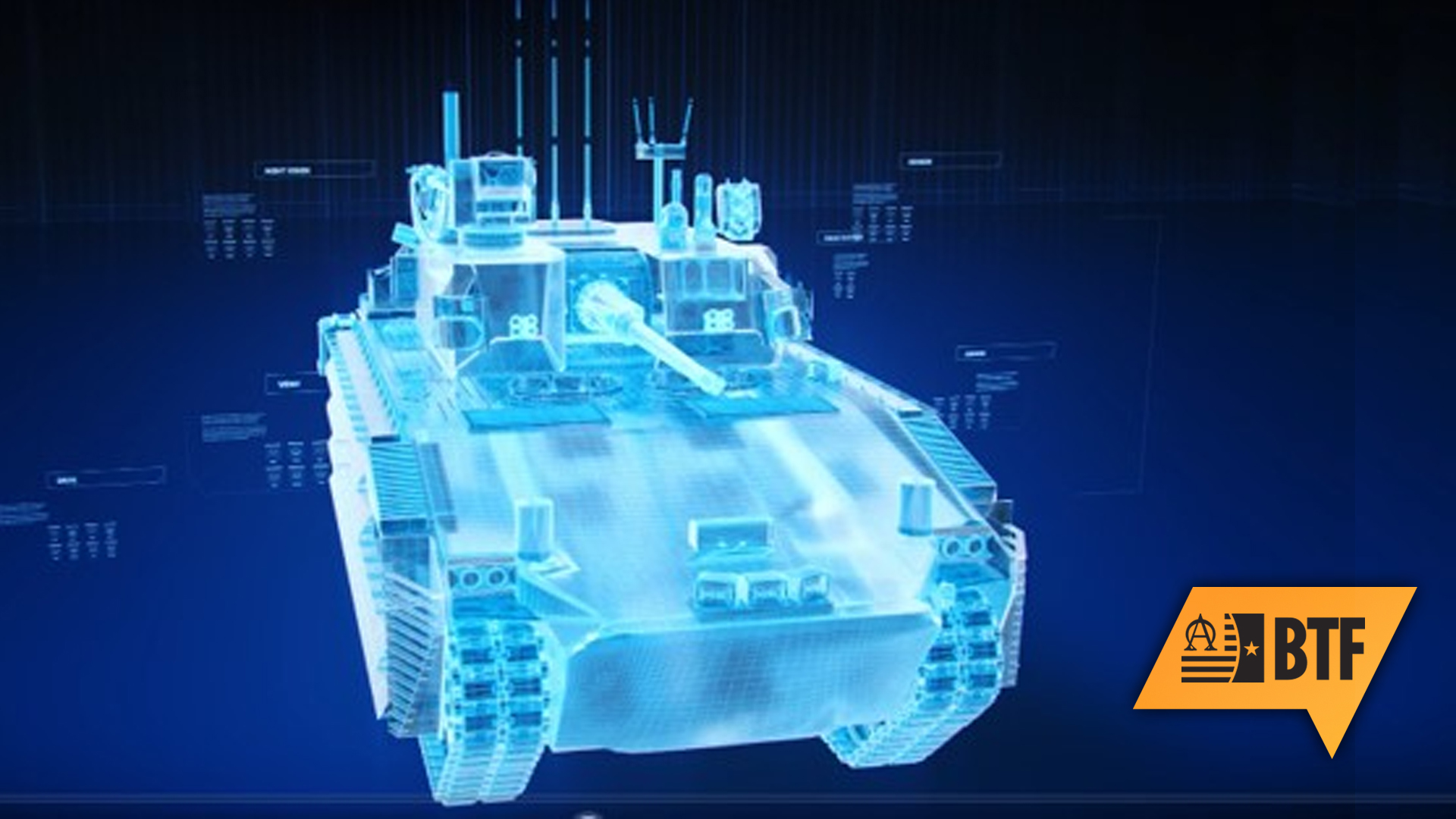
The XM30 Combat Vehicle, the Army’s first ground combat vehicle designed using state-of-the-art digital engineering tools and techniques, will deliver a decisive strike, while also controlling maneuver robotics and semi-autonomous systems. (Photo by Savannah Baldwin, PAE Maneuver Ground)
by Darren LeBlanc
Somewhere in the Pentagon, an Army senior leader recently made a program decision informed by live data, instead of slide decks. That moment reflects a broader transformation: as more information moves into digital models, decisions that once required weeks of staffing are now being made in hours.
This pattern is becoming more common, but it is not yet the norm. For example, the Army’s most significant ground vehicle development in decades, XM-30, has never seen a paper-based design review like the generations before it. Others are still working toward that. Importantly, the pipelines that move engineering data into decision rooms are maturing, and the systems-of-systems architecture that connects them is still being engineered.
The Army is in the middle of a transformation. More programs are thinking digitally from inception. More decisions are being made from data. But the harder problem—the one that will determine whether any of this sticks—is human. It comes down to the leaders we grow, the habits they build and the workforce we shape around technology.
Why Now?
Every Army leader feels the pressure of compressing acquisition timelines against emerging threats. Commercial technology released globally at breakneck speed levels the playing field. Closing the gap requires more than a new program office or a new policy. It requires a fundamentally different way of engineering, deciding and delivering.
That recognition is what gave rise to the Assistant Deputy for Acquisition and Systems Management, for Data, Engineering and Software (ADASM(DES)), an evolution of the former DASA(DES) with an expanded mandate that explicitly includes systems engineering and architecture. Leading the office is Rosie Bauer, the ADASM(DES), whose career has sat squarely at the seam between software, data and engineered systems. For her, the change in mission reflects a change in the landscape. “Data, software and hardware are the same problem now. The Army has to engineer them that way,” she said.
Under that mandate sits a new organization: Army Systems Engineering and Architecture (ASEA), a centralized selection list-led directorate established to give the Army a deliberate home at the Assistant Secretary of the Army for Acquisitions, Logistics and Technology (ASA(ALT)) for the systems engineering discipline. Leading this organization is Maj.(P) Domonique Hittner, an officer whose conviction is that the Army’s hardest engineering problem is, in fact, an organizational one.
“The technology is the easy part,” Hittner said. “The hard part is building the people, the structure and the habits to use it well.” ASEA exists to do exactly that.
The Diffusion Problem
Anyone familiar with Everett Rogers’s diffusion of innovations theory knows that adoption curves are shaped less by the quality of a technology than by the readiness of the people receiving it. Computer scientist Fred Brooks made the companion point about software itself in his famous essay “No Silver Bullet:” there is no single breakthrough that will eliminate software complexity. The Army is living both lessons right now.
The frameworks for model-based, data-driven engineering are mature. The infrastructure is real and extending. And yet the day-to-day reality for many program managers, engineers and decision-makers remains stubbornly familiar: PowerPoint trades, spreadsheet baselines and document-driven reviews. Some programs have leaned in early and are producing live, integrated reporting. Others are still working through the basics.
That unevenness is not necessarily a failure. It is what every large organization looks like in the middle of an adoption curve. But it indicates two points of friction still slowing the Army down.
The first is access. Modeling environments and integrated toolchains have historically been procured program by program, with each office negotiating its own licenses and standing up its own infrastructure. For instance, the XM-30 program chartered an O-5 specifically to manage its digital engineering environment. Programs with resources move forward. Programs without them default to the old ways. The enterprise loses the ability to compare, integrate or build on the work being produced across the portfolio.
The second is habit. Leaders have decades of “sets and reps” making decisions on PowerPoint, and the muscle memory is real. The leaders of tomorrow are already asking for the model over the slide, but a generation of decision-makers in between must make that shift deliberately. This shift could have cultural consequences.
Both points of friction are more human than technological. Both are addressable.
The Infrastructure Half
Infrastructure comes first because infrastructure lowers the cost of doing the right thing. The destination is straightforward. Portfolio reviews informed by integrated models.
Requirements trades evaluated against live data. Life cycle questions answered in hours, instead of weeks. Leaders defaulting to live, authoritative data, rather than artifacts assembled by hand for a single meeting.
In pockets of the Army, that is already happening. ASEA’s job is to make it the norm.
To shift culture, people need to see two things: that the new way of working is accessible and that it makes a difference. Accessibility without impact produces shelfware. Impact without accessibility produces a small group of well-resourced programs and a larger set watching from the sidelines. Culture shifts only when both are present.
The starting point for solving both is a digital engineering ecosystem. Imagine an Army Virtual Desktop, but purpose-built for the engineering and technical management workforce. The intent is to provide the core digital engineering toolset centrally, from headquarters, under a single licensing model, accessible to any program that needs it.
Army Virtual Desktop is an imperfect analogy. The toolchains are heavier, the licensing is thornier and the accreditation path is harder. But the institutional move is the same: stop making every program pay the full cost of entry and put the capability on the enterprise’s books.
The implications are significant. A program no longer must negotiate its own licenses, stand up its own infrastructure or absorb the full cost of entry into model-based engineering. An engineer in one program office works in the same environment as an engineer in another, making collaboration, integration, testing and enterprise analytics dramatically easier. The data the engineers produce lands in a shape the enterprise can consume, which strengthens the pipelines that feed senior leader decisions. Every program that joins the ecosystem makes it more valuable for the next program that joins.
Details are still being finalized and more will be shared as the rollout matures. But the direction is clear. The Army is building digital engineering into the institutional baseline; the same way it built enterprise services in the previous transformation.
The Acquisition Functional Data Manager for Engineering and Architecture
The infrastructure story has a governance counterpart. ASEA now serves as the Acquisition Functional Data Manager for Engineering and Architecture across ASA(ALT). The function is responsible for making authoritative engineering data discoverable, trustworthy and usable across the portfolio.
That role is moving on two fronts. The first is industry collaboration: working with vendors on how engineering data is delivered, structured and shared back to the Army, under terms that protect their intellectual property and make the data usable to the enterprise. The second is internal: exposing authoritative sources of truth for digital models and engineering data, so the digital thread can inform decision-makers throughout a system’s life cycle and carry feedback back to the engineers who need it.
The tools matter. The authoritative data flowing through them matters more.
The Leadership Half
Infrastructure does one job. It lowers the cost of working the new way. That alone will not change the culture. People still need to choose to work that way. The choice gets made when leaders clear the path and walk it first.
That is the leadership half of the problem, and it is also where the Army has historically performed at its best. Post-Vietnam professionalization, joint operations, the integration of cyber as a warfighting domain. Each of those shifts felt impossible until it became inevitable, and none of them happened because the Army bought the right tool. They happened because the Army built the right people, placed them in the right roles and let them model the change for everyone else. Digital engineering is the next one.
ASEA’s Services and Support branch is being built to do exactly that. It places military talent into engineering and technical management roles, where they can model what a digitally fluent Army looks like in practice.
We literally have cooks in the Army who can code.
We have noncommissioned officers building software in their off-duty hours that program offices would pay handsomely for. Across the force, we also have Soldiers with technical talent that the military occupational specialty structure was never built to identify, cultivate or fully use. For years, the Army has quietly under-leveraged the talent already in its formations. Standing up real military space inside the engineering and technical management workforce is how that starts to change.
The branch is also where ASA(ALT) headquarters gets closer to the units it serves. The plan is to embed staff in select, high-impact locations, placing systems engineering and architecture talent alongside the formations using what we deliver. The purpose is twofold. First, to make sure what we engineer at headquarters is what the Soldier needs in the field. Second, to close the loop between decision-maker and decision-executer, so the data flowing up and the decisions flowing down stay connected to the people who live with both.
This is what culture change looks like when it is done deliberately. People in the right roles, in the right places, modeling the new way of working until the new way becomes the default.
This is not a force-wide rollout. It is not a new force structure. But it is a deliberate cadre, placed where it can have outsized effect. “We have to start from somewhere,” Hittner says. “We intend to model culture change.”
CONCLUSION
The institutional work is well underway. The remaining variable is us.
Every program manager who starts with a model instead of a memo accelerates this transformation. Every commander who asks for the data and expects a live answer accelerates it. Every leader who makes room for technical talent, uniformed or civilian, strengthens the foundation upon which the next decade of modernization will rest on.
Mission dominance in this era will be won by the force that engineers, decides and adapts faster than its adversary. The infrastructure is being built. The institution is being built. What is left is the culture and culture is a choice.
For more information, contact the office of the ADASM(DES) at adasmdes@army.mil and ASEA at asea@army.mil.
DARREN LEBLANC is a senior technical adviser with CommNet, supporting the ADASM(DES). He helps shape Army strategy for systems engineering and architecture and facilitates the Army’s Chief Digital Transformation Officer program. He holds a B.S. in engineering from Messiah University and has completed interdisciplinary graduate-level study at Harvard Business School, Stevens Institute of Technology and Western Seminary.
Recent Posts
Read more of our recent Behind The Frontlines Posts.

HIRING CONTRACTING SPECIALISTS, THE SMART WAY

Acquisition is a Team Effort – Brice Ott

Protect Your Time – Tiffanie Bachar